Money and Finance in Malta: A Complete Guide for Foreigners (2027)
Moving to the Maltese islands often feels like a sunny escape until the first administrative hurdle hits your desk. Whether it is the frustration of waiting weeks for a local bank response or the confusion of seeing deductions on your first payslip that you do not recognize, managing your finances here requires local know-how. This guide simplifies the complex world of Maltese money and finance, providing you with a roadmap to navigate banking, taxes, and budgeting.
The Realities of Banking in Malta
When you first arrive in Malta, you will quickly realize that the banking sector operates at two very different speeds. On one hand, you have the traditional high-street banks like Bank of Valletta (BOV), HSBC, and APS. On the other, you have the digital-first revolution led by apps like Wise and Revolut. For many newcomers, the initial attempt to open a traditional account is an exercise in patience. It is not uncommon to wait several weeks for an appointment, only to be told that your documentation is insufficient because a utility bill is not in your name or your contract is still in a probationary period.
The traditional banks are heavily regulated due to Malta’s history with international financial scrutiny. This means their "Know Your Customer" (KYC) procedures are incredibly thorough. You will likely be asked for a reference letter from your previous bank, a certified copy of your passport, and a valid lease agreement. Even then, the process can drag on. However, having a local bank account is often necessary for larger transactions, such as taking out a home loan or receiving certain government benefits that require a local IBAN.
Digital banks have become the unofficial savior for the expat community. Many residents use Wise to receive their salary and manage daily spending while waiting for a local account to be approved. These platforms offer much better exchange rates and lower fees for international transfers, which is crucial if you are still paying off bills in your home country. It is wise to set up a digital account before you even land in Luqa to ensure you have a way to pay for your first month’s rent and groceries without incurring massive foreign transaction fees from your old bank.
The daily management of a Maltese bank account also involves understanding the local fee structures. Unlike some countries where banking is "free" if you maintain a balance, Maltese banks often charge quarterly management fees or fees for SMS alerts. You should also be aware of the "card culture." While Valletta and Sliema are very card-friendly, smaller villages and traditional "pastizzerias" may still prefer cash. Always keep a few Euros on you for those Sunday morning bread runs or quick coffee stops in the piazza.
Understanding the Maltese Tax System
Malta’s tax system is one of the primary reasons people choose to relocate here, but it is also one of the most misunderstood. The core of the system relies on two concepts: residence and domicile. Most expats living here are "residents but not domiciled." This distinction is vital because it determines how your worldwide income is taxed. If you are a non-dom resident, you are generally only taxed on income arising in Malta and on foreign income that you actually bring (remit) into the country.
The Maltese Tax System Explained: Residence, Domicile, and Remittance is a deep dive into these nuances, but for now, understand that your status can significantly lower your tax burden if managed correctly. For instance, if you have savings in a bank account back home and you never transfer that money to a Maltese account, it typically remains outside the scope of Maltese tax. However, the moment you use a foreign card to pay for dinner in St. Julian's, you might be technically remitting money. This is where professional advice from a firm like Taxes for Expats can be invaluable, especially for those with complex cross-border financial interests.
Income tax for employees is handled through the Final Settlement System (FSS). Every month, your employer calculates your tax based on your projected annual earnings and deducts it directly. Malta uses a progressive tax scale with three different sets of rates: Single, Married, and Parent. The Parent rate is particularly helpful for those with children under 18 (or 23 if in tertiary education), as it offers higher tax-free thresholds. It is your responsibility to ensure your employer has the correct status on file, otherwise, you might end up overpaying throughout the year.
If you are a freelancer or a digital nomad, the rules change slightly. You will likely need to handle your own provisional tax payments and social security. This often involves registering as self-employed with Jobsplus and the Commissioner for Revenue (CFR). Many newcomers find it helpful to look into Registering for Tax When You Arrive in Malta to ensure they don't miss the initial deadlines. Being proactive here prevents the dreaded "back-tax" surprise that often hits expats in their second year of residence.
Social Security and the Cost of Working
Social security in Malta is not just a tax; it is your gateway to the local healthcare system and future pension rights. Every employee and employer pays a percentage of the salary into the pot, usually around 10% each, depending on the wage bracket. For many foreigners, seeing this deduction on their payslip is the first time they realize they are contributing to a system they may not stay in forever. However, these contributions are what allow you to access Mater Dei hospital and local health centers without paying out of pocket.
The system is divided into Class 1 (employees) and Class 2 (self-employed). Social Security Contributions in Malta: Classes, Rates, and Benefits explains exactly how much you can expect to pay based on your income level. If you are self-employed, you will pay your contributions every four months. It is easy to forget these payments when you are busy building a business, but missing them can lead to penalties and, more importantly, can disqualify you from receiving sickness benefits or maternity leave support.
One of the major benefits of paying into the Maltese system is the portability of social security within the EU. If you work in Malta for five years and then move to Spain, your contributions here can often be counted toward your total years of service when you eventually retire. For non-EU citizens, the rules are a bit more complex and usually depend on bilateral agreements between Malta and your home country. It is worth checking your specific situation early on so you can decide if you need to supplement your future with a private pension plan.
Beyond healthcare and pensions, social security also covers the "Sickness Benefit." If you are unable to work due to illness, you are entitled to a daily allowance after a short waiting period. However, this only applies if you have a certain number of contributions paid. For those just starting out, there might be a gap in coverage. This is a realistic frustration many face—paying into a system for months before being able to take anything out. It is always wise to keep a small emergency fund to cover your rent and utilities during those first few months of "contribution building."
Cost of Living and Budgeting in 2026
Budgeting in Malta requires a realistic look at how the island has changed over the last few years. While Malta was once considered a "cheap" Mediterranean destination, prices have risen, particularly in the housing and grocery sectors. Rent will likely be your largest expense. If you want to live in the hub of Sliema or St. Julian's, you should expect to pay a premium. Moving further inland or to the south can save you hundreds of Euros a month, though you may then need to factor in the cost of a car or the time spent on public transport.
Cost of Living in Malta: Budgeting for the Real Numbers provides a detailed breakdown of what a typical month looks like, but one expense that catches everyone off guard is the utility bill. Electricity and water are managed by a single entity called ARMS. There is a specific "residential" rate and a "non-residential" rate. If your landlord has not registered you as a resident at the property, you will be charged the significantly higher non-residential rate. You must be firm with your landlord about this. For more help on this specific headache, see How ARMS Utility Bills Work in Malta.
Grocery shopping can also be an adventure in budgeting. Local markets and "the veg truck" that visits most villages are great for fresh, affordable produce. However, imported goods from the UK or Northern Europe come with an "island tax" due to shipping costs. To keep your budget under control, many expats split their shopping between the big supermarkets like Pavi or Lidl and the local "corner shops" for daily essentials. Eating out also varies wildly; a "ftira" from a local bakery might cost you €5, while a dinner in Valletta can easily reach €60 per person.
| Expense Category | Estimated Monthly Cost (Single) | Estimated Monthly Cost (Family of 4) |
|---|---|---|
| Rent (Central Area) | €900 – €1,300 | €1,800 – €2,500 |
| Utilities (Water/Elec) | €60 – €90 | €120 – €180 |
| Groceries | €300 – €450 | €800 – €1,100 |
| Internet/Mobile | €40 – €60 | €80 – €120 |
| Transportation (Bus/Fuel) | €0 – €100 | €150 – €250 |
| Leisure/Dining Out | €200 – €400 | €500 – €800 |
Borrowing, Credit, and the Property Market
For those looking to stay in Malta long-term, buying property is often seen as a better financial move than renting. However, the lending market is quite conservative. Most Maltese banks require a 10% deposit from residents, but if you are a foreign national or haven't lived here long, they may ask for 15% or even 20%. They will also look closely at your employment history. Having a stable job for at least a year is usually the baseline for even starting a conversation with a mortgage advisor.
The concept of a "credit score" doesn't exist in Malta in the same way it does in the US or UK. There is no central number that defines your worth. Instead, banks look at your actual bank statements, your "debt-to-income" ratio, and your history with the local bank itself. This is why Opening a Maltese Bank Account as a Newcomer and building a clean transaction history is so important. If the bank sees regular salary deposits and no bounced payments, you are much more likely to be approved for a loan.
Beyond property, credit cards are available but are not as common for daily "borrowing" as in other countries. Most locals use debit cards for everything. If you do apply for a credit card, the limits are often quite low initially. Interest rates are regulated but can still be high if you don't pay the balance in full. For larger purchases like a car, most people opt for a specific personal loan rather than putting it on plastic.
Investment options within Malta are somewhat limited to the Malta Stock Exchange (MSE) or local property funds. Many expats prefer to keep their primary investments in international brokerage accounts. If you are doing this, remember the "non-dom" rules. As long as the capital gains from your international stocks stay in your foreign brokerage or bank account, they generally aren't taxed in Malta. However, if you sell stock and bring that profit into Malta to buy a house, you need to be very careful about the tax implications. Using a tool like Wise to manage these transfers can help you track exactly what was "income" and what was "capital" for your year-end reporting.
Managing International Money Transfers
Life as an expat means money is constantly moving across borders. Whether you are sending money home to pay off a student loan, receiving a rental income from a property in your home country, or transferring your initial relocation funds, the fees can eat you alive if you aren't careful. Traditional Maltese banks often charge a flat fee for outgoing SWIFT transfers, plus a hidden margin on the exchange rate. This can result in losing 3% to 5% of your money on every transfer.
Platforms like Wise have changed the game by offering the mid-market exchange rate and transparent fees. This is particularly useful for nomads and those who get paid in currencies other than the Euro. If you are receiving a salary in USD or GBP, you can hold that currency in a digital wallet and only convert it to Euro when the rate is favorable. This kind of active management can save you thousands over the course of a year, essentially paying for your summer air conditioning bills.
Reporting these transfers is also a key part of financial compliance. If you are from the US, for example, you still have to report your foreign bank accounts (FBAR) once they hit a certain threshold. Malta participates in the Common Reporting Standard (CRS), meaning the Maltese tax authorities share information with other participating countries. Trying to "hide" money in a Maltese account is a recipe for disaster. Services like Taxes for Expats specialize in helping Americans and other expats navigate these dual-reporting requirements so you don't get hit with massive penalties back home.
Currency fluctuations are another reality of island life. Since Malta is in the Eurozone, you are protected from the volatility that some other expat destinations face, but if your income comes from outside the EU, you are at the mercy of the markets. It is wise to keep a "buffer" in a local Euro account that can cover three months of living expenses. This way, if the Euro suddenly strengthens against your home currency, you aren't forced to exchange money at a terrible rate just to pay your rent in Birkirkara.
Family Benefits and Financial Support
Malta is a very family-oriented society, and this is reflected in the financial support offered to residents with children. Once you have your eResidence card and are paying social security, you are entitled to apply for the Children’s Allowance. This is a means-tested benefit (though there is a minimum flat rate for high earners) that is paid every three months. For many expat families, this extra bit of cash helps cover school uniforms or extracurricular activities.
Children's Allowance and Family Benefits in Malta outlines the application process, which usually involves submitting birth certificates and proof of income to the Social Security department. In addition to the allowance, there are often one-time grants for the birth or adoption of a child. If you are working, you are also eligible for the free childcare scheme, which is a massive financial relief. The government pays the childcare center directly for the hours you are at work, which can save a family over €400 a month compared to private childcare in other European countries.
Pension planning is the final piece of the family finance puzzle. While you are building up rights to a state pension through your social security contributions, the state pension in Malta is capped at a relatively modest level. Most expats—and an increasing number of locals—choose to take out a "Third Pillar" private pension. The government actually offers tax credits to encourage this. You can get a tax rebate on a portion of your annual contributions, making it a very efficient way to save for the long term while reducing your current tax bill.
Navigating the paperwork for these benefits can be tedious. You might find yourself visiting the "Leap" centers or local Social Security offices multiple times because you missed a signature or a stamp. My advice is to always carry a folder with every possible document: your ID card, your marriage certificate (translated if not in English/Maltese), your latest payslip, and your Understanding the FSS (Final Settlement System) on Your Payslip form (the FS3). Being over-prepared is the only way to survive the Maltese bureaucracy with your sanity intact.
Final Financial Checklist for Newcomers
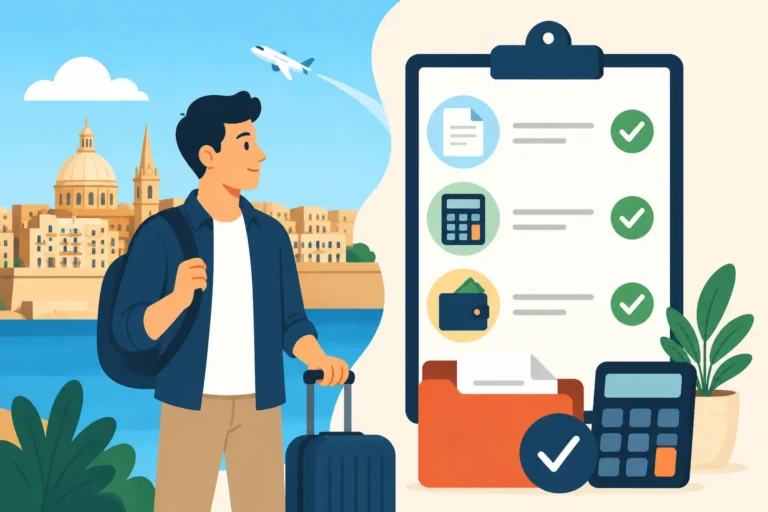
To wrap up your financial transition to Malta, there are a few "quick wins" you should aim for in your first 90 days. First, ensure your tax status is correctly registered so you aren't paying the emergency tax rate (which can be as high as 35% from the first Euro). Second, get your ARMS utility bill sorted so you are on the "Residential" tariff. Third, set up an automated savings plan. It is very easy to spend your entire salary on the Mediterranean lifestyle of boat trips and weekend brunches in Gozo.
Managing your money in Malta is about balancing the traditional with the modern. You need the local bank for the mortgage and the local identity, but you need the digital apps for the speed and the savings. You need to respect the local tax laws while taking advantage of the "non-dom" benefits that are legally available to you. By staying informed and keeping your paperwork in order, you can turn the financial hurdles of Malta into a smooth, manageable part of your new life in the sun.
Disclaimer
This guide is for informational purposes only and does not constitute professional financial, legal, or tax advice. Financial regulations and tax laws in Malta are subject to change, and individual circumstances vary. Always consult with a qualified accountant, tax specialist, or financial advisor who is familiar with Maltese law and your specific residency status before making significant financial decisions. All internal links provided are for further reading and do not imply an endorsement of any specific commercial entity unless otherwise stated.