The Nomad Residence Permit: Income Threshold and Conditions
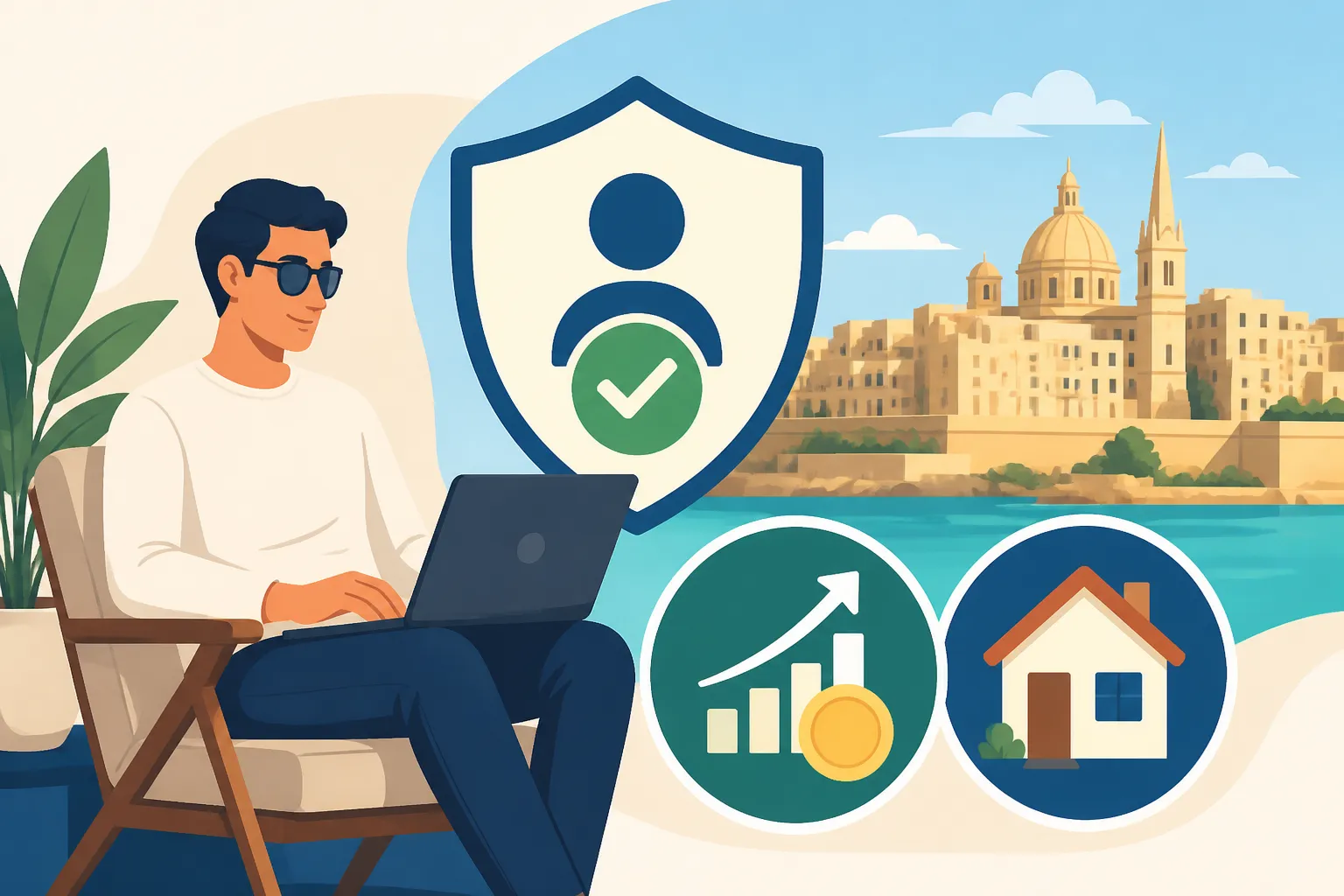
So, you’ve been dreaming of escaping the grey skies or the endless grind, picturing yourself working remotely from a sun-drenched island like Malta, laptop humming with a sea view. It’s a wonderful dream, and the Nomad Residence Permit (NRP) is designed to make it a reality for many. But let's be honest, navigating the bureaucracy of a new country, especially when it comes to proving your financial stability, can feel like trying to solve a Rubik's Cube blindfolded. This comprehensive guide will meticulously break down the crucial income thresholds and other essential conditions you absolutely need to meet for Malta's Nomad Residence Permit, demystifying the process so you can focus on packing your bags, not pulling your hair out.
Understanding Malta's Nomad Residence Permit
Malta's Nomad Residence Permit, often affectionately called the "digital nomad visa," is a testament to the island's forward-thinking approach to attracting global talent. It's specifically tailored for individuals who can perform their work remotely, independent of a specific location. Unlike traditional work permits that tie you to a Maltese employer, this permit grants you the freedom to live and work from Malta while continuing your professional activities for employers or clients based outside the country.
Who the Nomad Residence Permit is For
This permit isn't just for anyone with a laptop. It's designed for third-country nationals (non-EU/EEA/Swiss citizens) who meet specific criteria for remote work. Essentially, you must be either employed by a company registered outside Malta, conducting business activities for clients with a permanent establishment outside Malta, or a partner/shareholder in a company registered outside Malta. The core idea is that your economic activity must originate and be paid from outside Malta. It’s an exciting opportunity for professionals in tech, marketing, consulting, and many other fields who've embraced location-independent work. It truly caters to those who thrive on flexibility and a change of scenery, away from the typical office environment.
The Appeal of Malta for Digital Nomads
It’s no secret why Malta is such a magnet for digital nomads. Beyond the obvious 300 days of sunshine, stunning historical sites, and crystal-clear waters, Malta offers a unique blend of advantages. English is an official language, making communication and integration remarkably easy. The island boasts a robust digital infrastructure, with reliable internet and a growing tech-savvy community. There's a vibrant expat network, countless co-working spaces, and a generally laid-back Mediterranean lifestyle that many find incredibly appealing. The relatively low Cost of Living in Malta: Budgeting for the Real Numbers, especially compared to other Western European nations, also makes it an attractive base for those mindful of their expenses. Plus, being a Schengen area member, it offers excellent travel opportunities across Europe once you're settled.
The All-Important Income Threshold for Nomads
This is often the part that sends a shiver down prospective nomads' spines, but it’s crucial and non-negotiable. The Maltese authorities want to ensure that you are financially self-sufficient and won't become a burden on the local social system. This means proving a consistent and substantial income generated from outside Malta.
Detailed Breakdown of the Required Monthly Gross Income
As of recent updates, the primary applicant for the Nomad Residence Permit needs to demonstrate a minimum gross monthly income of €2,700. It's vital to understand that this figure is gross, meaning before any taxes or deductions are applied in your home country or country of employment. This isn't a "nice to have"; it's a strict requirement. The authorities, specifically Identità (the Maltese agency responsible for residence permits), will scrutinise your financial documentation to ensure this threshold is consistently met. They're looking for stability, not just a one-off payment that temporarily bumps you over the limit. This consistency is paramount, as the permit is about establishing a long-term, stable remote working life in Malta.
What Counts as Income for the NRP
The €2,700 gross monthly income isn't restricted to a single source. It can be a combination of various income streams, as long as they are legitimate, regular, and originate from outside Malta. Here’s what typically counts:
- Salaried Employment: If you're employed by a company based outside Malta, your regular salary is the most straightforward way to meet the threshold. Your employment contract and recent payslips will be key.
- Freelance/Consulting Income: For self-employed individuals or freelancers, income derived from contracts with clients established outside Malta is acceptable. This is where many digital nomads fit in. You'll need to show evidence of ongoing contracts and regular payments.
- Business Profits: If you're a partner or shareholder in a company registered outside Malta, your share of the profits or any regular remuneration you receive from that company can be considered.
- Investment Income: While less common as the primary source for the full amount, consistent and verifiable income from investments (e.g., dividends, rental income from properties abroad) can sometimes supplement your primary income source to reach the threshold. However, this must be clearly documented and proven to be regular and sustainable.
Crucially, any income that originates from or is generated within Malta will not be considered for the purpose of meeting this permit's financial requirement. The spirit of the Nomad Residence Permit is to attract foreign-generated wealth, not to compete with the local job market.
Proving Your Income: The Documentation You’ll Need
This is where the rubber meets the road. Identità requires solid, verifiable proof of your income. Preparing these documents meticulously will save you a lot of headaches.
- Bank Statements: You'll typically need to provide bank statements covering the last three to six months, clearly showing consistent income inflows that meet or exceed the monthly threshold. These statements should ideally be from a reputable bank and in English, or officially translated if not.
- Employment Contracts: If you're employed, your current employment contract, detailing your position, salary, and confirmation that you can work remotely, is essential. A letter from your employer confirming your status and remote work arrangement is also highly recommended.
- Client Contracts/Invoices: For freelancers and self-employed individuals, current contracts with your foreign clients, along with recent invoices and proof of payment, will be crucial. The more evidence you have of ongoing, stable client relationships, the better.
- Tax Returns: Your most recent income tax returns from your country of tax residence can provide an overview of your declared earnings and financial stability.
- Company Documents: If you're a business owner, company registration documents, proof of your shareholding or partnership, and financial statements demonstrating the company's profitability and your remuneration may be required.
The key here is transparency and consistency. Ensure all documents are up-to-date and clearly demonstrate that your income is stable and meets the stipulated requirements. Any discrepancies or gaps in information will likely lead to delays or requests for further clarification, adding to the already often challenging Understanding Identità Processing Times and Delays.
Core Conditions Beyond Income
While the income threshold is a significant hurdle, it's just one piece of the puzzle. There are several other crucial conditions that you must meet to be eligible for the Nomad Residence Permit. These conditions ensure that you are a genuine digital nomad and have the necessary provisions for living in Malta.
Your Employment or Business Status
As we touched upon, the nature of your work is central to the Nomad Residence Permit. You absolutely must demonstrate that your work activities are performed remotely and for entities not established in Malta. This isn't a loophole for job seekers in Malta.
- Working for a Foreign Employer: This means your employer's headquarters and primary operations are outside Malta. Your salary is paid by this foreign entity, and your employment contract reflects a remote working arrangement. You cannot be employed by a company with a Maltese registration or presence.
- Conducting Business for Foreign Clients: If you are self-employed or a freelancer, your client base and their permanent establishments must be outside Malta. This means you’re providing services to international clients, and your income streams originate from these foreign entities.
- Partner/Shareholder in a Foreign Company: You can qualify if you are a partner or shareholder in a company that is registered and operates outside Malta, and your work contributes to that company's activities while being performed remotely from Malta.
It's critical that your work genuinely requires a remote setup. If your profession typically demands physical presence in an office, or if your income is largely derived from Maltese sources, this permit is not for you.
Health Insurance Requirements
This is another non-negotiable condition for all non-EU/EEA permit holders, including digital nomads. You must have comprehensive private health insurance coverage for the entire duration of your stay in Malta. This isn't just a suggestion; it's a legal requirement to protect both you and the Maltese healthcare system.
- Coverage Details: Your insurance policy must cover all medical expenses, including hospitalisation, emergency treatment, and repatriation. The minimum coverage amount often stipulated by authorities is €30,000, but it’s always wise to opt for higher coverage if your budget allows. Ensure your policy is valid for Malta and the Schengen area.
- Why Private? As a third-country national on a Nomad Residence Permit, you are generally not entitled to public healthcare services in Malta unless you're contributing to the Maltese social security system (which you won't be if your income is from abroad) or have specific reciprocal agreements from your home country. Therefore, private insurance is your safety net. You'll need to provide proof of this policy with your application, so it's one of the first things you should arrange. Many expats in Malta opt for international providers like Cigna Global due to their comprehensive coverage and understanding of expat needs. Finding good Private Health Insurance Requirements for Non-EU Permit Holders in Malta is absolutely crucial for your peace of mind.
Stable Accommodation in Malta
You can’t just turn up with a backpack and expect a permit. You need to demonstrate that you have a stable and suitable place to live in Malta for the duration of your permit. This usually means securing a rental agreement.
- Rental Contract: A signed private residential lease agreement is the most common form of proof. The lease should be for a minimum of six months, ideally for the full year of your initial permit, and should be registered with the Housing Authority, as this is a legal requirement in Malta. If your initial lease is shorter than your desired permit duration, you might need to show proof of funds or a plan for extending it. For insights into securing a place, check out Renting a Home in Malta: Contracts, Deposits, and Tenant Rights.
- Sufficiency: The accommodation must be deemed suitable for you and any accompanying dependents. This means adequate space and living conditions. If you're bringing family, a studio apartment won't cut it.
- Address Registration: Once you have secured accommodation, your address will be registered with Identità, and it will be linked to your eResidence card. Any change of address must be reported to the authorities.
Providing proof of stable accommodation is another fundamental pillar of your application. The authorities need to know you have a legitimate base on the island.
Application Process and What to Expect
Applying for the Nomad Residence Permit, like most bureaucratic processes for foreigners, requires patience, meticulous attention to detail, and a good understanding of the steps involved. It’s handled by Residency Malta Agency, a specific unit under Identità.
Navigating Identità and the Application Portal
Your journey begins with the Residency Malta Agency, which is the entity managing this specific permit. While the overall umbrella is Identità (the agency handling all residence permits), you will specifically deal with the Nomad Residence Malta Unit.
- Initial Inquiry: Many applicants start with an email inquiry to the agency to confirm eligibility and receive the latest application forms and guidance. This can be a useful first step to ensure you have the most up-to-date information.
- Online Application: The application process typically involves submitting a detailed application form along with all supporting documents electronically via their dedicated portal or email. It’s a structured approach, so ensure you don’t miss any fields or attachments. It's similar to applying for other residence types, so understanding Applying for an eResidence Document Through the Identità Portal can provide some general context, though the specific NRP portal might differ.
- Biometrics and eResidence Card: If your application is approved in principle, you will be invited to Malta to complete your biometrics (fingerprints and photo) at their offices. This is a crucial step towards receiving your physical eResidence card, which is your official ID and proof of residence in Malta. The card usually arrives a few weeks after the biometrics appointment.
The Comprehensive Document Checklist
The list of documents required for the Nomad Residence Permit is extensive and precise. Preparing these in advance will significantly streamline your application.
- Application Form: Duly filled and signed (NRP Form).
- Passport Copy: All pages, valid for at least six months beyond your intended stay.
- CV/Resume: Detailing your professional experience and qualifications.
- Cover Letter: Explaining your motivation, remote work setup, and why Malta.
- Proof of Income: As detailed above (bank statements, employment contracts, invoices, tax returns).
- Health Insurance Policy: Comprehensive, covering Malta and the Schengen area, with minimum €30,000 coverage.
- Accommodation Proof: Registered rental agreement in Malta.
- Proof of Remote Work:
- For employees: Letter from employer confirming remote work, employment contract, company registration details.
- For self-employed/freelancers: Client contracts, business registration outside Malta, invoices, client testimonials.
- For business owners: Company registration, articles of association, proof of shareholding/partnership.
- Police Conduct Certificate: From your country of origin and any country you've resided in for over six months in the past year, translated into English if necessary.
- Marriage Certificate/Birth Certificates: If applying with dependents (translated and apostilled/legalised).
- Passport Photos: Specific size and format.
- Application Fee: A non-refundable fee applies (currently €300 for the main applicant).
Remember, all non-English documents must be officially translated and often apostilled or legalised by the appropriate authorities in your home country before submission. This entire bureaucratic dance is why many new arrivals find themselves utterly frustrated; it's a marathon, not a sprint.
Processing Times and Common Pitfalls
The official processing time can vary, but generally, expect a few weeks to a few months from initial submission to approval-in-principle. However, delays are not uncommon, especially if documents are incomplete or require further clarification. This is where patience truly becomes a virtue.
- Incomplete Documentation: The most common reason for delays. Double-check every single item on the checklist.
- Unclear Income Proof: If your bank statements aren't consistent, or your contracts lack clarity, expect questions.
- Incorrect Translations/Legalisation: Ensure all translations are official and that foreign documents are properly apostilled or legalised as per Maltese requirements.
- Communication Delays: While the agency is generally responsive, follow-ups can sometimes take time.
Being proactive, providing clear and comprehensive documentation from the outset, and having copies of everything will significantly improve your chances of a smoother process.
Bringing Your Family to Malta as a Nomad
One of the great advantages of the Nomad Residence Permit is the possibility to bring your immediate family members along. Malta understands that many digital nomads travel with their loved ones, making the island a truly appealing long-term base.
Who Qualifies as a Dependent Family Member
The permit generally allows for the inclusion of your direct family members. This typically includes:
- Spouse or Legal Partner: Your legally married spouse or civil partner.
- Minor Children: Your biological or legally adopted children who are under 18 years of age.
- Adult Dependent Children: In some specific cases, adult children (usually up to 26 years old) who are financially dependent on the main applicant and are not married may be considered, often if they are enrolled in full-time education.
- Dependent Parents: In very rare and specific circumstances, parents who are fully financially dependent on the main applicant may also be included, though this has stricter criteria.
Each family member will require their own application and set of documents, even though they are linked to your main application. For more detailed information, refer to Can I Bring My Family on the Malta Nomad Residence Permit?.
Additional Income Requirements for Dependents
Bringing family members means the financial bar is raised, and rightly so. The authorities need to ensure that the entire family unit can be adequately supported without relying on public funds.
- Increased Threshold: For each additional family member, an incremental increase in the gross monthly income threshold is required. Typically, this is an additional 15% of the main applicant's required income for a spouse, and an additional 10% for each dependent child. So, for a spouse and one child, you’d need €2,700 (main applicant) + 15% of €2,700 (spouse) + 10% of €2,700 (child). These figures are subject to change, so always confirm the latest requirements with the Residency Malta Agency.
- Proof of Funds for Family: Just as with your own income, you’ll need to provide clear, consistent proof that your combined income meets this higher threshold. This will involve showing bank statements and other income documents that reflect the increased financial capacity.
- Adequate Accommodation: Your chosen accommodation must also be suitable for the entire family. A one-bedroom apartment might be fine for a single person, but a family of four will certainly need something larger to be considered appropriate by the authorities. When you're making plans to relocate, resources like Sirelo can be incredibly helpful for managing the logistics of moving a whole household.
The Application Process for Family Members
Adding dependents means more paperwork, but the process generally mirrors that of the main applicant.
- Separate Application Forms: Each dependent will need their own application form to be completed.
- Individual Documents: Passport copies, police conduct certificates (for adults), birth certificates, marriage certificates, and specific passport photos for each family member.
- Proof of Relationship: Marriage certificates, birth certificates, and sometimes even photographs or shared utility bills may be requested to prove the genuine nature of your family relationships. Ensure these documents are translated and apostilled or legalised as required.
- Health Insurance for All: Every single family member, regardless of age, must also be covered by comprehensive private health insurance. This is a critical point that cannot be overlooked.
The meticulousness required for individual applications for each family member often adds to the perceived burden of the process, but it’s a necessary step to ensure everyone's status is legally sound.
Maintaining Your Nomad Status and Future Considerations
Once you've successfully secured your Nomad Residence Permit and settled into life on the island, the journey doesn't end there. There are responsibilities that come with your new status, and it’s important to understand the future implications of this particular permit.
Renewals and Staying Compliant
The Nomad Residence Permit is typically issued for one year, renewable annually, as long as you continue to meet the eligibility criteria. The renewal process is similar to the initial application, requiring updated documentation to prove your continued remote work, income, health insurance, and accommodation in Malta.
- Timely Renewal: It is crucial to apply for renewal well in advance of your current permit’s expiry date. Generally, it's recommended to start the process at least two to three months before expiry to avoid any gaps in your legal residence. For guidance on this, see Renewing Your Maltese Residence Permit Before It Expires.
- Continued Eligibility: You must maintain the same conditions as your initial application: consistently earning the minimum income from outside Malta, holding valid health insurance, having stable accommodation, and not seeking local employment. Any changes in your circumstances (e.g., a new remote job, change of address) should be reported to Identità.
- Physical Presence: While the Nomad Residence Permit offers flexibility, it is intended for individuals who genuinely reside in Malta. Excessive absences could raise questions about your actual residence status during renewal. There isn't a strict "days out of country" limit like some other permits, but demonstrating a clear intent to reside in Malta is important.
The Nomad Residence Permit and Tax Obligations
One area that often causes confusion for digital nomads is taxation. It's vital to understand that holding a Nomad Residence Permit means you are a tax resident in Malta if you spend more than 183 days on the island in a calendar year.
- Maltese Tax Residence: If you become a tax resident, you will be subject to Maltese income tax on income earned in Malta and on foreign income remitted to Malta. Malta operates on a remittance basis for non-domiciled individuals (which most NRP holders will be). This means you generally only pay tax on foreign income that is actually brought into Malta.
- Double Taxation Agreements: Malta has a vast network of double taxation agreements with many countries. These agreements prevent you from being taxed twice on the same income (once in Malta and once in your home country). Understanding your specific tax situation and how these treaties apply to you is paramount. Seeking professional tax advice is highly recommended. You can find more general information in The Maltese Tax System Explained: Residence, Domicile, and Remittance and Filing Your Maltese Tax Return: The CFR, FS3, and TA22/TA24.
- Provisional Tax: If you are self-employed or have income that is not taxed at source, you may be required to pay provisional tax in Malta. This is an advance payment towards your annual income tax liability.
Navigating international tax can be complex, so don't hesitate to consult with a Maltese tax advisor who specialises in expat taxation.
Path to Long-Term Residence and Citizenship
This is an important point to clarify: the Nomad Residence Permit is not a direct path to long-term residence status or Maltese citizenship. It is designed as a temporary, flexible residence option for remote workers.
- Not Counted for Long-Term Residence: The time you spend in Malta on a Nomad Residence Permit generally does not count towards the five-year legal and continuous residence required for Long-Term Residence Status After Five Years in Malta under EU law, nor does it typically contribute to the residency period required for naturalisation as a Maltese citizen.
- Transitioning to Other Permits: If your long-term goal is to obtain permanent residence or citizenship in Malta, you would typically need to transition to a different type of residence permit, such as a Single Permit (based on employment with a Maltese company) or another scheme that explicitly allows for this pathway. This would usually involve meeting entirely new criteria and potentially starting your "residency clock" from scratch for those purposes.
The Nomad Residence Permit is fantastic for what it is: a means to live and work remotely from Malta with flexibility. But it’s essential to set realistic expectations about its long-term immigration implications. It offers a wonderful lifestyle, but for those with broader immigration goals, it’s often a stepping stone rather than the final destination.
Disclaimer
The information provided in this guide is intended for general informational purposes only and does not constitute legal, financial, or immigration advice. While we strive to keep the information accurate and up-to-date, regulations in Malta, particularly concerning immigration, can change rapidly. We strongly advise consulting with the official Residency Malta Agency or a qualified immigration lawyer or consultant for personalised advice regarding your specific situation before making any decisions. We are not responsible for any actions taken based on the information presented herein.