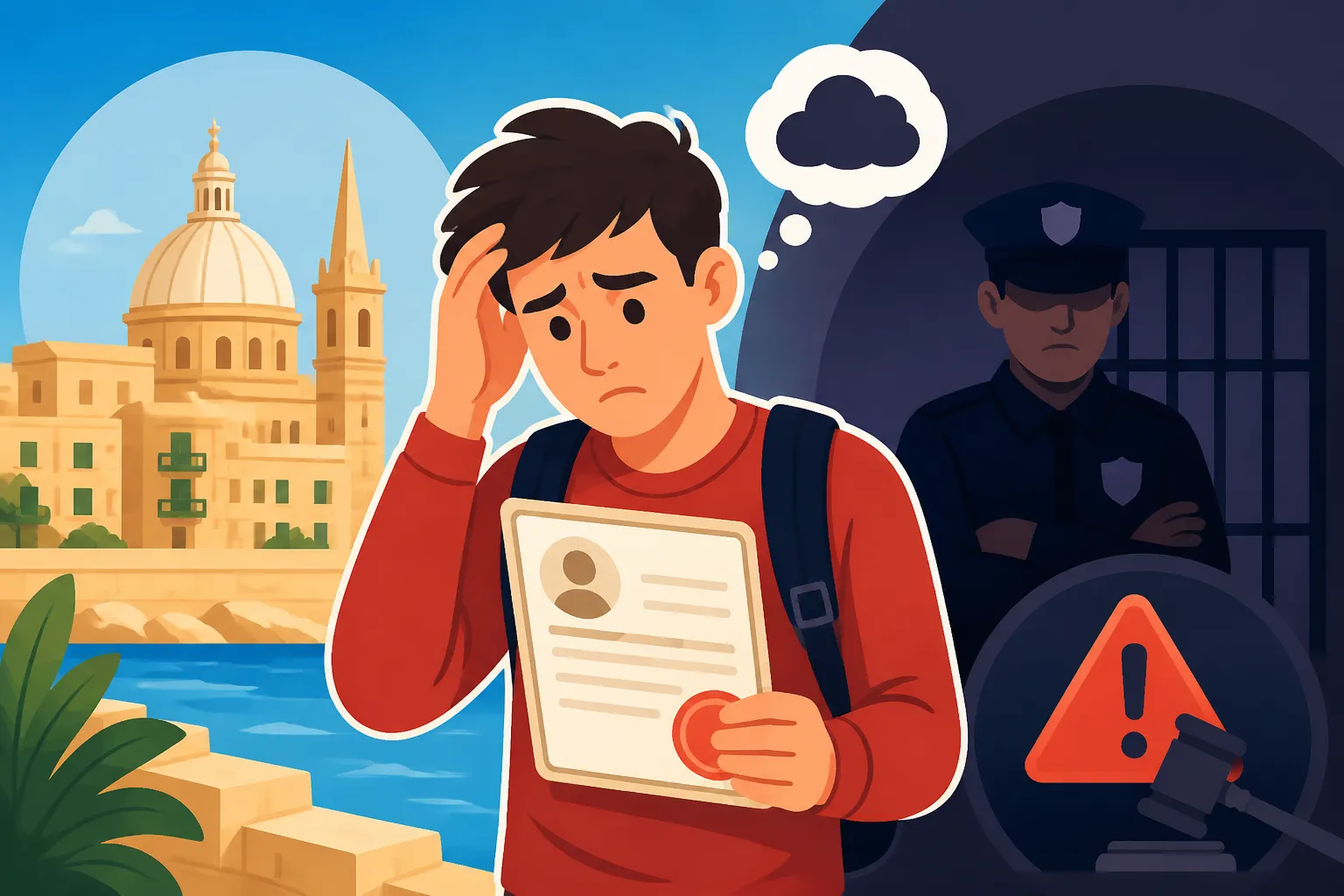
What Happens If I Overstay My Permit in Malta?
It's an uncomfortable truth that many expats face, sometimes due to circumstances entirely out of their control, or simply due to the sheer complexity of the Maltese immigration system: the risk of overstaying your permit. The anxiety, the fear of the unknown, and the sheer administrative labyrinth here can sometimes feel overwhelming, leading to situations where you might accidentally, or even intentionally, find yourself past your legal stay. Let me tell you, it's a tightrope walk, and understanding the ground rules is absolutely crucial for your peace of mind and your future in Malta, or anywhere else in the Schengen Area. This guide aims to pull back the curtain on what truly happens if you overstay your welcome.
The Immediate Aftermath: What Happens Right After Your Permit Expires?
The moment your residence permit or visa in Malta expires, your legal status in the country, and by extension the entire Schengen Area, ceases to exist. It's not a gradual process; it's an immediate shift from legal resident to an 'irregular migrant' or 'overstayer'. This isn't just a technicality; it impacts almost every facet of your life. Imagine waking up one day to find your world has suddenly shifted, and all the administrative structures you relied on no longer recognise you. It's a truly terrifying prospect, and one that carries significant weight.
Loss of Legal Status and Rights
The primary consequence of an expired permit is the instantaneous loss of your legal right to reside, work, and even remain in Malta. This means that, legally, you are now expected to leave the country. Any actions you take beyond this point – continuing to work, renting property, even just existing here – are technically illegal. This can feel incredibly jarring, especially if you've been diligently paying taxes and contributing to society. Your identity becomes blurred, and your once clear path forward suddenly vanishes into a bureaucratic fog.
For those who rely on an employment-based permit, like The Single Permit in Malta: Combined Work and Residence, Step by Step, this means your right to work is also immediately revoked. Your employer, if they are diligent, will likely be notified or discover this themselves. Continuing to employ someone without a valid permit carries severe penalties for the employer, so they will be under pressure to terminate your contract immediately. This creates a cascade effect, leading to loss of income, housing issues, and a rapidly dwindling support system.
The Slippery Slope of Illegality
Once you lose your legal status, many everyday activities become incredibly difficult, if not impossible. Access to vital public services, which relies heavily on your eResidence card and ID number, will be severely restricted. This isn't just about healthcare; it's about banking, driving, and even renewing basic subscriptions.
Let's say your bank asks for an updated residence permit, which is a common occurrence. Without it, they might freeze your account or limit your transactions, leaving you in a financial lurch. Your Maltese driving licence becomes invalid, and you cannot renew it. Think about the ripple effect: no legal right to stay, no legal right to work, no functional bank account, no valid driver's licence. The systems that once supported your life in Malta suddenly start to reject you, making daily existence a constant source of stress and vulnerability. This is precisely why it’s so critical to keep an eye on your permit’s expiry date and initiate the renewal process well in advance, even if Understanding Identità Processing Times and Delays can be frustratingly slow.
Administrative Blacklist and Future Implications
Overstaying your permit doesn't just affect your current situation in Malta; it can cast a long shadow over your future immigration prospects, not just here, but across the entire Schengen Area and potentially beyond. Identità, the agency responsible for residence permits, keeps detailed records. An overstay will be flagged on your immigration file.
This means that if you ever decide to apply for a visa or permit for Malta again, or for any other Schengen country, your past overstay will be a major red flag. It can lead to automatic refusals, or at the very least, subject your application to intense scrutiny and significantly longer processing times. It essentially puts you on an administrative blacklist, implying that you have disregarded immigration rules. This is a severe consequence for anyone who harbours dreams of returning to Malta, or even travelling freely within Europe in the future.
The Legal Ramifications: Fines, Detentions, and Deportation
The administrative difficulties are just the tip of the iceberg. The legal consequences of overstaying your permit in Malta can be severe and life-altering, ranging from financial penalties to physical detention and outright bans from re-entering the Schengen zone for years. It's not a scenario to take lightly, and the Maltese authorities, like those across the EU, are increasingly vigilant about enforcing immigration laws.
Financial Penalties and Charges
One of the most immediate and tangible consequences of overstaying is the imposition of fines. While the exact amount can vary depending on the length of the overstay and the discretion of the authorities, these are not trivial sums. For instance, being caught overstaying your Schengen visa by just a few days can already incur a substantial fine, let alone months or years. These fines are often calculated per day of overstay and can quickly accumulate, leading to a crippling financial burden.
Beyond the initial fine, you might also be charged for any administrative costs associated with your detention or eventual removal. This could include the cost of your flight back to your home country, any accommodation in a detention centre, and other processing fees. These costs are often added to the initial fine, creating a debt that you may be required to pay before you are allowed to leave the country, or which could remain on your record, impacting future applications. It’s a very harsh reality, designed to deter non-compliance with immigration rules.
Detention and Removal Procedures
Perhaps the most feared outcome for an overstayer is detention and forced removal. If you are apprehended by the Maltese authorities – whether during a routine check, a police stop, or even at the airport when attempting to leave – you will likely be taken into custody. Malta operates several detention centres, where irregular migrants are held while their cases are processed and arrangements are made for their deportation.
Life in a detention centre is, understandably, not easy. It’s a period of uncertainty, separation from your community, and significant stress. While you have certain rights, including access to legal representation, the process can be lengthy and emotionally draining. The authorities will verify your identity, nationality, and travel documents, and then arrange for your return to your country of origin. This removal is not a voluntary departure; it is a forced deportation, carried out under state authority. This is a critical distinction, as it carries different consequences for your future.
Entry Bans and Future Travel Restrictions
A forced removal, or even a voluntary departure after an extended overstay, almost invariably results in an entry ban to Malta and the entire Schengen Area. The standard ban period is usually five years, meaning you would be prohibited from entering any of the Schengen countries for half a decade. In severe cases, or for repeat offenders, this ban can be even longer.
This isn't just about Malta; it affects your ability to travel to popular destinations like Italy, Germany, France, or Spain for tourism, work, or family visits. This ban is recorded in the Schengen Information System (SIS), a shared database used by all Schengen member states. Any attempt to apply for a visa or enter a Schengen country during your ban period will be rejected. This far-reaching consequence means that a seemingly simple overstay can have profound and lasting effects on your international mobility and your personal plans, restricting future opportunities for travel, work, or even reconnecting with family and friends across Europe. It makes one think twice about leaving things to the last minute when it comes to Renewing Your Maltese Residence Permit Before It Expires.
Here’s a simplified look at the potential consequences of overstaying in Malta:
| Consequence Category | Immediate Impact (Day 1 of Overstay) | Long-Term Impact (Weeks/Months of Overstay) |
|---|---|---|
| Legal Status | Loss of all rights, irregular migrant | Criminal record risk, severe penalties |
| Financial | No immediate fine (if undetected) | Accumulating daily fines, deportation costs |
| Employment | Illegal to work, employer liability | Immediate job loss, difficulty finding new work |
| Healthcare | No public entitlement, no free care | Risk of untreated illness, high private costs |
| Housing | Lease invalidation risk | Difficulty renewing/finding accommodation |
| Travel | Potential detection at border exit | Schengen entry ban (e.g., 5 years), travel difficult |
| Future Permits | Negative impact on future applications | Automatic refusal for future visas/permits |
| Personal Freedom | Increased anxiety, vulnerability | Risk of detention, forced deportation |
Practical Challenges and Daily Life as an Overstayer
Beyond the legal and financial penalties, life as an overstayer in Malta presents a host of practical challenges that can make daily existence incredibly difficult, isolating, and precarious. It's not just about avoiding the authorities; it's about navigating a world that is no longer designed to accommodate you. The empathy here is real – I've heard stories that would break your heart about individuals who, through no fault of their own, found themselves in this impossible situation.
Healthcare and Essential Services
Access to healthcare is one of the most pressing concerns for anyone without a valid permit. Malta's public healthcare system is generally excellent, but it relies on your legal residence status, often linked to your Social Security contributions and your eResidence card. Once your permit expires, your entitlement to free or subsidised public healthcare, including visits to health centres or Mater Dei Hospital, effectively vanishes. You’d be left with emergency care for life-threatening situations, but even then, you might be billed for it.
Imagine falling seriously ill or having an accident. Without public healthcare access, you'd be looking at potentially astronomical private medical bills. While some people might consider private health insurance, it's a complicated matter if you're an overstayer. Most reputable private health insurers, even international ones like Cigna Global, require proof of legal residence to issue or maintain a policy. Even if you had a policy beforehand, its validity could be compromised once your legal status changes. This leaves you in an incredibly vulnerable position, where fear of medical expenses could deter you from seeking necessary treatment, putting your health, and even your life, at risk. This is why having robust cover, and ensuring your Private Health Insurance Requirements for Non-EU Permit Holders in Malta are always met before any expiry, is paramount.
Employment and Financial Woes
For most foreigners, the permit is tied to employment. When that permit expires, so does your legal right to work. This means an immediate loss of your legitimate income. Your employer, aware of the legal risks of employing an overstayer (which can include hefty fines and even imprisonment for repeated offences), will have no choice but to terminate your employment. Suddenly, you're without a job, without an income, and without legal standing to seek new employment.
Furthermore, your ability to access and manage your finances becomes severely hampered. As mentioned, banks can freeze or restrict accounts for customers who cannot provide valid residence documentation. This means you might be unable to withdraw money, pay bills, or even receive remittances. The situation quickly spirals, leading to immense financial stress, potential homelessness, and the inability to cover basic living expenses. You become reliant on informal networks, which can expose you to exploitation and further risks. The idea of Opening a Bank Account in Malta: A Step-by-Step Guide becomes a cruel memory when you can't even maintain your existing one.
Housing and Social Isolation
Finding and keeping housing becomes another monumental challenge. Most legitimate landlords and real estate agents require proof of valid residence before entering into a rental agreement. If your permit expires, your existing lease might become invalid, or your landlord might refuse to renew it. Many foreigners, having signed a lease attestation, are legally bound to have a valid permit. This could lead to forced eviction, leaving you without a roof over your head.
Even if you manage to find informal accommodation, you risk exploitation. Landlords might charge exorbitant rates, or you might find yourself in unsafe living conditions, knowing you have little legal recourse if things go wrong. Beyond the practicalities, there’s the crushing weight of social isolation. The fear of being discovered can lead to withdrawing from social life, avoiding public places, and cutting ties with friends and community. This constant state of anxiety and fear takes a severe toll on mental health, often leading to depression and feelings of hopelessness. The once vibrant expat life you enjoyed in Malta can quickly turn into a lonely and perilous existence.
What to Do if You've Overstayed or Are About to
Discovering you've overstayed your permit, or realising you're dangerously close to doing so, is a terrifying moment. However, panicking won't help. The most crucial thing is to act decisively and intelligently. While the situation is serious, there are pathways and professionals who can offer guidance.
Proactive Steps Before Expiration
The absolute best defence is proactive prevention. Do not wait until the last minute. The Maltese immigration system, operated by Identità, can be slow, and delays are common. Start your renewal process well in advance – typically 2-3 months before your permit is due to expire. Gather all necessary documents, including your passport, new passport photos, proof of accommodation (like your registered lease), proof of funds, and your employment contract if applicable. Read guides like Applying for an eResidence Document Through the Identità Portal or Renewing Your Maltese Residence Permit Before It Expires carefully.
If you submit your application before your current permit expires, you typically have the right to remain in Malta while your application is being processed. You should receive an acknowledgement of receipt from Identità, which serves as temporary proof of your legal stay. This is key. Keep this document safe, as it’s your lifeline. However, be aware that while your application is pending, travelling outside Malta and the Schengen Area can be risky, as there’s no guarantee you’ll be allowed back in without your new eResidence card. It's often safer to stay put, even if Can I Stay in Malta While My Residence Permit Is Being Processed? gives conditional reassurance.
Seeking Legal Advice Immediately
If your permit has already expired, or if you're very close to it and cannot submit a renewal application in time, the very first thing you should do is seek legal advice from an immigration lawyer in Malta. Do not try to navigate this complex situation on your own. An experienced lawyer will understand the nuances of Maltese and EU immigration law, assess your specific situation, and advise you on the best course of action.
They can help you understand your rights, whether there are any possible avenues for regularisation (though these are rare for overstays), or the most advantageous way to approach voluntary departure. They can also represent you in communications with Identità or other authorities, potentially mitigating the severity of consequences. Spending money on legal advice now could save you from much larger fines, detention, and longer bans in the long run. Many law firms in Malta specialise in immigration, so finding an English-speaking expert won't be an issue. A lawyer can also advise on the process of Appealing to the Immigration Appeals Board in Malta if your application was refused.
Voluntary Departure vs. Forced Removal
If you have overstayed, and there's no immediate path to regularisation, the authorities will eventually expect you to leave. In such cases, a voluntary departure is almost always preferable to a forced removal (deportation).
Voluntary Departure: This means you arrange your departure from Malta yourself, usually within a specified timeframe given by the authorities (or even before you are detected). While you might still face fines and potentially an entry ban, the consequences are generally less severe than a forced deportation. A voluntary departure demonstrates cooperation with the authorities, which can sometimes result in a shorter or less stringent re-entry ban. It also avoids the trauma and indignity of being detained and forcibly removed.
Forced Removal (Deportation): This happens when the authorities apprehend you, detain you, and physically escort you out of the country. This almost always results in a significant entry ban (often five years or more) across the entire Schengen Area, and a permanent mark on your immigration record. It's a more serious and impactful consequence.
An immigration lawyer can help negotiate a voluntary departure, ensuring you understand the process and any associated conditions. If the decision is made for you to leave Malta, whether voluntarily or otherwise, repatriating or moving your belongings can be a logistical nightmare, especially if your funds are restricted. Services like Sirelo can often assist with international removals, helping you manage the logistics of moving your possessions back home or to your next destination, even under challenging circumstances. It’s a messy situation all around, and taking control where you can, with the right advice, is paramount.
Disclaimer
The information provided in this guide is for general informational purposes only and does not constitute legal or professional advice. Immigration laws and procedures in Malta are complex and subject to change. It is essential to consult with a qualified immigration lawyer or the official Maltese authorities (Identità) for advice tailored to your specific situation. Reliance on any information provided in this guide is solely at your own risk.