Tax Residency in Malta: The 183-Day Rule Explained
Moving to a new country is often a whirlwind of finding the right apartment, navigating the local bus routes, and figuring out which supermarket has the best fresh bread. However, many expats find themselves blindsided by the sudden realization that their physical presence in Malta has triggered a major shift in their global tax obligations. This guide breaks down exactly how the 183-day rule functions, helping you navigate the transition from visitor to tax resident without the usual administrative headache.
Understanding the Basics of Tax Residency in Malta
The moment you step off the plane at Luqa, the clock effectively starts ticking on your relationship with the Commissioner for Revenue (CFR). While you might feel like a temporary guest for those first few months, the Maltese government uses a very specific quantitative measure to decide when you have become part of the local economic fabric. This isn't just about whether you have an eResidence card; it is about where you physically spend your life.
The 183-Day Rule Defined
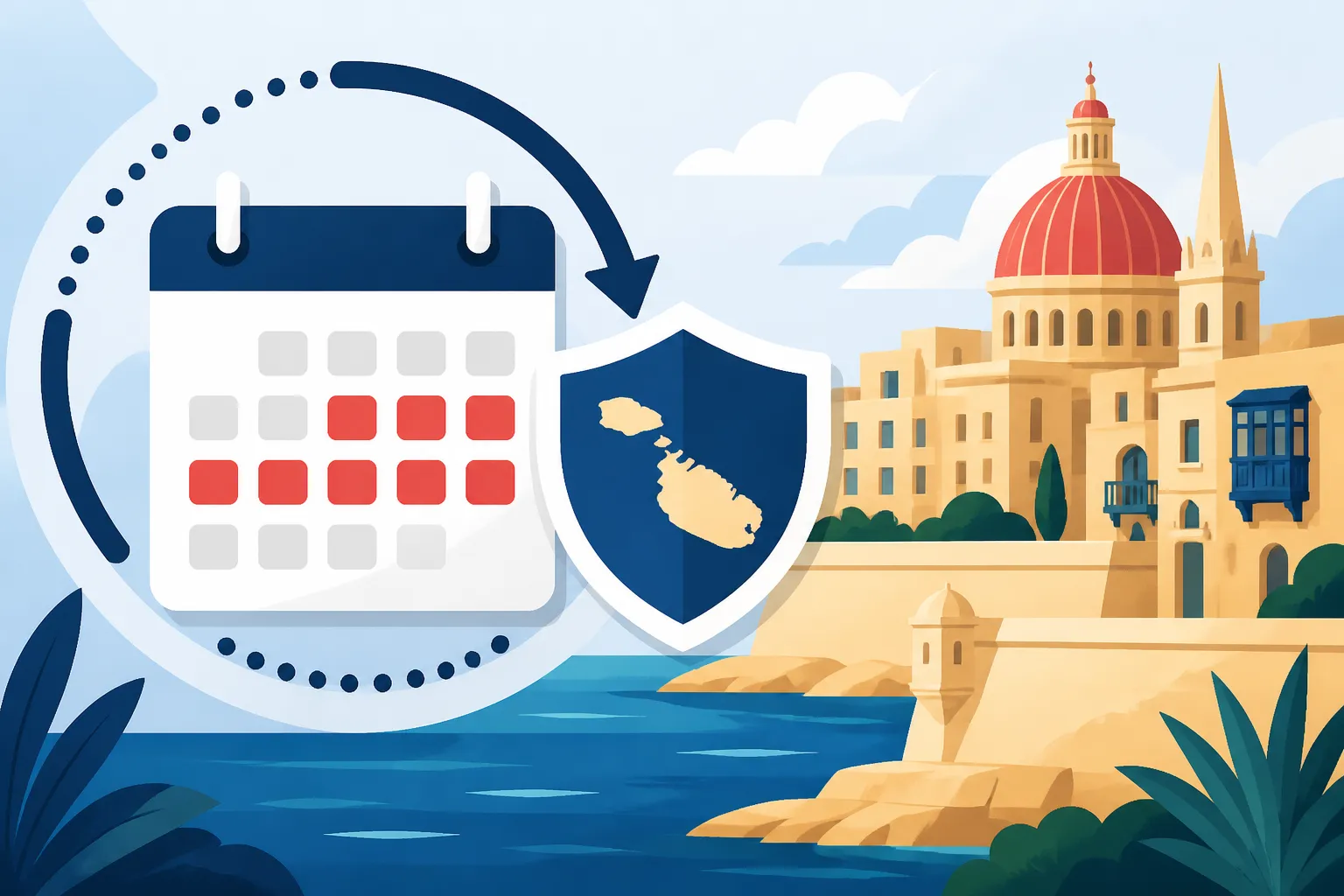
In the most literal sense, the 183-day rule is the threshold used by Malta to determine your tax residency status for any given calendar year. If you spend more than half the year—specifically 183 days or more—within the Maltese islands, the law presumes that your center of life has shifted here. This is a bright-line rule used by many jurisdictions, but in Malta, it is applied with a focus on your "intent" and physical presence rather than just your bureaucratic registration.
For a veteran expat, the frustration often lies in the "accidental" nature of this rule. You might have arrived in April with plans to stay for a short project, but as the summer festivals roll in and the lifestyle grows on you, you realize by October that you’ve crossed that invisible line. Once you hit that 183rd day, you are generally considered a tax resident for the entire year, which means your Maltese salary and any foreign income brought into the country become subject to local tax rates.
Tax Residence vs Domicile in Malta: Why Both Matter
One of the most confusing hurdles for newcomers is distinguishing between where you live and where you are "domiciled." In Malta, you can be a tax resident without being domiciled here. Your domicile is generally the place you consider your permanent home or the country of your birth, whereas residency is simply a matter of where you are currently residing. This distinction is vital because it determines how your foreign-sourced income is handled.
If you are a resident but not domiciled in Malta (often referred to as a "non-dom"), you are only taxed on income earned in Malta and foreign income that you actually bring into the country. This is a significant relief compared to other EU nations that might tax your global income regardless of where it stays. Understanding Tax Residence vs Domicile in Malta: Why Both Matter is the first step in planning your finances effectively so you don't end up paying more than is legally required.
Why Your Presence Matters
The Maltese tax authorities are increasingly focused on substance. In an era of digital nomads and remote work, simply claiming you live elsewhere while spending all your time in a seafront apartment in Sliema won't fly. Your physical presence is the primary evidence of your residency. This status unlocks certain benefits, such as access to the public healthcare system once you are paying social security, but it also means you must comply with local filing requirements.
Many foreigners struggle with the shift from a flat-rate tax in their home country to the progressive system here. By staying over 183 days, you are essentially telling the government that you are making use of the country's infrastructure, and in return, you are expected to contribute to the pot. This is where professional services like Taxes for Expats can be incredibly helpful, as they specialize in ensuring you don't get double-taxed when navigating the rules of two different countries simultaneously.
Determining Your Status: How the 183 Days Are Counted
Counting to 183 sounds simple enough, but when you factor in weekend trips to Sicily, business travel back to London, or a month spent visiting family over the holidays, the math gets complicated quickly. The Maltese authorities are quite strict about what constitutes a "day" of presence, and it is your responsibility to keep an accurate log.
Day Counting and Partial Days
A common question I hear from new arrivals is whether the day of arrival and the day of departure count. Generally, any part of a day spent in Malta counts as a full day for residency purposes. If you land at 11:30 PM on a Friday and leave at 6:00 AM on a Sunday, you have effectively spent three days in Malta in the eyes of the CFR.
It is a good habit to keep a digital folder of your boarding passes or a simple spreadsheet of your travel. When you eventually go to file your return or if you are ever audited, having this proof is invaluable. The burden of proof lies with the taxpayer, and "I think I was away for most of August" is rarely an acceptable answer when the tax office is looking at your status.
The Concept of Ordinary Residence
Beyond the 183-day rule, there is the concept of "ordinary residence." This is less about a specific number of days and more about the regularity of your life in Malta. If you move here with a long-term work contract and a one-year lease, the authorities may consider you an ordinary resident from day one, even before you've hit the 183-day mark.
Ordinary residence implies that your stay in Malta is not merely casual but is part of your regular order of life. This is particularly relevant for those who move to Malta mid-year. If you arrive in September, you won't hit 183 days by December 31st, but because you have moved here with the intent to stay, you might still need to look into Registering for Tax When You Arrive in Malta to ensure your first few months of employment are handled correctly.
Avoiding the Tax No-Man's Land
There is a dangerous scenario where an expat spends 120 days in three different countries in a single year, effectively becoming a tax resident nowhere. While this sounds like a dream for your wallet, it is a nightmare for your legal standing. Most banks and international organizations require you to have a tax residence somewhere to maintain accounts and comply with Anti-Money Laundering (AML) rules.
Without a clear tax home, you may find it impossible to open a local bank account or even renew your residence permit. Being a resident in Malta provides a stable "tax home" that is respected globally. If you are moving money between jurisdictions during this transition, using a service like Wise can help you manage different currencies and provide clear records of your transfers, which is helpful when proving the source of your funds to the Maltese authorities.
The Financial Impact: How Tax Residency Affects Your Pay
Once you are classified as a tax resident, the way your income is treated changes significantly. You move away from being a "non-resident taxpayer" (who is often taxed at a higher flat rate on every Euro earned) to the progressive tax brackets that apply to locals.
The Progressiveness of Maltese Tax Brackets
Malta uses a progressive tax system where the more you earn, the higher the percentage of tax you pay on those additional earnings. However, the first €9,100 (for individuals) is generally taxed at 0%. This is a huge benefit for those who might have spent the first half of the year earning a lower income or who are working part-time.
| Income Range (€) | Tax Rate (%) | Subtraction (€) |
|---|---|---|
| 0 – 9,100 | 0% | 0 |
| 9,101 – 14,500 | 15% | 1,365 |
| 14,501 – 19,500 | 25% | 2,815 |
| 19,501 – 60,000 | 25% | 2,725 |
| 60,001+ | 35% | 8,725 |
As you can see, understanding Malta's Progressive Tax Brackets: Single, Married, and Parent Rates is crucial for calculating your take-home pay. If you are married or have children, you may qualify for different rates that are even more favorable, potentially saving you thousands of Euros annually just by being correctly registered.
The Final Settlement System (FSS)
If you are employed by a Maltese company, your tax is usually deducted before you even see it. This is known as the Final Settlement System (FSS). Your employer acts as the middleman, taking the tax and social security directly from your gross salary and passing it to the government. This is designed to make life easier, but it can be confusing if you don't know Understanding the FSS (Final Settlement System) on Your Payslip.
When you first start a job, if you haven't yet reached the 183-day threshold, your employer might inadvertently tax you at the non-resident rate, which is a flat 35% on most income. This can be a massive shock to your budget. Usually, this is corrected once you prove your residency, and any overpaid tax can be claimed back at the end of the year, but it requires you to be proactive with your HR department.
Social Security Contributions and Benefits
Being a tax resident also goes hand-in-hand with paying social security. These contributions are not just another "tax"; they are what unlock your rights to the Maltese social safety net. This includes sick pay, unemployment benefits, and, most importantly for many, access to free public healthcare at Mater Dei.
It is worth reading up on Social Security Contributions in Malta: Classes, Rates, and Benefits to understand what exactly your money is buying. For most employees, it’s about 10% of your basic salary, which is capped at a certain level. If you are self-employed, the rates work differently, but the 183-day rule remains the trigger for when these obligations become mandatory rather than voluntary.
Managing Foreign Income and the Remittance Basis
For many expats, the primary reason for choosing Malta isn't just the sun; it's the specific way the country taxes foreign income. If you are a resident but not domiciled, you fall under the "remittance basis" of taxation, which is a unique and highly beneficial system if managed correctly.
The Non-Dom Advantage
Under the remittance basis, foreign-sourced income (like rental income from a property in your home country or dividends from a foreign company) is only taxed in Malta if you bring that money into a Maltese bank account. If you leave that money in an account outside of Malta and use it for expenses outside of Malta, it generally remains untaxed here.
This is where many people get tripped up. If you use a foreign credit card to pay for dinner in St. Julian's, you have technically "remitted" that money into Malta. While the tax office isn't checking every grocery receipt, significant transfers or consistent use of foreign funds for local living expenses can lead to questions. You should check the details of The Remittance Basis: Taxing Only What You Bring Into Malta to ensure you are structuring your lifestyle to take full advantage of this rule legally.
Reporting Foreign Income to the CFR
Even if you aren't paying tax on all your foreign income, you are still required to be transparent about your status. Once you hit the 183-day mark, you are an "as of right" taxpayer. This means you must include any remitted income on your annual tax return. Failing to do so can lead to penalties and interest, which are notoriously difficult to negotiate down in Malta.
The process for Reporting Foreign Income to the CFR in Malta involves specific forms and schedules. It isn't always intuitive, especially when you have to convert foreign currencies into Euro using the official exchange rates provided by the Central Bank of Malta. Many expats find it helpful to consult with Taxes for Expats during their first year to establish a clean reporting template that they can follow in subsequent years.
Transfers and the Role of Platforms like Wise
Managing a life across borders means you are constantly moving money. If you are living on savings earned before you moved to Malta (capital), that money is generally not taxed when brought into the country. However, if you are moving income earned after you became a resident, it is taxable.
To keep things clear for the taxman, it is best to separate your "pre-arrival" capital from your "post-arrival" income. Using an account with Wise allows you to hold balances in different currencies and move them as needed with low fees and transparent records. This clear paper trail is your best defense if the CFR ever asks why a large sum of money suddenly landed in your Maltese account.
Practical Steps for New Arrivals to Formalize Residency
Knowing the rules is one thing, but actually getting your paperwork in order is where the real work begins. The Maltese administrative system can feel like a labyrinth of different departments that don't always talk to each other.
Registering for Tax When You Arrive
Don't wait until the end of the year to think about your tax status. As soon as you have your work contract or your residence permit, you should ensure you are in the system. If you are an employee, your employer usually handles the registration for an FSS number, but you still need to ensure your personal details are correct.
If you are self-employed or living on private means, you must be more proactive. You will need to look into How to Register for Tax When You Arrive in Malta to ensure you aren't hit with a massive bill later on. Early registration also helps in establishing your "start date" for residency, which is vital when calculating that all-important 183-day threshold.
Getting Your Maltese Tax Identification Number (TIN)
Your Tax Identification Number is the golden key to almost everything in Malta. Without it, you cannot file a tax return, you might struggle with some banking services, and you certainly can't claim any tax refunds. For EU citizens, your TIN is often the same as your ID card number (without the final letter), but for non-EU citizens, it is a separate nine-digit number.
The process for Getting Your Maltese Tax Identification Number (TIN) usually happens automatically when you apply for your eResidence card, but there can be delays. It is worth double-checking with the Business First office or the CFR directly if you haven't received yours within a few weeks of getting your ID card.
Filing Your Maltese Tax Return
Every year, usually by the end of June, residents are required to submit their tax return for the previous calendar year. Even if all your tax was deducted via FSS, you might still need to file if you have other income or if you want to claim deductions (like for private school fees or certain sporting activities).
Navigating the online portal can be a bit of a headache at first, so reading Filing Your Maltese Tax Return: The CFR, FS3, and TA22/TA24 is a good way to prepare. The system has improved recently, but it still requires a "Maltese" way of thinking—be patient, save your progress often, and make sure you have your FS3 (the annual summary from your employer) ready before you start.
Common Pitfalls and the Role of Double Taxation Treaties
One of the biggest fears for any expat is paying tax twice on the same Euro. Thankfully, Malta has an extensive network of double taxation treaties (DTTs) with over 70 countries, including the UK, USA, and most of the EU.
Resolving Dual Residency Conflicts
What happens if your home country also considers you a resident because you still own a house there or have family there? This is a common conflict. Most DTTs have "tie-breaker" rules. These rules look at where you have a permanent home, where your personal and economic interests are closer (the center of vital interests), and where you habitually live.
If you spend 200 days in Malta, you generally win the residency argument for Malta under the 183-day rule. However, you may still need to file a "non-resident" return in your home country. This is another area where professional advice from Taxes for Expats is indispensable, as they can help you invoke the treaty protections so that the tax paid in Malta is credited against any liability in your home country.
The Importance of Professional Advice
While it’s tempting to try and figure everything out using forum posts and Facebook groups, tax is one area where "crowdsourced" advice can be dangerous. Everyone’s situation is unique—your visa type, your source of income, and your long-term goals all change the math.
A single mistake in how you report remitted income or how you count your days can lead to years of back-and-forth with the CFR. Spending a few hundred Euros on a professional consultation early on can save you thousands in the long run. It provides peace of mind, knowing that you are fully compliant with both Maltese law and the laws of your home country.
The €5,000 Minimum Tax Rule
It is important to note that for some high-income residents who are not domiciled in Malta, there is a minimum tax requirement. If you earn over €35,000 outside of Malta and are a resident here, you may be subject to a minimum tax of €5,000 even if you don't bring all that money into the country.
This rule was introduced to ensure that those taking advantage of the Maltese lifestyle and infrastructure are contributing a fair share. You can find more about this in The €5,000 Minimum Tax Rule for Non-Doms in Malta. It doesn't apply to everyone, but if you are a high-earner or a digital nomad with significant foreign clients, you need to factor this into your annual budget.
Disclaimer
The information provided in this article is for general informational purposes only and does not constitute legal, financial, or tax advice. Tax laws in Malta are subject to frequent changes and individual circumstances can significantly impact how these rules apply to you. We strongly recommend consulting with a qualified tax professional or accountant who specializes in Maltese and international tax law before making any financial decisions or filings. Use of any information provided in this guide is at your own risk.