Does the Minimum Tax Apply to Me as a Non-Dom in Malta?
The labyrinthine world of Maltese taxation can feel like a maze, especially when you're trying to figure out if that notorious €5,000 minimum tax rule applies to you as a non-dom. Many expats arrive here with dreams of a simpler financial life, only to find themselves drowning in jargon and specific conditions. This guide is here to shed light on this particular tax provision, helping you understand if it impacts your personal financial situation in Malta and what you might need to do about it.
Demystifying Non-Domicile Status and the Remittance Basis in Malta
Let's cut through the noise, shall we? When you first hear "non-domicile" (or non-dom for short) and "remittance basis" in Malta, it sounds like some secret society of tax-savvy individuals. In reality, it's a specific tax regime that many foreigners residing in Malta can potentially benefit from, but it comes with its own set of nuances and, yes, potential minimum tax implications.
What It Actually Means to be "Non-Dom" in Malta
First things first: your domicile isn't about where you live right now, or even where you have a residence permit. It's a legal concept, often described as your "permanent home" or the country you consider your spiritual or ancestral home, where you intend to return one day, even if you’re living elsewhere for years. It’s tricky because unlike residence, which is based on clear-cut days in a country, domicile is about intent. Most expats coming to Malta, particularly those who haven't cut all ties with their home country, will likely retain their domicile of origin – meaning, they are "non-domiciled" in Malta.
This distinction is absolutely crucial for your tax situation here. You could be living in Malta for five, ten, even twenty years, be tax resident here, and still be considered non-domiciled if your intent isn't to make Malta your forever home, severing all ties elsewhere. The Maltese tax authorities generally assume you retain your domicile of origin unless there's compelling evidence to the contrary. So, for most new arrivals and long-term expats, being non-dom is a given. If you want to dive deeper into this fascinating legal concept, take a look at our guide on Tax Residence vs Domicile in Malta: Why Both Matter.
The Remittance Basis of Taxation: A Golden Cage?
The remittance basis is the primary draw for many non-domiciled individuals moving to Malta. In a nutshell, if you are tax resident but non-domiciled in Malta, you are taxed in Malta on:
- Income and capital gains arising in Malta: This is straightforward. If you earn money from a job, rent out property, or make a profit from selling assets in Malta, it's taxed here, regardless of where you're domiciled.
- Foreign-source income remitted to Malta: This is where it gets interesting. Any income you earn from sources outside Malta (e.g., foreign salaries, pensions, dividends, interest) is only taxed in Malta if and when you bring it into the country.
- Foreign-source capital gains: This is the real gem for some. Foreign capital gains, no matter how substantial, are never taxed in Malta, even if you remit them.
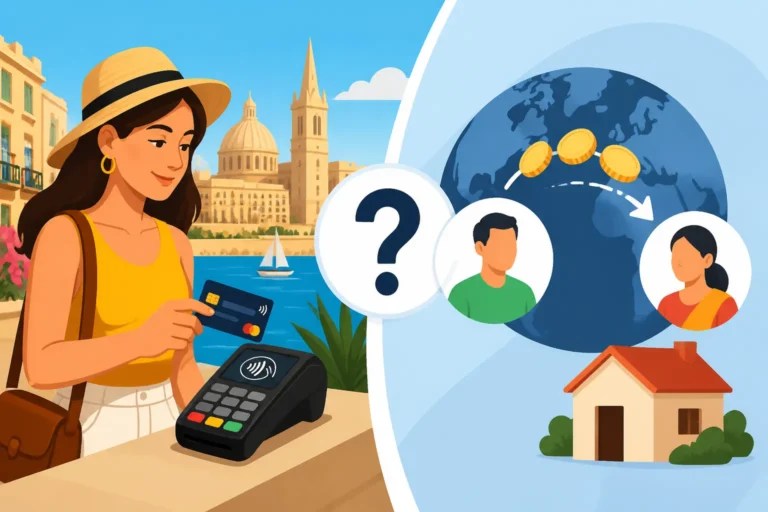
Sounds fantastic, doesn't it? You can keep your foreign earnings tucked away in an offshore bank account, and as long as you don't bring them to Malta, they remain untaxed here. Many individuals leverage this to manage their global finances efficiently. However, this "golden cage" requires careful management, because any money you do bring into Malta – even unknowingly through spending on a foreign debit card – can be deemed a remittance and become taxable. We break down the ins and outs of this in The Non-Dom Remittance Basis in Malta: How It Works.
Understanding Malta's €5,000 Minimum Tax for Certain Non-Doms
Now, let's get to the heart of the matter: the €5,000 minimum tax. This particular provision can certainly cause a bit of a panic for some, and rightly so, because it was designed to ensure that even those benefiting from the attractive remittance basis still contribute a baseline amount to the Maltese economy. It’s an interesting little twist in the Maltese tax tapestry that isn't always immediately obvious when you read the general rules.
Who the Minimum Tax Was Designed For (and Against)
The €5,000 minimum tax isn't a blanket rule for all non-doms. It specifically targets a particular group: non-domiciled individuals who are ordinarily resident in Malta (meaning they spend enough time here to be considered tax resident), but who might otherwise pay very little or no tax to Malta because most of their income is foreign-sourced and not remitted.
The Maltese government introduced this to prevent situations where high-net-worth individuals, living comfortably in Malta and enjoying its infrastructure and services, might legitimately declare minimal taxable income under the remittance basis due to meticulous financial planning (i.e., not remitting much income). They wanted to ensure a fair contribution from these residents. So, if you're a non-Maltese citizen, ordinarily resident in Malta, and non-domiciled here, this minimum tax applies if your chargeable income in Malta (after deductions) falls below €5,000, and your global income exceeds a certain threshold. It effectively sets a floor on the tax you'll pay.
The Specifics: Income Thresholds and Application
Alright, let’s get down to the nitty-gritty. The €5,000 minimum tax will apply to you if all of the following conditions are met:
- You are an individual: This rule doesn't apply to companies.
- You are resident (ordinarily resident) in Malta for tax purposes: This typically means you've spent more than 183 days in Malta during the tax year.
- You are not domiciled in Malta. (As discussed, most expats fall into this category).
- You are not a Maltese citizen.
- Your chargeable income (taxable income) in Malta is less than €5,000. This is the amount of income you actually declare as taxable in Malta, which would include your Malta-source income and any foreign income you remitted.
- Your total income from all sources worldwide (gross global income) is €35,000 or more. This is the crucial threshold. This is all the income you earn, everywhere, regardless of whether it's remitted to Malta or not.
If you tick all these boxes, then your tax liability in Malta for that year will be a minimum of €5,000. It's not an additional tax; it's a minimum. If your calculated tax bill, based on your remitted income and Malta-source income, is less than €5,000, it will be topped up to €5,000. If your calculated tax is already €5,000 or more, then the minimum tax rule has no effect on you.
Consider a hypothetical scenario: You're a retired expat, non-dom in Malta, and you spend all year here. You have a foreign pension of €60,000 (well over the €35,000 threshold). You manage your finances carefully and only remit €10,000 of your pension to Malta for living expenses, and you have no other Malta-source income.
Your taxable income in Malta is €10,000. Under Malta’s progressive tax rates (using the single rates for simplicity), your tax might be around €1,300 (after personal deductions). Since this is less than €5,000, and your global income exceeds €35,000, your tax bill for the year will be bumped up to €5,000.
This is exactly the kind of situation this rule was designed to address. It’s a good idea to speak to a tax advisor, perhaps one from a firm like Taxes for Expats, especially if your income streams are diverse and you're hovering around these thresholds. They can help you accurately assess your global income and how it might impact your Maltese tax liability.
The "Catch" of Ordinary Residence and Why it Matters
The concept of "ordinary residence" is key here. It doesn't mean being a permanent resident in the immigration sense; it relates specifically to tax residency. To be ordinarily resident in Malta for tax purposes, you generally need to show an intention to reside here regularly and habitually, typically established by spending more than 183 days in Malta during a calendar year.
Even if you are scrupulously managing your foreign income and only remitting small amounts, if your global income (from all sources, whether remitted or not) is €35,000 or more, and you are tax resident in Malta, the €5,000 minimum tax is a very real possibility. It's not about how much you remit, but about your capacity to remit, tied to your global earnings. It’s a floor, regardless of how modest your taxable income in Malta might appear due to careful remittance planning. This is why understanding The €5,000 Minimum Tax Rule for Non-Doms in Malta is so vital for many foreigners here.
Practical Scenarios and Exemptions: Does It Apply to YOU?
It's easy to get bogged down in the legalese, but let's look at this from a practical perspective. Who needs to worry about this, and who can breathe a sigh of relief?
When You Likely Won't Be Subject to the Minimum Tax
For many expats, the €5,000 minimum tax simply won't apply. Here are the common scenarios where you're likely in the clear:
- You're an employee with only Maltese-source income: If your only income is a salary from a Maltese employer, and you have no significant foreign income, this rule won't affect you. Your tax will be calculated based on your Maltese salary under the standard progressive rates, usually handled via the FSS (Final Settlement System) on your payslip. For details on how that works, refer to Understanding the FSS (Final Settlement System) on Your Payslip.
- You're under a special tax programme: Malta has several attractive residence programmes designed for specific groups (e.g., retirees, high-net-worth individuals). These include the Global Residence Programme (GRP), the Malta Retirement Programme (MRP), and others. Individuals benefiting from these programmes have their own specific minimum tax thresholds and rules, which supersede the general €5,000 minimum tax for non-doms. For instance, the GRP has a minimum annual tax of €15,000. If you are enrolled in one of these, you're governed by its specific conditions. To understand these programmes, check out Special Tax Programmes in Malta: GRP, MRP, and the Residence Schemes.
- Your global income is below €35,000: If your total income from all sources worldwide, before any deductions, is less than €35,000, then the €5,000 minimum tax simply doesn't kick in, regardless of your remittance patterns.
- You are domiciled in Malta: If, for some reason, you have established Maltese domicile (which is rare for most expats), you would be taxed on your worldwide income and capital gains, so the remittance basis and its associated minimum tax wouldn't apply to you.
- You are not tax resident in Malta: If you spend less than 183 days in Malta and are not considered tax resident here, then Maltese tax rules on income (including the minimum tax) generally won't apply to your foreign income. This might be the case for digital nomads who don't establish tax residency, but they still need to be careful about their presence and any income sourced here.
Scenarios Where It Could Apply and How to Navigate
The €5,000 minimum tax is primarily a concern for those who are highly mobile, non-domiciled in Malta, spend most of their time here, and have substantial income generated outside Malta.
- The Foreign Consultant/Freelancer: Imagine you're a consultant working remotely for clients outside Malta. You earn €80,000 a year, all from foreign sources. You live in Malta for 10 months of the year, making you ordinarily resident and non-domiciled. You manage your finances carefully, only bringing €15,000 into Malta for your living expenses. Your tax calculation based on €15,000 remitted income might be, say, €2,500. However, since your global income is €80,000 (well over €35,000), you would be liable for the €5,000 minimum tax.
- The Wealthy Retiree: A retiree with an annual foreign pension of €50,000, living in Malta full-time, might choose to only transfer €1,000 a month to their Maltese bank account, leaving the rest offshore. Despite remitting only €12,000, their global income is €50,000, meaning the €5,000 minimum tax will apply if their calculated tax on the remitted amount is less.
In these situations, careful planning around remittances is key. Some individuals find that after accounting for the minimum tax, it might make more sense to remit slightly more income to cover living costs, or to restructure their finances. This is where tools like Wise can be incredibly helpful for managing international transfers. By carefully controlling what funds enter your Maltese bank account, you can better track your remittances, but remember, the minimum tax isn't just about how much you remit, but your overall global earning capacity if you meet the other conditions. For more on this, check out How Foreign Income and Capital Gains Are Treated in Malta and Will I Be Taxed If I Transfer Foreign Savings to Malta?.
To give you a quick overview, here's a table to help you decide if you might be impacted:
| Condition | Your Status (Yes/No) | Impact on Minimum Tax Applicability |
|---|---|---|
| Are you ordinarily resident in Malta? | Yes | Potentially applies |
| Are you not domiciled in Malta? | Yes | Potentially applies |
| Are you not a Maltese citizen? | Yes | Potentially applies |
| Is your global income €35,000 or more? | Yes | Potentially applies |
| Is your calculated Maltese tax < €5,000? | Yes | Minimum tax will apply |
| — | — | — |
| Are you under a special residence program? | Yes | Minimum tax does NOT apply |
| Is your global income < €35,000? | Yes | Minimum tax does NOT apply |
| Is your calculated Maltese tax >= €5,000? | Yes | Minimum tax does NOT apply |
| Are you only working for a Maltese employer? | Yes | Minimum tax does NOT apply |
Seeking Professional Guidance
Honestly, tax matters are rarely straightforward, and Malta's system, while advantageous for some, can be complex. If you believe any of the "could apply" scenarios resonate with you, or if your financial situation is at all intricate, my best advice, honed over years of expat life, is to consult with a qualified tax advisor in Malta. They can review your specific circumstances, clarify your domicile status, assess your global income, and help you structure your affairs in a compliant and efficient manner. Firms like Taxes for Expats specialise in assisting foreigners, and their expertise can be invaluable. It's an investment that can save you a lot of stress and potential headaches down the line. For guidance on filing, you might find our article Filing Your Maltese Tax Return: The CFR, FS3, and TA22/TA24 useful, but professional advice remains paramount. For understanding how to manage different types of income, consider reading How Do I Keep Capital and Income Separate for Maltese Tax?.
Staying Compliant and Avoiding Pitfalls
Understanding these tax rules isn't just about saving money; it's about staying on the right side of the law and ensuring your life in Malta remains as stress-free as possible. Tax authorities here are increasingly vigilant, and ignorance is rarely an acceptable excuse.
The Importance of Accurate Declarations
When you register for tax in Malta, you'll get a Tax Identification Number (TIN). This is your key to the system. You’ll need to declare all your relevant income on your annual tax return. If you're a non-dom under the remittance basis, this means accurately reporting your Malta-source income and any foreign income that has been remitted to Malta. If the €35,000 global income threshold is met, and you're eligible for the minimum tax, the system will apply it.
The consequences of not declaring accurately can be severe, including fines and penalties. It's far better to be transparent and seek professional help if you're unsure. Get familiar with Registering for Tax When You Arrive in Malta and Getting Your Maltese Tax Identification Number (TIN) as early steps.
Managing Your Money Smartly to Optimise Your Tax Situation
For non-doms, the golden rule of the remittance basis is often: don't remit what you don't need. This means keeping foreign-sourced income in bank accounts outside of Malta. When you do need to bring money into Malta for living expenses, carefully plan those transfers. Using a service like Wise can help you manage your international funds efficiently, allowing you to transfer specific amounts without incurring excessive fees or accidentally "remitting" more than intended by drawing directly from foreign accounts in Malta.
Be mindful of how you spend money in Malta. If you use a foreign bank card that draws directly from an account holding foreign-sourced income, that transaction counts as a remittance. It's often safer to transfer a planned amount to a Maltese bank account and use that for your local spending. For more on this, refer to Does Spending on a Foreign Card in Malta Count as a Remittance?. The key is intentionality and clear separation of funds if you want to minimise your remitted income.
Ultimately, navigating the Maltese tax landscape as a non-dom requires diligence and, for many, professional advice. But with the right information, you can make informed decisions and enjoy all that Malta has to offer without unnecessary financial worries.
Disclaimer
This article is for general informational purposes only and does not constitute professional advice. Laws, prices and regulations vary by location and change over time. Consult a qualified professional for guidance on your specific situation.