Does Spending on a Foreign Card in Malta Count as a Remittance?
One of the trickiest things about moving to a new country, especially one with a unique tax system like Malta, is figuring out how to handle your money without accidentally landing yourself in hot water with the taxman. It’s a common worry for many of us, especially those of us who still maintain financial ties to our home countries: "Does swiping my foreign credit card here in Malta count as bringing money into the country in a way that makes it taxable?" It’s a completely valid question that causes a fair bit of anxiety and confusion, and this guide is here to shed some light on the subject, clarifying the nuances of Malta's remittance basis of taxation and how it applies to your everyday spending.
Unpacking Malta's Remittance Basis of Taxation
Let's cut through the jargon and get to the heart of what the "remittance basis of taxation" actually means here in Malta. It's a system that, on the surface, sounds wonderfully simple, but in practice, often leads to head-scratching moments for newcomers.
Who is Subject to the Remittance Basis?
First things first, this particular tax regime isn't for everyone. It primarily applies to individuals who are resident but not domiciled in Malta. Now, "resident" is usually pretty straightforward – if you live here for more than 183 days in a calendar year, you're generally considered resident. But "domicile" is a whole other beast. It's not about where you live, but where your long-term, spiritual, or ancestral home is considered to be. For many expats, particularly those who foresee returning to their home country someday, their domicile often remains abroad.
So, if you’re living in Malta, have acquired tax residency here, but still consider your ‘true home’ (your domicile) to be elsewhere, then Malta taxes you on what’s known as the remittance basis. This is a critical distinction that can significantly impact your tax obligations. It's a cornerstone of the Maltese tax system that many expats rely on, but it requires a careful understanding of its mechanics. If you're unclear about your domicile status, it’s always best to consult with a professional, like those at Taxes for Expats, to ensure you're on the right track.
The Core Principle: Only Remitted Income and Capital Gains are Taxable
The beautiful, and sometimes bewildering, aspect of the remittance basis is this: as a non-domiciled resident, you are generally only taxed in Malta on:
- Income arising in Malta.
- Income arising outside Malta that is received in or remitted to Malta.
- Certain capital gains arising in Malta.
Crucially, foreign capital gains are generally not taxable in Malta, even if remitted. This is a significant advantage for many, but the real complexity often lies in that second point: "income arising outside Malta that is received in or remitted to Malta." What exactly constitutes "remitted"? Does bringing physical cash count? What about an international bank transfer? And, the million-dollar question, does simply swiping your foreign debit card at a local supermarket mean you've "remitted" funds? This is where the practical application often gets murky, and where most of the confusion arises. The law isn't always as black and white as we'd like it to be when it comes to modern financial transactions.
The Nitty-Gritty of Foreign Card Spending in Malta
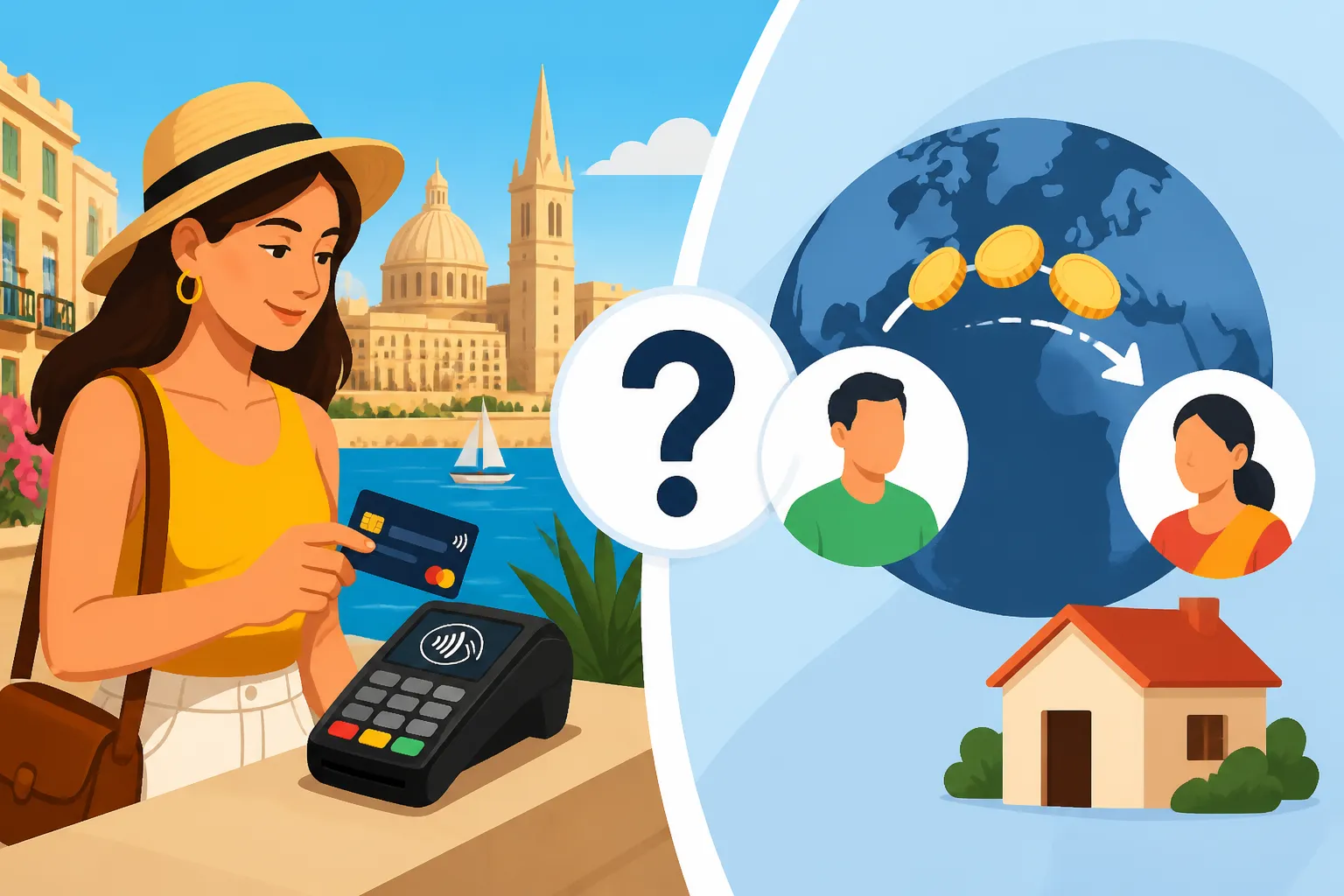
Alright, let's tackle the burning question head-on. The general rule of thumb, which might surprise some, is that simply using your foreign bank card (debit or credit) to make purchases for goods and services directly in Malta, where the transaction is processed from your foreign bank account, does not typically count as a remittance for tax purposes.
When Spending Doesn't Count as a Remittance
Imagine you're at the local pastizzeria in Sliema, craving a pastizz, and you pay with your UK-issued debit card. Or you're buying groceries at a supermarket like PAMA or PAVI, using your American credit card. In these scenarios, the funds are being drawn directly from an account outside Malta. The money itself isn't being physically brought into the Maltese financial system before the purchase. It's a direct payment from an offshore source to a Maltese vendor. Think of it this way: your foreign bank is essentially making a payment on your behalf to the Maltese merchant, using funds that never actually "entered" Malta as part of your personal income or capital transfer. The money flows directly from your foreign account to the merchant's account, often via international payment networks, bypassing your personal Maltese bank accounts entirely.
This also extends to online shopping where the payment gateway is outside Malta and the items are shipped here. For instance, if you order something from Amazon.de and pay with a German bank card, the transaction and the funds remain outside Malta’s remittance scope. The key here is that the funds themselves were never first brought into a Maltese bank account or held in Malta as part of your personal capital or income, before being spent. You’re simply accessing funds already held abroad to pay for a local expense.
When Spending Could Be Seen as a Remittance (The Grey Areas)
Now, this is where things get a bit more nuanced, and where unintentional "remittances" can occur. While direct card spending for local goods and services generally flies under the radar, certain actions can indeed trigger a remittance event:
- Topping Up a Maltese Bank Account from a Foreign One: This is the most straightforward example of a remittance. If you transfer money from your foreign bank account (e.g., an HSBC account in your home country) to your Maltese bank account (say, your BOV or APS account here), that foreign-sourced income or capital has explicitly been "received in" Malta. This applies whether you do it via a traditional bank transfer or using an international money transfer service.
- Large Cash Withdrawals Followed by Deposit: If you use your foreign card to withdraw a significant amount of cash from an ATM in Malta, and then proceed to deposit that cash into your Maltese bank account, this action could be construed as a remittance. You've effectively brought foreign funds into the local financial system for your personal use and integration into your Maltese finances. While the initial withdrawal isn't strictly a remittance (as per the direct spending rule), the subsequent deposit transforms it.
- Paying a Maltese Credit Card from a Foreign Account: If you have a Maltese-issued credit card and pay off its balance by transferring funds from your foreign bank account, this is also a remittance. The foreign income is being used to settle a debt within the Maltese financial system.
The distinction often hinges on whether the foreign funds are being directly consumed at the point of sale from their offshore location, or if they are first integrated into the Maltese financial infrastructure (e.g., via a local bank account) before being spent. This is why many non-domiciled residents opt to primarily use their foreign bank cards for daily expenses, only remitting larger sums for specific purposes like rent or savings into a local account.
The "Source of Funds" Rule
Malta’s tax authorities are primarily concerned with the "source of funds." For non-domiciled residents, the aim is to tax income that is generated and received within Malta. If your foreign bank account contains funds that are not foreign income (e.g., they are funds that were already taxed in Malta and then transferred abroad, or pure capital that you brought in before becoming tax resident), then their subsequent "remittance" might not lead to a new tax charge. However, establishing this can be complex. You need to be able to clearly demonstrate the origin of the funds and their tax status. This is why maintaining meticulous financial records, tracing the flow of funds, becomes absolutely paramount for those operating on the remittance basis.
For instance, if you paid tax on a bonus from your job in Malta, and then transferred that taxed money to an offshore account, bringing it back to Malta later (even if it's from the foreign account) would generally not be considered a taxable remittance, as it was already taxed in Malta. However, if that foreign account also contains untaxed foreign income, it becomes a much murkier picture. This brings us to the importance of segregation.
Practical Strategies for Non-Doms in Malta
Navigating the remittance basis can feel like walking a tightrope, but with a few smart strategies, you can manage your finances effectively and stay compliant.
Segregating Your Funds
One of the most crucial pieces of advice for anyone living in Malta under the remittance basis is to segregate your funds. This means keeping your foreign-sourced income and capital gains separate from any money you intend to remit to Malta.
Consider having at least two bank accounts in your home country (or offshore): one for pure capital (e.g., inherited money, proceeds from property sales, or savings accumulated before you became a Maltese tax resident and non-domiciled) and another for foreign income that you do not intend to bring to Malta (e.g., rental income from an overseas property, dividends from foreign investments). When you need money for living expenses in Malta, only transfer what you genuinely need from a designated "remittable" income account. This approach makes it much clearer to both yourself and the tax authorities where your funds originate and which portions have been introduced into the Maltese tax net.
It also means being mindful of your Maltese bank accounts. Don't just top them up indiscriminately from any foreign source. Only bring in the amounts you've calculated are necessary and are prepared to declare as remitted income.
Using International Money Transfer Services
When you do need to bring funds into Malta, using a reputable international money transfer service is often a much more transparent and cost-effective option than traditional bank transfers. Services like Wise (formerly TransferWise) allow you to send money from your foreign bank account directly to your Maltese bank account, often with better exchange rates and lower fees. The crucial aspect here is that these services provide a clear, traceable record of the transfer, making it straightforward to account for these funds as remitted income when it comes to your tax declaration.
While using such services for planned remittances is excellent, remember that the act of transferring funds from your foreign income account to your Maltese account is the remittance event itself. The service simply facilitates it cleanly.
Seeking Professional Tax Advice
I cannot stress this enough: the Maltese tax system, particularly for non-doms, has its complexities. Trying to interpret every nuance yourself based on online articles (even this one!) can be risky. For peace of mind and accurate compliance, it is highly advisable to seek professional tax advice from a qualified Maltese tax advisor. They can assess your specific circumstances, clarify your domicile status, help you understand your obligations, and guide you on the most tax-efficient ways to manage your finances.
They can help you navigate situations like declaring your remitted income on forms such as the TA22 or TA24 if you're self-employed or have rental income, or simply understand your FSS breakdown as an employee. An expert can make all the difference in ensuring you're compliant and not missing any important deadlines for filing your tax return on the CFR portal.
What About the €5,000 Minimum Tax?
Another point that often creates confusion alongside the remittance basis is the €5,000 minimum tax rule for non-doms in Malta. It's important to understand that this is a separate, albeit related, obligation and not directly tied to whether you spend with a foreign card.
Under this rule, if you are a non-domiciled individual ordinarily resident in Malta and your foreign income remitted to Malta is less than €35,000 per year, you will be subject to a minimum tax of €5,000 (plus social security contributions, which can bring the total to around €5,750-€6,000, depending on your situation). This minimum tax is essentially a baseline for non-doms, ensuring that even if they remit very little foreign income, they still contribute a certain amount to the Maltese fiscus.
So, even if you are meticulous about not remitting foreign income and only use your foreign card for direct spending, if you meet the criteria for being a non-domiciled resident, you might still be liable for this minimum tax. It’s crucial not to confuse the rules around card spending with this separate minimum tax obligation. They are distinct elements of the tax regime for non-domiciled residents.
| Scenario | Does it count as a remittance? | Explanation |
|---|---|---|
| Paying for groceries with your foreign debit/credit card | Generally No | Funds are drawn directly from an account outside Malta. Money doesn't enter the Maltese financial system before the purchase. |
| Online shopping from an international retailer with foreign card | Generally No | Similar to direct POS spending; payment is processed abroad, and funds don't enter Malta's financial system for your personal use first. |
| Transferring funds from foreign bank to Maltese bank account | Yes | This is the clearest form of remittance, explicitly bringing foreign income or capital into Malta's financial system. |
| Withdrawing cash from a Maltese ATM with a foreign card | Generally No | Direct access of funds from abroad. However, depositing this cash into a Maltese bank account would constitute a remittance. |
| Paying a Maltese utility bill (e.g., ARMS) directly with a foreign card | Generally No | Similar to direct POS spending; foreign funds pay a Maltese expense without first entering your Maltese bank account. |
| Paying a Maltese credit card balance with a transfer from a foreign bank account | Yes | Foreign funds are used to settle a debt within the Maltese financial system, thus being "received in" Malta in the form of debt settlement. |
| Receiving foreign pension payments directly into a Maltese bank account | Yes | Foreign income (pension) is directly received into Malta. |
Ultimately, while the idea of a simple card swipe triggering a tax event can feel daunting, the Maltese tax system, in this specific context, is often more practical than many expats initially fear. The key is understanding the distinction between directly accessing offshore funds for purchases and explicitly moving funds into the Maltese financial system for personal use.
Disclaimer
The information provided in this article is intended for general informational purposes only and does not constitute financial, legal, or tax advice. While we strive to provide accurate and up-to-date information, tax laws and regulations in Malta can be complex and are subject to change. Individual circumstances vary significantly. Therefore, it is strongly recommended that you consult with a qualified Maltese tax advisor or legal professional to obtain advice tailored to your specific situation before making any financial decisions or taking any action. We cannot be held responsible for any errors or omissions, or for any actions taken based on the information provided herein.