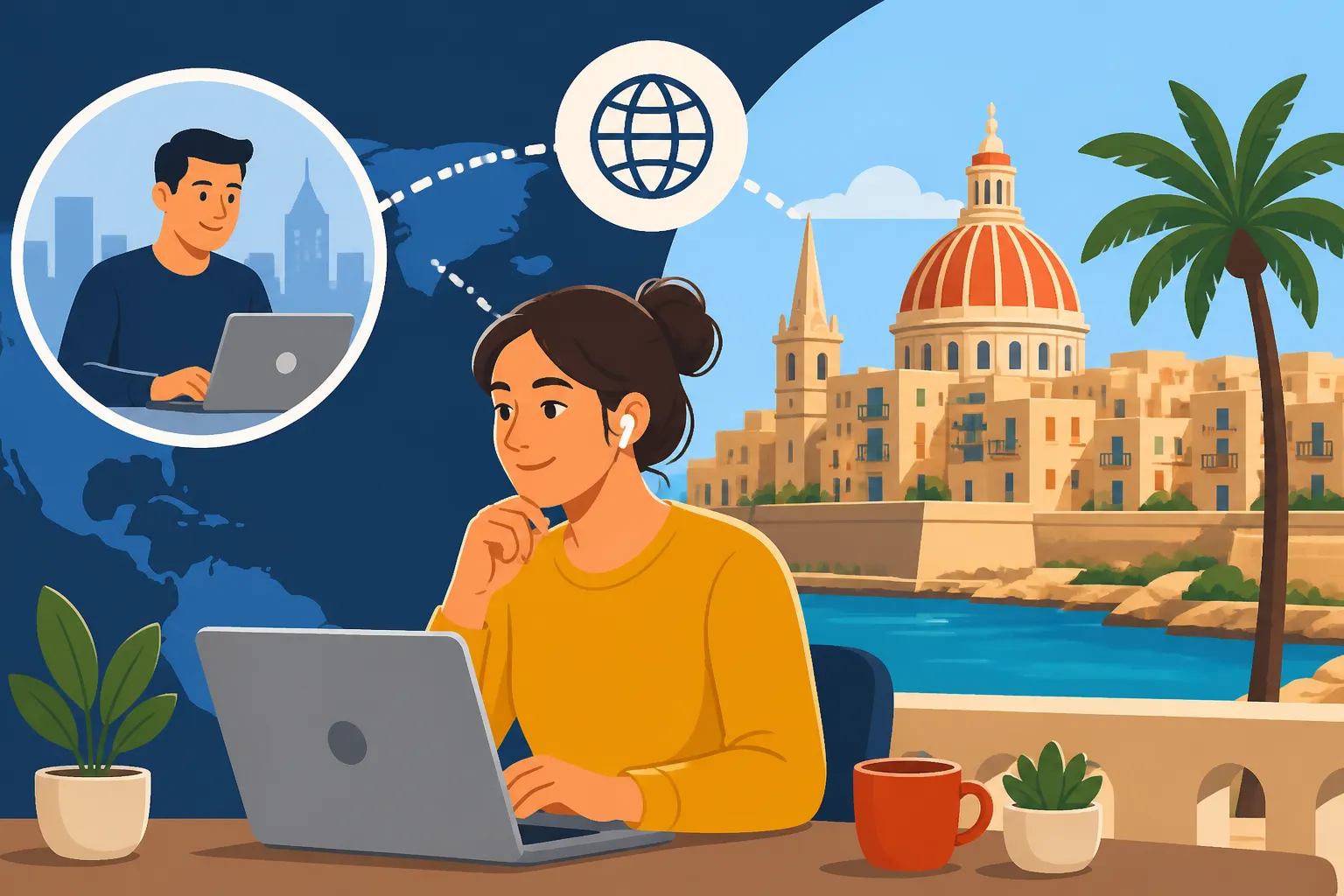
Can I Work Remotely for a Foreign Employer While Living in Malta?
Many digital nomads and professionals dream of trading their grey office views for a limestone balcony overlooking the Mediterranean, but they often stumble over the legalities of remote employment. Simply landing at Luqa airport with a laptop does not automatically grant you the right to work for a foreign company while living here. This guide breaks down the specific residency permits, tax liabilities, and social security obligations you must navigate to work remotely in Malta legally.
Understanding the Legal Framework for Remote Employment
The most important thing to realize when moving to Malta is that the "digital nomad" lifestyle is no longer a legal grey area. In the past, people would move here on a tourist visa and work quietly from a cafe, but the Maltese government has tightened regulations significantly. If you are a non-EU citizen, you cannot simply work for a foreign employer on a standard tourist stay. You need a specific legal basis to remain on the islands while performing any kind of professional activity, even if your employer has no physical presence in the country.
For third-country nationals, the primary gateway is The Nomad Residence Permit and Residence Programmes in Malta. This permit was specifically designed to bridge the gap for those who have a contract with a company registered outside of Malta or who provide freelance services to foreign clients. It acknowledges that your economic activity is happening elsewhere, but your physical presence is here. Without this permit, or a similar residence document, you risk being flagged for overstaying your 90-day Schengen allowance, which can lead to future entry bans across Europe.
EU citizens have it much easier due to freedom of movement, but even they are not exempt from all paperwork. If you are an EU national and intend to stay longer than three months while working for your home-country employer, you are still required to register your residence. While you don't need a "work permit" in the traditional sense, you do need to document your status to access local services. Many newcomers ask, Can I Use My Foreign ID While Waiting for a Maltese One? while they wait for their local documentation. The answer is generally yes for daily life, but for long-term legal stability, getting your Maltese eResidence card is a priority.
The Nomad Residence Permit Eligibility and Requirements
To qualify for the Nomad Residence Permit, you must prove that you earn a gross monthly income of at least €3,500. This threshold is strictly enforced by Identità (formerly Identity Malta). You will need to provide bank statements and a valid employment contract showing that your work can be performed regardless of location using telecommunications. It is a fantastic option for those who want to experience the island life without being tied to a Maltese company, but the application process requires meticulous attention to detail, including a clean police conduct report and proof of health insurance.
If you are wondering about the specifics of the application, you should look into What Is the Nomad Residence Permit in Malta? to see the latest list of required documents. Many applicants get their applications rejected simply because their health insurance didn't cover the full duration of their intended stay or because their contract didn't explicitly state that remote work was permitted. Ensure your employer is on board with providing a letter that confirms you are allowed to work from Malta; without this, the authorities will likely decline your request.
Remote Work for EU and EEA Nationals
If you are lucky enough to hold an EU passport, your path is paved with significantly less red tape, but you shouldn't ignore the rules entirely. After 90 days, you are technically a resident and must apply for an eResidence document under the "Economic Self-Sufficiency" or "Employment" category. Even if your employer is in Germany or Sweden, the Maltese government wants to know that you are living here and contributing to the system or, at the very least, not becoming a burden on the state.
Registering as an EU remote worker also simplifies your access to local infrastructure. For example, Setting Up Your Home in Malta: Utilities, Internet, and Insurance becomes much easier when you have a local ID number. Internet providers and utility companies often have different deposit requirements for those who haven't yet registered their residence. Many expats find that having that plastic eResidence card makes everything from opening a gym membership to signing a lease go much smoother.
Navigating Taxes and Social Security for Remote Workers
Taxation is the area where most remote workers in Malta find themselves in hot water. There is a common misconception that if you pay tax in your home country, you don't owe anything to Malta. However, if you spend more than 183 days a year on the island, you typically become a tax resident. Malta operates on a "remittance basis" of taxation for non-domiciled residents, which is a complex but often beneficial system. Understanding How Does the Remittance Basis of Taxation Work in Malta? is essential to ensuring you aren't paying more than you should—or inadvertently committing tax evasion.
For many remote workers, the fear of double taxation is real. Malta has an extensive network of double taxation treaties, but navigating them requires professional help. Services like Taxes for Expats are often suggested to people who are struggling to reconcile their US or UK tax obligations with the Maltese system. They specialize in the unique hurdles faced by people who live in one country while earning in another. It is much cheaper to pay for professional advice upfront than to face the penalties of the Commissioner for Revenue later down the line.
Social security is another pillar you cannot ignore. If you are working remotely, you need to determine where your social security contributions should be paid. Under EU rules, you generally pay where you are physically working, but there are "A1" forms that allow for temporary postings. If you are a freelancer or under the Nomad permit, you might need to look into Social Security Contributions in Malta: Classes, Rates, and Benefits to see if you are required to pay locally. Paying into the Maltese system is often the key to unlocking What Exactly Does Maltese Public Healthcare Cover? if you don't want to rely solely on private insurance.
The Remittance Basis of Taxation Explained
In simple terms, as a non-domiciled resident of Malta, you are generally taxed on income arising in Malta and foreign income that is "remitted" (brought into) Malta. If you keep your foreign salary in a foreign bank account and only transfer what you need for living expenses, you might only be taxed on that transferred amount. However, there are nuances, such as the €5,000 minimum tax rule for certain high-earners, which can catch people off guard.
This system is one of the main reasons Malta is so attractive to high-earning remote workers. By strategically managing how you bring money into the country, you can often achieve a very favorable effective tax rate. But beware: using a foreign credit card to pay for your groceries in Sliema counts as a remittance. This is where a specialized service like Taxes for Expats becomes invaluable, as they can help you track these movements and report them correctly to both the Maltese and your home-country authorities.
Social Security and Healthcare Access
If you are not paying social security in Malta because you are covered by an A1 form from another EU country, you will need to ensure your EHIC card is up to date for emergency care. However, for those on the Nomad Residence Permit, the rules are slightly different; usually, you are expected to have private health insurance because you aren't contributing to the local social security pot. This means you won't automatically have access to the free public healthcare system that locals enjoy.
If you do decide to register as self-employed in Malta to handle your remote work, you will start paying Class 2 contributions. This entitles you to the same healthcare benefits as any other Maltese resident. Before making this jump, it is worth checking the Cost of Living in Malta: Budgeting for the Real Numbers to see if the social security costs and tax obligations of self-employment outweigh the benefits of staying on a Nomad permit. Sometimes, the administrative burden of local self-employment is higher than newcomers anticipate.
| Requirement | Nomad Residence Permit (Non-EU) | EU Remote Worker (Self-Sufficient) |
|---|---|---|
| Minimum Income | €3,500 monthly (gross) | Proof of self-sufficiency |
| Health Insurance | Private cover mandatory | EHIC or private cover |
| Tax Status | Non-dom / Remittance basis | Non-dom / Remittance basis |
| Permit Duration | 1 year (renewable) | Permanent (as long as criteria met) |
| Social Security | Usually paid in home country | A1 form or local contributions |
| Application Body | Identità | Identità (Expatriates Unit) |
Daily Life and Integration as a Remote Worker
Once the paperwork is submitted, the real challenge begins: actually living and working in a new culture. Malta is a hub for iGaming and Fintech, so the remote work community is thriving. However, working from your apartment in St. Paul's Bay can get lonely. Newcomers often benefit from joining co-working spaces like Soho Office or Hub Workspace. These places aren't just about desks and high-speed internet; they are the heart of the expat community where you can find mentors, friends, and even potential collaborators.
Language is rarely a barrier in professional circles, as English is an official language. However, to truly feel at home, Learning Maltese: Why and How Newcomers Pick It Up is a great step. Even knowing a few phrases like "Bonġu" (Good morning) or "Grazzi" (Thank you) will earn you a lot of respect from the locals. For those who want to get serious about the language or improve their English for a global remote role, I highly recommend using iTalki. It’s an easy way to find tutors who can work around your remote schedule, and having a local language partner can help you navigate the more traditional parts of the islands.
You also need to be prepared for the logistical quirks of island life. While you are working for a shiny tech company in London or New York, your Maltese apartment might be dealing with a summer heatwave or a sudden power cut. The infrastructure is improving, but it’s always wise to have a backup mobile data plan from a provider like Epic or Melita. Reliability is key when you are working remotely, and you don't want to miss a Zoom call because the neighborhood transformer decided to take a nap in the 40-degree August heat.
Building a Professional Network
Integration isn't just about the people you meet at the beach; it's about building a professional safety net. Malta has numerous networking groups for digital nomads and tech workers. Attending meetups in Valletta or St. Julian's can provide you with "boots on the ground" advice that you won't find in any official manual. These connections are vital when you run into issues with your lease or need a recommendation for a trustworthy accountant who understands the remote work niche.
Using iTalki to find a Maltese tutor can also be a "secret weapon" for networking. Often, these tutors are locals who can explain the nuances of Maltese business etiquette or tell you which government office is currently the fastest at processing paperwork. It turns a language lesson into a cultural deep dive that helps you move beyond the "tourist" phase of your stay. The more you understand the local context, the more successful your remote working stint in Malta will be.
Managing the Digital Nomad Lifestyle
The "nomad" part of the Nomad Residence Permit implies flexibility, but the Maltese authorities do expect you to actually live here. If you spend too much time outside the country, you might find your renewal application under scrutiny. It’s a balance between enjoying the proximity to the rest of Europe and maintaining your status as a Maltese resident. Keeping a log of your travel dates and keeping all your local receipts is a boring but necessary part of the lifestyle.
Lastly, don't forget to take advantage of the very thing that brought you here. It is easy to get sucked into a "business as usual" mindset and spend all day inside. Make sure to schedule your "out of office" time to explore the sister island, Gozo, or take a swim in the Blue Lagoon. Living in Malta is a unique experience, and as long as your taxes are handled by professionals like Taxes for Expats and your legal status is secure, you can truly enjoy the best of both worlds: a global career and a Mediterranean lifestyle.
Disclaimer
The information provided in this article is for general informational purposes only and does not constitute legal, financial, or tax advice. Residency laws, tax regulations, and visa requirements in Malta are subject to frequent change. Always consult with qualified professionals, such as immigration lawyers or tax accountants, and refer to official government sources like Identità and the Commissioner for Revenue before making any decisions related to your relocation or employment status.