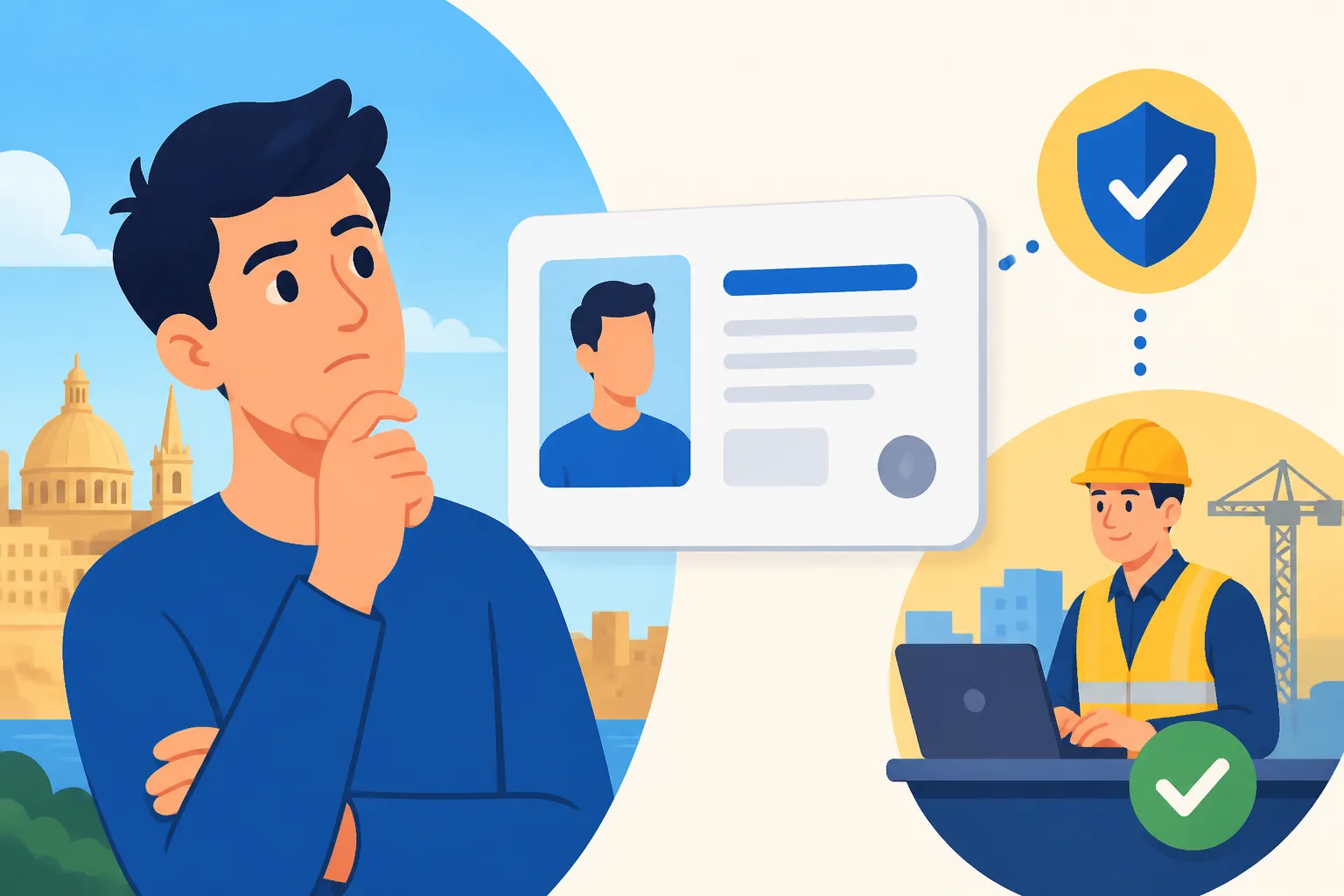
Why Do I Need an ID Card Number to Start Working in Malta?
You have finally secured that dream job in the Mediterranean sunshine, signed the contract, and found a flat with a view of the Grand Harbour. But as your start date approaches, your HR manager sends an urgent email asking for your Maltese ID card number. Without this specific nine-digit sequence ending in a letter, the machinery of your employment will grind to a halt. This guide explains why the ID card is the mandatory "Master Key" for working, getting paid, and accessing social protections in Malta.
The eResidence Card: The Administrative Master Key
When you first arrive in Malta, you might assume that your passport is your primary identification. While it serves for international travel, it carries very little weight within the local Maltese administrative ecosystem. The eResidence card—often simply called the ID card—is the document that officially bridges the gap between being a visitor and being a resident. For the Maltese government, your ID number is the primary way they track your legal status, your right to work, and your integration into the national infrastructure.
The ID number itself is a unique identifier that stays with you for life, even if you leave the island and return years later. It usually consists of seven digits followed by a letter, such as "123456(A)" for foreign residents. This number is required for almost every interaction with the state. Without it, you are essentially "invisible" to the digital systems used by employers and government departments. Getting Your Maltese ID Card Number: The Key to Accessing Healthcare is often the first thing expats realize they need once the reality of living here sets in.
Furthermore, the ID card acts as a residence permit. For non-EU citizens, it is the physical proof of their The Single Permit in Malta: Combined Work and Residence, Step by Step, which authorizes them to live and work for a specific employer. For EU citizens, while the right to work is inherent under EU law, the ID card serves as the local registration required for stays exceeding three months. In both cases, the card is the only document that tells an employer, "This person is legally allowed to be on my payroll."
Navigating the initial application can be stressful, especially when dealing with the busy offices of Identità in Msida. Many expats find that having a basic grasp of the local context helps when communicating with administrative staff. Using a platform like iTalki to practice a few conversational phrases or to better understand the nuances of Maltese English can make these face-to-face interactions much smoother. Being able to explain your situation clearly often helps bypass the "come back tomorrow" culture that occasionally surfaces in busy government bureaus.
Financial Compliance: Taxes and Social Security
The most immediate reason you need an ID number to start work is for financial compliance. Malta operates under a system called the Final Settlement System (FSS). This system requires employers to deduct income tax and social security contributions directly from your salary before you ever see it. However, the employer cannot create a record for you in the tax department's system without your ID number. Without this link, the Commissioner for Revenue has no way of knowing who is paying the tax or which tax bracket should be applied to your income.
If you attempt to work without a registered ID number, you risk being placed on an "emergency" tax rate, which can be significantly higher than the standard progressive rates. This happens because the system defaults to a high flat rate when it cannot verify your residency status or family
situation. Understanding How the FSS (Final Settlement System) on Your Payslip Works is vital to ensuring you aren't losing half your paycheck to administrative errors. Once your ID is processed and your tax status is correctly updated, you can eventually reclaim overpaid tax, but this can take over a year to resolve, leading to significant cash-flow issues for a new arrival.
Social security is the other side of the financial coin. Your ID number is used to generate your social security record, which tracks your Social Security Contributions in Malta: Classes, Rates, and Benefits. These contributions are not just another tax; they are your "buy-in" to the Maltese welfare state. They fund your future pension, sickness benefits, and, most importantly for newcomers, your access to the public healthcare system. Without an ID number to link your contributions to your person, you may find yourself facing bills for medical treatment that should otherwise be free.
For those moving from high-tax jurisdictions or individuals who have complex income streams from abroad, the intersection of Maltese tax and foreign obligations can be a headache. Services like Taxes for Expats can be invaluable during your first year in Malta to ensure that you are taking advantage of The Non-Dom Remittance Basis in Malta: How It Works while remaining compliant with your home country's tax laws. Managing your transition correctly from the start prevents the Maltese tax authorities from flagging your account for inconsistencies once your ID number is finally issued.
The Operational Reality: Banking and Utilities
Beyond the legal requirement to work, the ID number is a functional necessity for almost every part of your daily life that supports your employment. Perhaps the biggest hurdle for any new worker in Malta is opening a local bank account. While some digital banks are more flexible, traditional Maltese banks like BOV, HSBC, or APS almost universally require a physical eResidence card or at least an official "Blue Paper" (the interim receipt from Identità) to start the onboarding process.
Employers in Malta generally prefer—and often insist—on paying salaries into a local bank account. If you do not have an ID number, you cannot open the account; if you cannot open the account, your employer may struggle to pay you. This "Catch-22" is one of the most common frustrations for expats. This is why Opening a Bank Account in Malta: A Step-by-Step Guide usually starts with the advice to get your ID application submitted the very day you arrive or as soon as you have a signed Employment Contracts and Conditions of Work in Malta.
Even your home life is tied to this number. Setting up a monthly mobile contract, installing high-speed fiber internet, or even getting the "Residential" rate for your electricity and water bills requires an ID number. Without it, you are often stuck on the "Domestic" rate for utilities, which is significantly more expensive. In the eyes of Maltese service providers, if you don't have an ID number, you are a tourist, and tourists pay a premium for everything.
To manage these various administrative hurdles, many newcomers spend a lot of time on the phone or in queues. This is another area where language and communication skills play a role. Utilizing iTalki to improve your English or learn basic Maltese can help you navigate the specific terminology used by bank clerks and utility providers. Being able to ask, "Has my application been processed?" in a way that is both polite and firm can often get you through the queue faster than someone who is visibly frustrated and unable to communicate their needs.
Navigating the Identità Bureaucracy
The process of actually getting the ID card is the final hurdle. For workers, this usually involves a visit to the Identità (formerly Identity Malta) offices. You will need to provide your passport, your work contract, proof of address (such as a registered lease agreement), and proof of health insurance if applicable. Once you submit these, you are issued a "Blue Paper." This document contains your new ID number and serves as a temporary ID while your plastic card is being printed and mailed to you.
It is important to note that you must register your employment with Jobsplus: Registering Your Employment and Finding Work in Malta. Jobsplus is the national employment agency, and they work hand-in-hand with Identità. If your employer fails to register your commencement of work with Jobsplus, your ID card application may be delayed or rejected because the government cannot verify that you are actually employed. This cross-departmental verification is why the ID number is so central; it is the common thread that links your employer, Jobsplus, the Tax Department, and the Social Security Department.
| Benefit of ID Number | Without ID Number | With ID Number |
|---|---|---|
| Tax Rate | Emergency/Non-resident (high) | Standard Progressive/Resident rate |
| Banking | Limited to digital/foreign apps | Full access to local Maltese banks |
| Healthcare | May be charged as a private patient | Access to Mater Dei and Health Centres |
| Utilities | Higher "Domestic" or "Tourist" rates | Lower "Residential" tariffs |
| Work Status | Risk of being flagged for illegal work | Fully compliant and legally protected |
Once your card arrives, you will also be able to set up an e-ID account. This is a digital version of your identity that allows you to log in to government portals. With an e-ID, you can check your social security contributions online, view your tax history, and even Booking Appointments and Using myHealth Online in Malta. It effectively moves you from being a manual paper-filler to a digital resident of the island.
For those who are self-employed or working as freelancers, the ID number is even more critical. You cannot even begin the process of Registering as Self-Employed with Jobsplus and the CFR in Malta without that identifier. For freelancers, managing the tax implications of working with international clients while living in Malta is a major task. Consulting with Taxes for Expats during your first year can ensure that your Social Security Class 1 and Class 2 Contributions in Malta are calculated correctly, preventing any nasty surprises when the tax man comes calling at the end of the year.
Finally, remember that the ID card is not just about work. It is about your right to exist in the community. It allows you to join the public library, get a Tallinja card for cheaper bus travel, and eventually apply for How the Specialist Referral System Works in Malta's Public Hospitals. While the paperwork feels like an uphill battle, once that plastic card is in your wallet, the island truly starts to feel like home. If you want to dive deeper into the culture while you wait for your card, Learning Maltese: Why and How Newcomers Pick It Up is a great way to pass the time and integrate faster. Using iTalki to find a local tutor during this waiting period can turn a boring administrative gap into a productive cultural experience.
Disclaimer
The information provided in this guide is for general informational purposes only and does not constitute legal, financial, or professional advice. While we strive to keep the information up to date and correct, regulations regarding ID cards, taxes, and employment in Malta change frequently. Always consult with official government sources such as Identità, Jobsplus, and the Commissioner for Revenue, or seek professional legal and tax counsel before making decisions regarding your residency or employment.