Can I Use My Foreign ID While Waiting for a Maltese One?
Landing in Malta, you're immediately swept up in the island's charm and unique pace, but soon the reality of paperwork hits, especially the wait for your official eResidence card. It's completely normal to feel a bit anxious, wondering if your passport or driving licence is enough to navigate daily life while you're in this administrative limbo. This guide is here to untangle that uncertainty, explaining exactly what you can use and where, helping you gracefully manage those initial administrative hurdles.
The Waiting Game: Why Your Maltese ID Takes Time
Ah, the infamous wait for your Maltese eResidence card! It’s a rite of passage for almost every expat here, and it can feel like an eternity. You’ve submitted your application to Identità, perhaps you’ve even had your biometrics taken, and now you’re just…waiting. This period of anticipation often sparks a lot of questions about what’s actually acceptable as identification in the meantime.
Understanding Identità Processing Times
First off, let's acknowledge that Identità, the agency responsible for issuing eResidence cards, handles a colossal volume of applications. They’re dealing with everything from initial residence permits to renewals, family reunifications, and changes of status. This sheer workload, combined with the meticulous checks required for each application, means that processing times can be quite unpredictable. What might be a few weeks for one person could stretch into a couple of months, or even longer, for another. It really depends on the complexity of your case, the time of year, and sometimes, well, just the flow of things.
During this period, you’re usually issued an acknowledgement letter or a receipt after your application and biometrics. This document is crucial, as it proves you have an active application. However, it's vital to understand its limitations. While it confirms your application is underway, it's not a universally accepted form of identification, especially not outside of official government offices. It's more of an internal administrative record. If you're ever curious about the expected timelines, you might find solace in our guide on Understanding Identità Processing Times and Delays.
The Importance of Your Passport and National ID
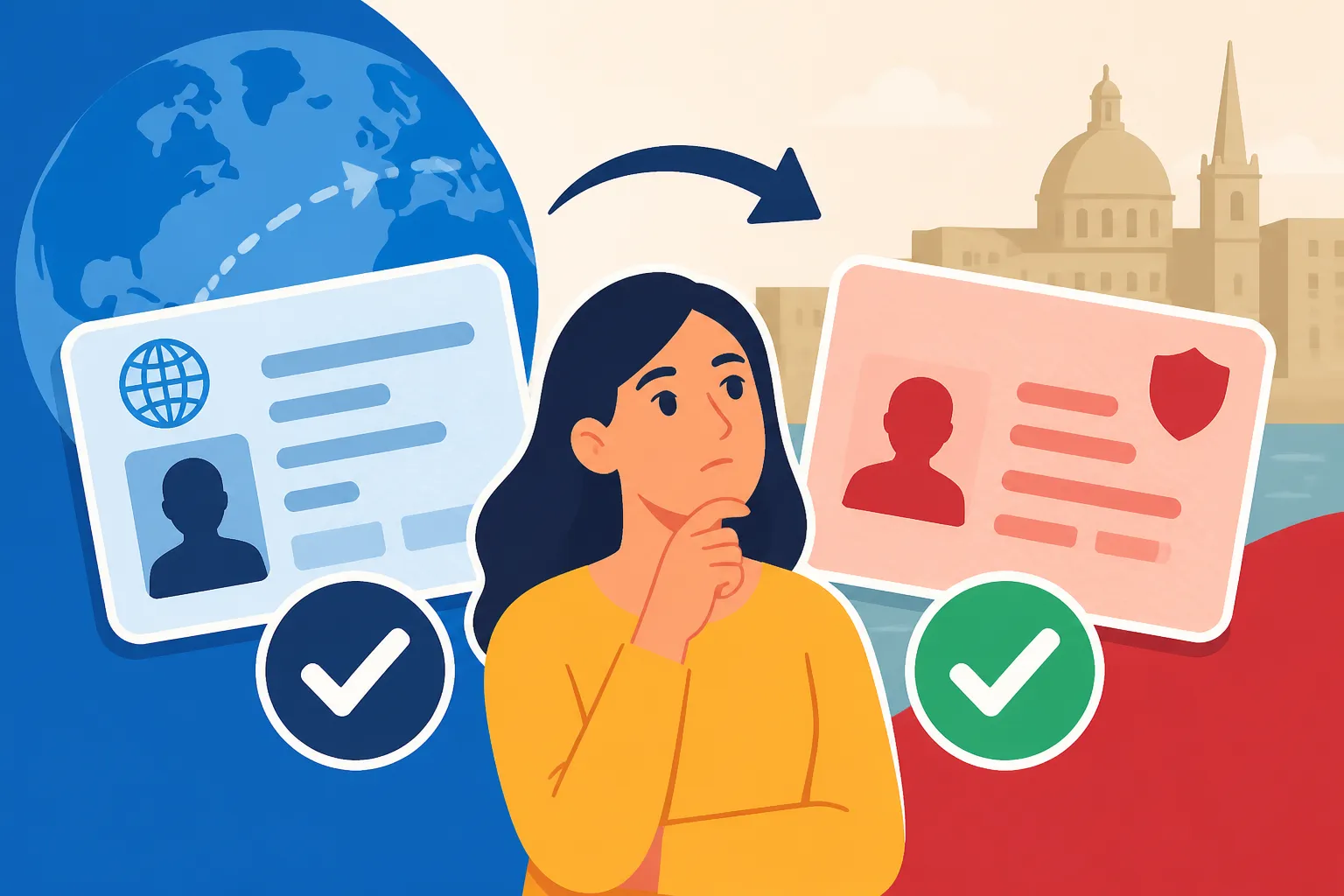
Before your eResidence card arrives, your primary and most robust forms of identification remain your passport (for non-EU nationals) or your national ID card (for EU nationals). These are internationally recognised documents, and their legitimacy is rarely questioned. Think of them as your bedrock ID while you're navigating the initial stages of your life here.
For non-EU citizens, your passport is your travel document and your ultimate proof of identity and nationality. It’s what allowed you to enter Malta in the first place, often after securing a D-Visa (national long-stay visa). For EU citizens, your national ID card holds significant weight within the EU, allowing free movement and serving as official identification. While you might be itching to put your passport away in a safe, especially in a new country, it often remains your go-to for situations demanding high-level identification, especially before that Maltese ID card comes through.
Navigating Malta with Your Foreign ID: What's Accepted
So, you’re in Malta, you’ve applied for your eResidence card, and you’re carrying your trusty foreign passport or national ID. The big question is: where can you actually use it, and where will you run into hurdles? The answer, as with many things administrative in Malta, is a bit of a mixed bag, depending on the context.
Everyday Transactions and Services
For the most part, you’ll find that your foreign ID, particularly your passport, is widely accepted for everyday transactions.
- Shopping and Restaurants: Generally, if you’re just buying groceries, grabbing a coffee, or paying for dinner, you won’t be asked for ID unless you’re purchasing age-restricted items like alcohol or tobacco, or making a high-value purchase on a credit card that requires verification. Your foreign passport or national ID will be perfectly fine here.
- Mobile Phone Contracts: Setting up a mobile phone plan is usually straightforward. Providers like GO or Epic will accept your passport or national ID. Sometimes, they might ask for proof of address, but for a pay-as-you-go SIM, usually just your ID is enough. It's a great way to stay connected, and if you're looking for an immediate solution for data without the hassle of a local contract right away, services like Airalo offer eSIMs that work instantly on arrival, giving you peace of mind while you sort out local options.
- Public Transport: Once you apply for your Tallinja card, you'll need your ID. However, for initial journeys, buying a single ticket or using contactless payment doesn't require ID. If you're using the free public transport scheme for residents, you absolutely need your Maltese eResidence card with its associated ID number. Before you get that, you'll be paying standard fares.
- Medical Appointments: This is where things get a bit more nuanced. If you're an EU citizen, your EHIC (European Health Insurance Card) is your lifeline for necessary medical care while you're settling in or waiting for your entitlement. You'll present your EHIC along with your national ID or passport. Non-EU citizens, especially those required to have private health insurance for their permit, will rely on their passport and insurance details. You can sometimes see a doctor in Malta before your health entitlement is approved, but usually, it won't be free public care. For accessing public health centres or specialists via the public system, having your Maltese ID card number, which confirms your social security contributions and entitlement, is pretty much essential. Our guide on Can I See a Doctor in Malta Before My Health Entitlement Is Approved? delves into this further.
Administrative Tasks and Official Dealings
This is where the distinction between a foreign ID and your pending Maltese eResidence card becomes critical.
- Opening a Bank Account: This is often one of the biggest headaches for new arrivals. Maltese banks (like BOV, HSBC, APS) are notoriously strict due to anti-money laundering regulations. While your passport is essential, it's often not enough on its own. They almost always require proof of Maltese residence (utility bill, rental contract registered with the Housing Authority) and, crucially, your Maltese ID card number or at least proof of application for it, sometimes even the actual eResidence card itself. Many expats find they need to jump through hoops. A full breakdown can be found in our guide on How to Open a Maltese Bank Account as a Newcomer.
- Registering Your Lease Agreement: When you rent a property, your landlord is legally obliged to register the lease agreement with the Housing Authority. For non-EU nationals, this registration, along with your passport and the application receipt from Identità, is often needed for the "lease agreement attestation," a requirement for your residence permit. For EU citizens, a registered lease helps prove your residency. Your foreign ID is foundational for this, but it's part of a larger package of documents.
- Jobsplus Registration: If you’ve arrived for work, you’ll need to register with Jobsplus. Your passport will be necessary, but your Single Permit application (which leads to your eResidence card) is the real key here. Jobsplus needs to confirm your right to work, which is tied to your permit status.
- Tax Identification Number (TIN): To get your Maltese TIN, which you'll need for employment and other financial matters, you'll provide your passport and proof of residence. While you might not have your eResidence card yet, your application receipt and rental contract can often suffice. Learn more in Getting Your Maltese Tax Identification Number (TIN).
- Setting Up Utilities (ARMS): Registering for electricity and water with ARMS and Enemalta can be a bit of a challenge without your Maltese eResidence card number. While your passport proves your identity, you need to prove residency to get the residential tariff, which is significantly cheaper than the commercial rate. They generally require the registered lease agreement and your eResidence card number. If you don't have this, you might be stuck on the higher tariff for a while, leading to those famously high utility bills. Our guide on Setting Up Electricity and Water with ARMS and Enemalta in Malta offers more details.
Travel Within and Outside the Schengen Area
This is a critical point. Your foreign passport or national ID is still your travel document.
- Within the Schengen Area: If you’re an EU citizen, your national ID card is sufficient for travel to other Schengen countries. If you’re a non-EU citizen, your passport is what you’ll use. While your Maltese eResidence card will also serve as a travel document within Schengen, until you have it, your passport is paramount. Always carry it if you plan to travel internationally, even for a short hop to Sicily.
- Outside the Schengen Area: For any travel beyond the Schengen zone, your passport is absolutely indispensable, regardless of whether you have your Maltese eResidence card. That little plastic card isn't accepted for non-Schengen border crossings as it's not typically a standalone international travel document.
Potential Pitfalls and Best Practices While You Wait
The interim period, while you're waiting for your official Maltese eResidence card, can be a time of uncertainty and minor frustrations. It's best to be prepared for these common challenges and adopt some strategies to smooth your transition.
Common Frustrations and Limitations
The biggest hurdle you'll likely face is the inability to open a full-service Maltese bank account or to convert your utilities to the residential tariff. Many newcomers get stuck paying inflated "non-residential" rates for electricity and water because they don't yet have the eResidence card number needed to prove official residency. This is a common and legitimate source of annoyance for expats. While your foreign passport proves who you are, it doesn't confirm your legal residency status in Malta for the purpose of these local services.
Another area where you might hit a wall is accessing free public healthcare. While emergency care is generally available, for routine GP visits at a health centre or referrals to specialists through the public system, your Maltese ID card number, linked to your social security contributions, is usually required to confirm your entitlement. Without it, you might need to opt for private care, which comes with out-of-pocket costs.
You might also find difficulties with certain rental processes, beyond just the initial lease signing. If you need to make changes to your lease, or if your landlord needs to prove your residency for some reason, the lack of an official Maltese ID might slow things down.
Strategies to Mitigate Issues
To make this waiting period as smooth as possible, here are a few best practices:
- Always Carry Your Passport/National ID: Treat your foreign passport or national ID like gold. It’s your most important document. While you might not need it for every single interaction, it's wise to have it on you (or a high-quality photocopy/digital image if you prefer not to carry the original everywhere) for any unexpected situation where identification is requested.
- Keep Your Identità Application Receipt Handy: This document proves you are in the process of regularising your stay. While not an ID, it can be useful in administrative contexts, especially if questioned about your legal status in Malta. It shows you’re not just a tourist overstaying your welcome.
- Consider Digital Banking Alternatives: While waiting to open a traditional Maltese bank account, many expats rely on digital banks like Revolut or Wise. These can be set up relatively quickly with your foreign ID and proof of address from your home country, or even a temporary Maltese address if accepted. They allow you to manage funds, pay bills, and make payments while you wait for local banking options to become available. However, be mindful that these often don't provide a Maltese IBAN, which can be a requirement for some local payments or direct debits.
- Prioritise Your eResidence Card Application: As soon as you are eligible and have all the necessary documents, apply for your eResidence card. Don’t delay. The sooner you apply, the sooner that little plastic beacon of officialdom will be in your hand. Our guide on Getting Your Maltese eResidence Card and ID Number walks you through the steps.
- Communicate with Employers/Landlords: Be transparent with your employer and landlord about the status of your ID card application. They are often familiar with the process and may be able to advise or offer temporary solutions. For example, your employer might accept your passport and application receipt for initial payroll setup before your Maltese tax number is fully processed.
- Use Relocation Services: If the administrative burden feels overwhelming, especially when managing documentation from a different country, consider a relocation service. Companies like Sirelo can provide invaluable assistance, helping you navigate the paperwork for moving countries, including advice on necessary documents for your initial arrival and the subsequent ID card application. Their expertise can save you a lot of stress.
Making Life Easier: Tips for Your Transition
Life in Malta is wonderful, but the initial settlement period can be tough. Beyond the immediate ID card issue, there are other aspects of transitioning that, if managed proactively, can really smooth things out.
Staying Connected and Organised
Beyond the immediate need for a physical ID, staying connected and organised is paramount during your first few weeks or months. Imagine needing to contact Identità about your application, or your landlord about a flat issue, but your phone isn’t working, or you can’t look up crucial information. That’s a headache you don’t need.
- Reliable Mobile Data: Before your Maltese SIM card is fully functional or you've decided on a local provider, having an eSIM from a service like Airalo can be a lifesaver. You can activate it before you even land, ensuring you have data for maps, messaging, and urgent calls right from the moment you step off the plane. This removes the immediate pressure of finding a mobile shop and going through the initial setup with your foreign ID.
- Digital Copies of Documents: Scan and securely store digital copies of all your important documents – passport, national ID, birth certificate, marriage certificate, degree certificates, and especially your Identità application receipt. Keep them in a cloud service (like Google Drive, Dropbox, or a secure encrypted storage) that you can access from your phone or laptop. This way, if you’re asked for a copy, you don’t have to rush home, and if an original is lost or stolen, you have backups.
- Physical Folder for Originals: While digital is great, have a well-organised physical folder for your original documents. You'll need these for official appointments, and having them neatly arranged will save you immense stress.
What to Do in Case of Loss or Theft
Losing your passport or national ID in a foreign country, especially when you're already waiting for a new ID, is a nightmare scenario. However, knowing what to do can significantly reduce the panic.
- Report Immediately: If your foreign ID is lost or stolen, report it to the local police immediately. You’ll need a police report for your embassy and for Identità.
- Contact Your Embassy: Your next step is to contact your country’s embassy or consulate in Malta. They can assist you in getting a replacement passport or emergency travel document. This is often the only path to legally identify yourself again for travel or official purposes until your Maltese eResidence card arrives.
- Inform Identità: If you have an ongoing eResidence application, inform Identità of the loss or theft, especially if your passport number was linked to your application. This might cause some delays, but it's crucial for record-keeping.
Long-Term Planning and Document Management
As you settle into Malta, document management becomes an ongoing task. It's not just about the initial ID card; it's about renewals, updates, and ensuring everything remains current.
- Renewing Your Permit: Don't wait until the last minute to renew your Maltese residence permit. Start the process well in advance, as processing times can be lengthy. Our article on Renewing Your Maltese Residence Permit Before It Expires can provide detailed guidance.
- Updating Information: If you change address or your circumstances change (e.g., job, marital status), remember to update Identità. This ensures your records are accurate and can prevent issues down the line.
- Leveraging Relocation Expertise: Sometimes, the sheer volume of administrative tasks can feel overwhelming, from understanding legal requirements to finding reliable services. This is where comprehensive relocation platforms like Sirelo come into their own. They offer guides, resources, and even connections to moving companies, making the transition significantly smoother. From finding a moving company that delivers to Malta to understanding the nuances of customs, having such a resource can be a real game-changer for international movers.
Ultimately, while the waiting period for your Maltese eResidence card can be a bit challenging, with your foreign passport or national ID, you are generally well-equipped for most situations. By understanding the limitations, being proactive, and staying organised, you can navigate this administrative limbo with confidence and enjoy your new life in Malta.
Disclaimer
The information provided in this article is intended for general guidance and informational purposes only, and does not constitute legal, financial, or immigration advice. While we strive to provide accurate and up-to-date information, rules and regulations in Malta can change rapidly. Always consult with official government sources (such as Identità, Jobsplus, Housing Authority, or relevant ministries), and if necessary, seek professional advice from a qualified lawyer, accountant, or immigration consultant for your specific situation. Reliance on any information provided in this article is solely at your own risk.