Can I Be Employed and Self-Employed at the Same Time in Malta?
Many expats moving to the sunny shores of the Mediterranean find that a single salary, even in a thriving sector like iGaming or Fintech, doesn't always cover the high costs of lifestyle in Sliema or St. Julian’s. You might have a stable 9-to-5 but find yourself wanting to pick up freelance design work, teach a language online, or launch a small consultancy on the side. This guide explains how you can legally navigate being both an employee and self-employed in Malta simultaneously.
Understanding the Legal Landscape of Dual Status in Malta
In the local administrative vernacular, being both employed and self-employed is often referred to as having a "secondary" activity. It is a perfectly legal setup, provided you follow the registration dance required by Jobsplus and the Commissioner for Revenue (CFR). Many newcomers assume that their primary employment license or residency permit covers all forms of work, but Malta’s system is quite compartmentalized. Each "stream" of income needs its own paper trail.
The Role of Jobsplus in Your Side Hustle
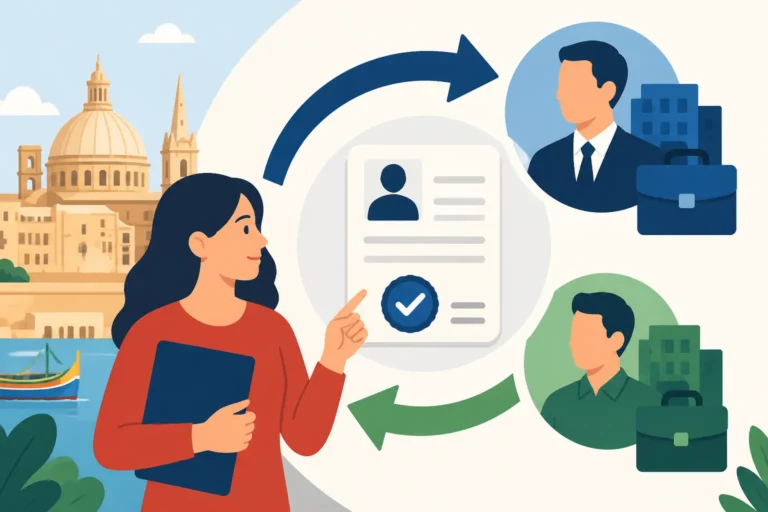
Jobsplus is the government entity responsible for monitoring the labor market. When you are hired by a Maltese company, your employer submits an engagement form. To start a side business, you must submit your own engagement form as a self-employed person. In this scenario, your full-time job remains your "Primary" employment, and your freelance work is registered as "Secondary."
Maintaining this distinction is crucial because it dictates how your social security is calculated. If you fail to register the secondary activity, you aren't just "working off the books"; you are technically in breach of your employment conditions, which can be a massive headache if you are here on a work permit. For those looking at the long-term, Self-Employment in Malta: Registering a Business and Going Freelance is often the natural evolution of this dual-status journey.
Navigating the CFR and Tax Identification
Once Jobsplus knows you are working, the taxman wants to know too. Even if you already have a Tax Identification Number (TIN) through your employer, you need to inform the Commissioner for Revenue of your new self-employed status. This involves choosing a NACE code (an industry classification) for your business.
For many expats, especially those from the US or UK, the complexity of managing two income streams while living abroad is where things get tricky. Using a service like Taxes for Expats can be a lifesaver here, as they specialize in the intersection of Maltese tax obligations and your home country’s reporting requirements. They ensure that while you are focusing on your Maltese side-hustle, you aren't accidentally creating a massive tax liability back home.
Social Security and Taxation for the Multi-Tasking Expat
One of the most common questions I get from fellow expats is: "Do I have to pay social security twice?" The short answer is no, but the way it’s structured is specific to your total hours and income. In Malta, social security is divided into Class 1 (for employees) and Class 2 (for the self-employed).
Class 1 vs Class 2 Contributions
When you are employed, your employer deducts your 10% contribution directly from your paycheck. This is part of the Social Security Contributions in Malta: Classes, Rates, and Benefits system that funds the local healthcare and pension schemes. If you are already working full-time (40 hours a week), you are generally covered. You do not typically pay a second round of social security on your part-time self-employed income, provided that income doesn't become your primary source of sustenance.
However, the rules change if your "side hustle" starts to out-earn your 9-to-5. If you find yourself in a position where your freelance work is your main focus, you might need to switch to Class 2. It is vital to understand What Your Maltese Social Security Contributions Pay For to ensure you aren't missing out on benefits or overpaying into a system where you've already hit the cap.
The 15% Part-Time Tax Rate
Malta offers a very attractive incentive for people working secondary jobs: the 15% part-time tax rate. If you are employed full-time elsewhere, you can elect to pay a flat 15% tax on your first €12,000 of self-employed profit. This is often much lower than the progressive tax brackets you might fall into otherwise.
To benefit from this, you must use a specific form (TA22) when filing your year-end paperwork. This allows you to keep your side-hustle earnings separate from your main salary. If you’re teaching English or a foreign language on a platform like iTalki in your spare time, this 15% rate makes the extra hours much more rewarding. Without this registration, that extra income would be added to your main salary and could be taxed at 25% or even 35%, depending on your total earnings.
| Feature | Primary Employment (Class 1) | Secondary Self-Employment (Class 2/Part-time) |
|---|---|---|
| Registration | Employer-led via Jobsplus | Self-led via Jobsplus & CFR |
| Social Security | 10% deducted from salary | Often exempt if full-time employed |
| Tax Rate | Progressive (0% – 35%) | Option for flat 15% up to €12,000 |
| Reporting | FS3 form from employer | TA22 and self-assessment forms |
| Payment | Deducted at source (FSS) | Paid via provisional tax or year-end |
Immigration and Permit Constraints for Non-EU Nationals
If you are an EU citizen, the process is relatively straightforward. You have the right to work, live, and start businesses with minimal friction. However, for Third-Country Nationals (TCNs), the road is paved with significantly more red tape. If you are here on a Single Permit, you are tied to a specific employer for a specific role.
The Single Permit Side-Hustle Nightmare
For TCNs, your residency is usually contingent on your employment with a specific company. If you want to start a side-hustle, you cannot simply start invoicing clients. Doing so would violate the terms of The Single Permit in Malta: Combined Work and Residence, Step by Step. To legally be self-employed on the side, you would technically need a secondary work permit, which is notoriously difficult to obtain for a part-time activity.
The government's logic is that a permit was granted because a local or EU citizen couldn't fill that specific role. Proving that you are the only person who can do "part-time freelance graphic design" while already working as a "full-time software engineer" is an uphill battle. Most TCNs find that they have to wait until they qualify for long-term residence before they can explore the dual-status route.
Exceptions and The Nomad Residence Permit
There are slight variations if you are in Malta on a Nomad Residence Permit. Nomads are allowed to work for foreign employers or their own foreign-registered companies. However, if a Nomad wants to start taking on local Maltese clients or get a part-time job at a local Maltese cafe, they would typically need to switch their permit type. The systems are not designed to overlap easily. If you are trying to navigate this, Registering as Self-Employed with Jobsplus and the CFR in Malta is a process you must follow only if your permit allows for local economic activity.
Practical Steps to Maintaining Dual Status
Once you have the green light from a permit perspective and you’ve registered with Jobsplus, the day-to-day management of your dual status requires a bit of discipline. You are effectively living two financial lives: one as an employee and one as a business owner.
Invoicing, VAT, and Bookkeeping
Even for a small side hustle, you must issue proper fiscal receipts or invoices. In Malta, this often means registering for a VAT number. Most part-time freelancers fall under "Article 11," which is for small businesses that don't need to charge VAT to their customers because their turnover is below a certain threshold (usually €30,000). You still get a VAT number, but it is an "exempt" status.
If you are using iTalki to supplement your income, your "clients" are often overseas, which adds a layer of complexity to your VAT reporting. Keeping your invoices organized is essential for when you have to tackle Filing Your Maltese Tax Return: The CFR, FS3, and TA22/TA24. Remember, your employer will provide an FS3 at the end of the year, but for your self-employed work, you are the one responsible for the "Profit and Loss" statement.
Managing Your Time and Employer Expectations
Before you dive into the dual-status world, check your primary employment contract. Many Maltese contracts, especially in professional services or iGaming, include "non-compete" or "exclusivity of service" clauses. These clauses might prevent you from doing any other work, even in your own time, without written permission from your boss.
In a small island like Malta, word travels fast. If you are registered with Jobsplus as a part-time freelancer in the same niche as your 9-to-5, your employer will eventually find out. It’s usually better to be transparent. Explain that you are doing something that doesn't conflict with your main duties. For instance, if you work in HR but want to spend your weekends teaching English, most employers won't mind. If you are a developer for one betting company and start freelancing for another, expect a very short conversation with your manager.
Dealing with the Administrative Burden
Don't underestimate the "hidden" time cost of being dual-status. You'll need to stay on top of your How Do I Get a Tax Number (TIN) in Malta? requirements and ensure you’re not falling behind on provisional tax payments if your side-hustle grows. It’s easy to get excited about the extra cash, but if you haven't set aside 15% for the taxman and perhaps a bit more for your own private pension or emergency fund, you could be in for a shock come June when tax settlements are due.
The Maltese system is surprisingly robust once you’re in it, but getting the initial settings right is where most expats stumble. You have to be proactive. The departments won't talk to each other to "fix" your status automatically. You have to tell Jobsplus, who tells the CFR, who then updates your tax profile. If you get a pay rise at your main job, check if it affects your Minimum Wage, the COLA, and Pay in Malta standing, as this can sometimes shift the thresholds for your part-time tax eligibility.
Is Dual Status Right for You?
Choosing to be both an employee and self-employed is a great way to test the waters of entrepreneurship without losing the safety net of a monthly paycheck and paid health insurance. Malta’s 15% tax rate is a genuine "gift" from the government to encourage people to be productive.
However, if you value your weekends and hate paperwork, the extra €200 or €500 a month might not feel worth the hours of invoicing and the stress of tax deadlines. For those with a clear vision—perhaps an expat who wants to eventually transition fully into their own business—starting as dual-status is the smartest move you can make. It allows you to build a client base while your primary employer pays for your Understanding the FSS (Final Settlement System) on Your Payslip contributions and keeps your residency card valid.
Disclaimer
The information provided in this guide is for educational and informational purposes only. While every effort has been made to ensure accuracy, Maltese tax laws, employment regulations, and immigration policies are subject to frequent changes. This guide does not constitute legal, financial, or professional tax advice. We strongly recommend consulting with a qualified Maltese accountant or a specialized immigration lawyer before making any decisions regarding your employment or self-employment status in Malta, especially if you are a non-EU national.