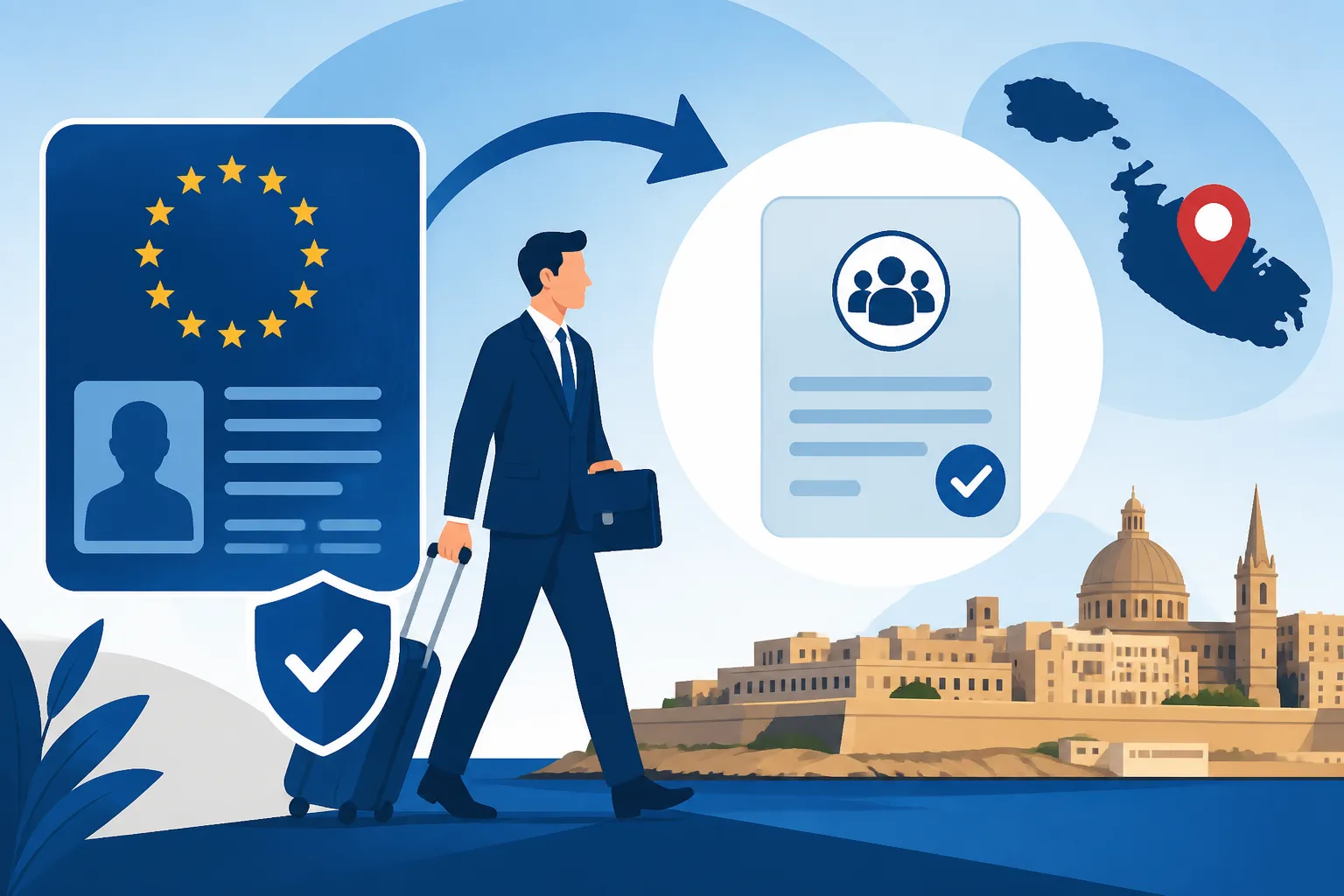
The EU Blue Card and Intra-Corporate Transfer Permits in Malta
Navigating the labyrinthine world of immigration and work permits in a new country can feel like a Herculean task, especially for highly skilled professionals from outside the EU/EEA who dream of contributing their talents to Malta's thriving economy. Many find themselves overwhelmed by the sheer volume of information and the specific requirements for long-term stays. This guide aims to demystify two critical pathways for such individuals: the EU Blue Card and the Intra-Corporate Transfer (ICT) Permit, laying out the intricacies of each to help you determine the best route for your move to the islands.
Understanding Malta's Approach to Highly Skilled Workers
Malta, despite its small size, has become a dynamic hub for various industries, from iGaming and fintech to pharmaceuticals and maritime services. This growth has created a significant demand for specialized skills, prompting the government to implement schemes to attract and retain top-tier international talent. However, simply having a sought-after skill isn't always enough; understanding the specific immigration pathways is crucial.
Why Malta is Attracting Global Talent
Malta's economy has been consistently growing, driven by sectors that often require highly specialized knowledge and experience not always readily available within the local workforce. The island offers a compelling mix of career opportunities, a Mediterranean lifestyle, and a relatively low cost of living compared to other European capitals, making it an attractive prospect for professionals seeking a change. Companies here are actively looking to diversify their teams and bring in diverse perspectives, leading to an open, albeit regulated, approach to foreign talent. This demand ensures that professionals holding permits like the EU Blue Card or an ICT permit often find themselves in rewarding roles within a vibrant international community.
The Challenge for Non-EU Professionals
For those coming from outside the European Union or European Economic Area, the path to working in Malta is different from their EU counterparts. EU/EEA citizens enjoy the freedom of movement and generally only need to register their residence, as outlined in guides like eResidence for EU/EEA and Swiss Nationals in Malta. Non-EU nationals, however, must secure a specific work and residence permit before they can begin employment. This often starts with a single permit application, but for certain roles, more specialised routes like the EU Blue Card or an ICT permit offer distinct advantages. The process can sometimes feel like an endless loop of documents and waiting, a common frustration for newcomers, but with the right guidance, it's entirely manageable. The key is to demonstrate that your skills are genuinely needed and that you meet the stringent criteria set out for these specialized permits.
The EU Blue Card in Malta: A Gateway for High-Flyers
The EU Blue Card is a Europe-wide residence and work permit for highly qualified non-EU citizens. It’s designed to make Europe, including Malta, more attractive to skilled workers from around the globe, aiming to streamline the process for those in demand. While it shares similarities with Malta's general single permit scheme, it offers additional benefits and greater mobility within the EU.
Eligibility Criteria: Do You Qualify?
To qualify for an EU Blue Card in Malta, you need to tick several boxes, primarily demonstrating a high level of professional qualification and a concrete job offer. Firstly, you must have a valid work contract or a binding job offer for highly qualified employment with a duration of at least one year. The salary specified in this contract must be at least 1.5 times the average gross annual salary in Malta for the particular profession concerned. This isn't a fixed number across the board but is determined by Jobsplus, Malta's public employment service, based on specific industry averages. So, a software engineer's threshold might differ from a financial analyst's.
Secondly, you need to demonstrate that you possess the necessary higher professional qualifications. This usually means a university degree requiring at least three years of study, or, in certain regulated professions, at least five years of relevant professional experience. It's not enough to just say you have the skills; you need to provide certified copies of your diplomas, academic transcripts, and professional references. For some, getting these documents verified can be an extra hurdle, often involving recognition of foreign qualifications through agencies like MQRIC (Malta Qualifications Recognition Information Centre), adding another layer to the process that can take time. Without these specific qualifications and the salary threshold, the Blue Card simply isn't an option.
The Application Process: Navigating the Bureaucracy
Applying for an EU Blue Card in Malta involves a multi-step process, largely handled by Identità (formerly Identity Malta Agency) and Jobsplus. The journey typically begins with your prospective employer, who must apply for a Labour Market Consideration (LMC) to prove that no suitable candidate could be found locally or within the EU/EEA. This can sometimes be the longest part of the waiting game, as Jobsplus assesses the labour market needs. Once the LMC is approved, your employer then submits the official application for the EU Blue Card on your behalf to Identità.
The application package is extensive, requiring not only your employment contract and qualification proofs but also a copy of your passport, a police conduct certificate from your home country, and evidence of suitable accommodation in Malta. It's a paper trail that can feel never-ending! The processing times can vary, often ranging from a few weeks to several months, and it’s not uncommon to be asked for additional documents mid-process. Remaining patient and meticulous with your documentation is paramount. Once approved, you’ll be invited for biometric data collection (fingerprints and photo) and eventually receive your eResidence card, which is your physical proof of residence and work entitlement. This card is truly your key to unlocking various services, from opening a bank account to accessing public healthcare, as outlined in Getting Your Maltese ID Card Number: The Key to Accessing Healthcare.
Benefits and Freedoms of the Blue Card
The EU Blue Card isn't just another work permit; it comes with a range of benefits designed to make life easier for highly skilled migrants. Perhaps one of the most significant advantages is enhanced mobility. After 12-18 months of legal residence in Malta, EU Blue Card holders and their families can move to another EU member state (that also issues Blue Cards) for highly qualified employment under simplified procedures, usually without having to go through a whole new, lengthy visa process. This intra-EU mobility is a game-changer for many professionals who might envision a broader European career path.
Furthermore, family reunification is significantly smoother for Blue Card holders. Your spouse and dependent children are generally entitled to join you in Malta from the outset, without having to wait for a minimum period of residency, which is often a requirement for other permit types. This ensures that families can stay together, easing the transition into a new country. The process for bringing your family is detailed in Family Reunification in Malta: Bringing Your Loved Ones. Additionally, Blue Card holders often have equal treatment with nationals regarding working conditions, access to education, and recognition of qualifications. While Malta's public healthcare system is generally available to those contributing social security, the Blue Card streamlines access to these benefits.
Intra-Corporate Transfer (ICT) Permits: Moving with Your Company to Malta
Distinct from the EU Blue Card, the Intra-Corporate Transfer (ICT) permit is specifically designed for non-EU/EEA nationals who are transferred by their multinational company from a branch outside the EU to a branch within Malta. It's a pathway for existing employees, not for those seeking new employment with a Maltese company.
Who is the ICT Permit For?
The ICT permit caters to a very specific group of professionals: managers, specialists, and trainee employees who have been working for a company outside the EU/EEA and are now being temporarily assigned to a group entity (e.g., a subsidiary, branch, or head office) in Malta. This isn't about finding a new job in Malta; it's about continuing your existing role or taking on a new, related role within the same corporate group, but in a different geographical location. The transfer must be temporary, usually for a maximum duration of three years for managers and specialists, and one year for trainee employees.
This permit is perfect for large international corporations that need to move talent around their global offices, ensuring continuity in projects and skill transfer. If your company has a presence in Malta and you're being asked to relocate there from, say, their Dubai or Singapore office, then the ICT permit is likely your most appropriate route. It acknowledges that these individuals are already established within their company and are merely changing their work location rather than entering the European job market anew.
Requirements for the Transferring Employee and Company
The requirements for an ICT permit involve both the employee being transferred and the host company in Malta. For the employee, you must provide proof that you've been employed by the transferring company for a continuous period of at least three to twelve months immediately preceding the transfer, depending on your role (manager, specialist, or trainee). You'll also need to show your professional qualifications and experience, demonstrating that you fit the definition of a manager, specialist, or trainee. A valid travel document (passport) and proof of health insurance (covering your stay) are also standard requirements.
The host entity in Malta plays a crucial role too. They must demonstrate that they belong to the same group of undertakings as the transferring company and provide a comprehensive transfer plan. This plan details the duration of the transfer, the location of the host entity, the position the employee will hold, and the remuneration package. Unlike the EU Blue Card, there isn't a specific salary threshold tied to average national wages, but the remuneration must be in line with Maltese labour laws and comparable to what local employees in similar positions would receive. The administrative burden on the company can be significant, but for well-established multinationals, it's a routine part of global talent management.
The ICT Application Journey
The application for an Intra-Corporate Transfer permit is also submitted to Identità, usually by the host company in Malta on behalf of the employee. Similar to the Blue Card, a substantial amount of documentation is required, including the inter-company transfer letter, proof of the corporate relationship between the entities, the employee's existing employment contract, and their qualifications. It’s vital to ensure all documents are accurately translated into English and certified where necessary.
Processing times for ICT permits can also vary, but generally fall within a similar timeframe to other complex residence and work permits. You should anticipate a waiting period and plan your relocation accordingly. Once the permit is approved, the employee will attend an appointment for biometrics and will then be issued with an eResidence card specific to the ICT status. This card grants both residence and work authorization, allowing you to live and work legally in Malta for the duration of your transfer. It's a streamlined process compared to applying for a completely new job in a foreign country, recognizing the existing employment relationship.
Comparing the EU Blue Card and ICT Permit
While both the EU Blue Card and the Intra-Corporate Transfer permit facilitate highly skilled non-EU professionals working in Malta, they serve different purposes and come with distinct characteristics. Understanding these differences is key to choosing the right pathway.
Key Differences and When to Choose Which
The fundamental difference lies in the applicant's employment situation. The EU Blue Card is for those who have secured a job offer directly from a Maltese employer or who are actively seeking highly skilled employment in Malta. It's about attracting new talent to the Maltese and European labour markets. The ICT Permit, conversely, is for existing employees of a multinational company who are being transferred within the same corporate group to a Maltese entity. It’s not for new hires in Malta but for internal company mobility.
Here’s a breakdown of their main distinctions:
| Feature | EU Blue Card | Intra-Corporate Transfer (ICT) Permit |
|---|---|---|
| Purpose | Attract highly qualified non-EU talent to the EU. | Facilitate temporary transfers within a multinational group. |
| Employment | New job offer from a Maltese employer. | Existing employee transferred within the same company group. |
| Salary Req. | At least 1.5x average gross annual salary for the profession in Malta. | Must be in line with Maltese labour laws and local comparable salaries. |
| Qualifications | University degree (3+ years) or 5+ years relevant experience in regulated professions. | Manager, Specialist, or Trainee with specific prior employment within the group. |
| Duration | Typically 1-4 years, renewable. | Max 3 years for managers/specialists, 1 year for trainees (non-renewable beyond max). |
| Mobility | Enhanced EU mobility after 12-18 months. | Mobility limited to the specific transfer, no enhanced EU mobility outside of ICT rules. |
| Family Reuni. | Simplified, often immediate. | Simplified, often immediate. |
| Labour Market Test | Required (LMC from Jobsplus). | Generally not required as it's an internal transfer. |
If you're a highly qualified individual who has secured a fantastic job offer with a Maltese company, or you're actively searching for such a role, the EU Blue Card is your probable path. However, if your company is sending you to Malta as part of an internal relocation, and you've been with them for a sufficient period, the ICT permit is the correct and often more direct route for you. Choosing the wrong permit type can lead to unnecessary delays and even refusal, so it's critical to identify your situation accurately.
Family Reunification under Both Schemes
Both the EU Blue Card and the ICT permit offer relatively smooth pathways for family reunification, which is a significant relief for many expats. Under both schemes, your immediate family members – typically your spouse and dependent children – are generally entitled to join you in Malta without having to wait for a minimum period of residency that is sometimes imposed on other types of permits. This is a huge advantage, as waiting months or even years to bring your loved ones can be one of the toughest aspects of moving abroad.
For EU Blue Card holders, this means your family can often apply for their residence permits at the same time as yours or very shortly thereafter. The same applies to ICT permit holders. The requirements for family members will typically include proof of relationship (marriage certificates, birth certificates), copies of their passports, and sometimes proof of sufficient funds and adequate accommodation in Malta to support them. While the application for each family member still involves paperwork and processing by Identità, the underlying entitlement to join you is usually clearer and more expedited than with general work permits. This allows for a more cohesive transition into your new life in Malta.
Life in Malta with a Blue Card or ICT Permit
Securing your permit is just the first step. Truly settling into Malta involves understanding the local workplace culture, managing your finances, and embracing the vibrant island lifestyle.
Integrating into the Maltese Workplace
The Maltese workplace is generally quite English-speaking, especially in international companies and sectors like iGaming, finance, and tech. This is a huge relief for many expats who worry about language barriers. However, while English is widely spoken, particularly in business contexts, you'll still encounter the unique nuances of Maltese communication and work culture. Hierarchy can be more pronounced than in some Western European countries, and personal relationships often play a significant role in professional interactions. Punctuality is valued, but meetings might not always run strictly to schedule, reflecting a slightly more relaxed Mediterranean pace.
Networking is important, and many companies have diverse teams, so you'll find yourself working alongside people from all over the world. It’s common for workplaces to have a friendly, almost family-like atmosphere, especially in smaller firms. Getting involved in team events and social gatherings can really help you integrate. While not mandatory for most jobs, picking up some basic Maltese phrases can go a long way in showing respect and building rapport with local colleagues. If you're keen to learn, platforms like iTalki can connect you with Maltese tutors, making it much easier to pick up the basics from the comfort of your home.
Tax Implications and Financial Planning
Once you're earning an income in Malta, understanding your tax obligations is paramount. Malta operates a progressive income tax system, meaning the more you earn, the higher percentage you pay, up to a certain point. As a resident, you'll generally be subject to Maltese tax on your worldwide income if you are domiciled in Malta, or on income arising in Malta and income remitted to Malta if you are not domiciled but resident here. The distinction between tax residence and domicile can be complex, and it’s a good idea to seek professional advice, especially if you have foreign assets or income. Our guide, The Maltese Tax System Explained: Residence, Domicile, and Remittance, delves into this in detail.
Your employer will typically deduct income tax and social security contributions at source through the FSS (Final Settlement System). You'll also need to ensure you apply for your Maltese Tax Identification Number (TIN) soon after arrival. Many expats find it useful to consult with specialists like Taxes for Expats to ensure they are compliant with both Maltese and their home country's tax laws, avoiding any nasty surprises down the line. Setting up a local bank account with institutions like BOV or HSBC is also one of the first financial steps you'll need to take after arriving.
Embracing Maltese Culture and Language
Malta offers a rich tapestry of culture, heavily influenced by its strategic location and long history. Integrating into this involves more than just working; it's about experiencing the local life, from village feasts (festas) to the bustling markets. The Maltese people are generally very welcoming, and the island has a strong sense of community. While English is an official language and widely used, especially in business and tourism, Maltese is the national language and a core part of the island's identity.
Learning even a few phrases in Maltese can significantly enhance your experience and help you connect with locals on a deeper level. Imagine ordering a coffee using "grazzi" (thank you) or "bongu" (good morning) – it makes a real difference! Resources like iTalki can provide one-on-one lessons with native speakers, making the learning process engaging and personalised. Beyond language, immerse yourself in the local cuisine, explore historical sites, and participate in local events. This not only enriches your personal life but also helps you build a strong support network outside of your immediate workplace.
Renewals, Long-Term Prospects, and What Comes Next
Your EU Blue Card or ICT permit isn't a permanent solution. Understanding the renewal process and potential pathways to long-term residency is crucial for anyone planning an extended stay in Malta.
Extending Your Stay and Path to Long-Term Residence
Both the EU Blue Card and ICT permits are issued for specific durations, which means you'll eventually need to consider renewal if you wish to continue living and working in Malta. For the EU Blue Card, renewals are generally possible as long as you continue to meet the original eligibility criteria, such as having a valid employment contract that meets the salary threshold. The application for renewal should be submitted well in advance of your current card's expiry, usually a few months prior, to avoid any gaps in your legal status.
For ICT permits, the maximum duration is typically three years for managers and specialists and one year for trainees. While extensions within these maximum limits are possible, once you reach the maximum, you would usually need to return to a non-EU country for a specific period before another ICT transfer could be considered, or explore other residence permit options if you wish to remain in Malta. The path to The Path to Long-Term and Permanent Residence in Malta is generally available after five continuous years of legal and ordinary residence in Malta. Periods spent on an EU Blue Card typically count towards this, offering a clear route for those planning a very long-term future on the islands. However, time spent on an ICT permit may have different implications for long-term residency calculations, so it's always best to verify with Identità as your situation evolves.
Switching Employment or Permit Types
Life happens, and sometimes your career path takes an unexpected turn. If you hold an EU Blue Card and wish to change employers in Malta, you are generally permitted to do so, but there are rules. For the first two years of your Blue Card validity, you usually need permission from Identità to change employers, which typically involves a new Labour Market Consideration for the new role. After two years, you have more flexibility and generally only need to notify Identità of the change. This provides a balance between ensuring labour market stability and offering flexibility to highly skilled workers.
Switching from an ICT permit to another permit type, especially if you wish to stay in Malta beyond your transfer's maximum duration or leave your current company, is a more complex process. An ICT permit is tied to your intra-company transfer, so if that transfer ends or you leave the company, your permit status would be affected. In such cases, you would likely need to apply for a different type of permit, such as a Single Permit if you secure new employment with a different Maltese company, or even the EU Blue Card if you meet its criteria. It’s crucial to initiate these processes well before your current permit expires to avoid any period of irregular stay, as navigating the full range of residence permits in Malta can be complex and is best understood by reviewing comprehensive guides like Residence Permits in Malta: Types, Requirements, and How to Apply.
Disclaimer
Please remember that immigration laws and procedures are subject to change. While every effort has been made to provide accurate and up-to-date information, this guide should be considered for general informational purposes only and does not constitute legal advice. Always consult with Identità or a qualified immigration lawyer in Malta for advice specific to your individual circumstances.