Do I Need Private Health Insurance for My Maltese Residence Permit?
The bureaucracy in Malta can feel like a labyrinth, especially when you are standing in a humid queue in Msida, clutching a folder of documents and wondering if your health insurance policy will actually be accepted. When I first moved here, I spent weeks second-guessing whether my international cover met the specific requirements of Identità. This guide solves that confusion by breaking down exactly who needs private health insurance for their Maltese residence permit and what those policies must include to avoid a rejection.
Understanding the Residence Permit and Health Insurance Nexus
The requirement for health insurance is not just a whim of the Maltese government; it is rooted in the principle that anyone residing in Malta should not become an "unreasonable burden" on the public healthcare system. Whether you are an EU citizen exercising your right to free movement or a non-EU citizen arriving for a specific job, the state wants to ensure that if you fall ill or have an accident, you have the financial means to cover your treatment without draining local resources.
When you submit your application for an eResidence card, the officers at Identità are looking for a specific set of criteria in your insurance certificate. This is often where the first-person frustration kicks in. You might have a premium policy from your home country, but if it doesn’t explicitly state that it covers "full inpatient and outpatient care in Malta," you might find yourself sent back to the end of the line. Understanding the nuance of these requirements is the first step to a successful application.
The Legal Basis for Health Cover Requirements
For EU, EEA, and Swiss nationals, the requirement usually stems from Directive 2004/38/EC. If you aren't working and paying Social Security Contributions and what they fund in Malta, you must prove you have "comprehensive" sickness insurance. This applies to students, the economically self-sufficient, and retirees. The Maltese authorities interpret "comprehensive" quite strictly, meaning it should cover almost everything a public health center would provide.
For Third Country Nationals (TCNs), the rules are even more stringent. Since you are often entering on a specific work or study visa, your residence permit is tied to your ability to support yourself. Even if you are an employee, there is often a gap between your arrival and the moment you are fully registered in the system. Private insurance acts as a bridge during this period, and for many permit types, it remains a mandatory requirement for the duration of your stay.
Why Identità is So Particular About Wording
Applications are often flagged when insurance documents are too vague. Identità needs to see that your policy is valid for Malta (or worldwide/Europe including Malta) and that it specifically covers hospitalization and day-care treatments. They are less concerned about your dental check-ups and more concerned about who pays the bill if you end up at Mater Dei Hospital after a moped accident.
If you are a remote worker, you might find that Why Do Nomad Residence Permit Holders Need Private Insurance in Malta? becomes a central theme of your transition. The nomad permit has its own set of rules, often requiring a policy that includes repatriation of remains and emergency evacuation. If your certificate doesn't mention these keywords, you can expect a polite but firm "no" at the service desk.
Who Exactly Needs Private Health Insurance in Malta
The short answer is: almost everyone at some point in their residency journey, but the type and duration of the cover vary significantly depending on your nationality and the "basis" of your stay. Malta categorizes residents into several buckets, and the insurance requirements are tailored to the perceived risk each group poses to the public health coffers.
Navigating these categories is often where the "I've been there" headache starts. I remember thinking that because I was paying taxes, I was automatically "safe" from needing private cover. That isn't always the case, especially during the initial application phase when you haven't yet received your Getting Your Maltese ID Card Number: The Key to Accessing Healthcare.
Non-EU Third Country Nationals TCNs
If you are moving to Malta from outside the EU for work, you will likely be applying for a Single Permit. This is a combined work and residence permit. Most TCNs are required to have private health insurance that covers them for the duration of their permit, or at least for the first year. Even though you will be paying social security from your first paycheck, the private policy is a mandatory attachment to your initial application.
This is where a flexible provider like SafetyWing can be incredibly useful. SafetyWing offers the kind of travel-medical hybrid cover that often satisfies the initial entry requirements for TCNs who need to show they are protected the moment they step off the plane. Because TCNs are often in a state of flux during their first few months, having a policy that can be managed digitally is a massive relief.
Nomad Residence Permit Holders
The Nomad Residence Permit has become incredibly popular in recent years, but it comes with a very specific insurance mandate. Since nomads are technically not employed by a Maltese company and are not paying local social security contributions in the traditional sense, they do not have access to the free public healthcare system. Therefore, a comprehensive private policy is a non-negotiable part of the permit.
For this group, SafetyWing is often the "Hero" solution. Their Nomad Insurance is specifically designed for people who live and work outside their home country and satisfies the Maltese requirement for international coverage that includes the necessary emergency and inpatient clauses. Many nomads have found that local Maltese insurers were too "old school" for their needs, making international digital-first options a much better fit.
EU EEA and Swiss Nationals
If you are an EU citizen moving to Malta to live on your savings (Economic Self-Sufficiency), you must prove you have health insurance. However, if you are moving to work for a Maltese company, your access to healthcare is generally covered by your social security contributions. In this case, you might only need a policy for the "gap" period while you wait for your eResidence document to be issued.
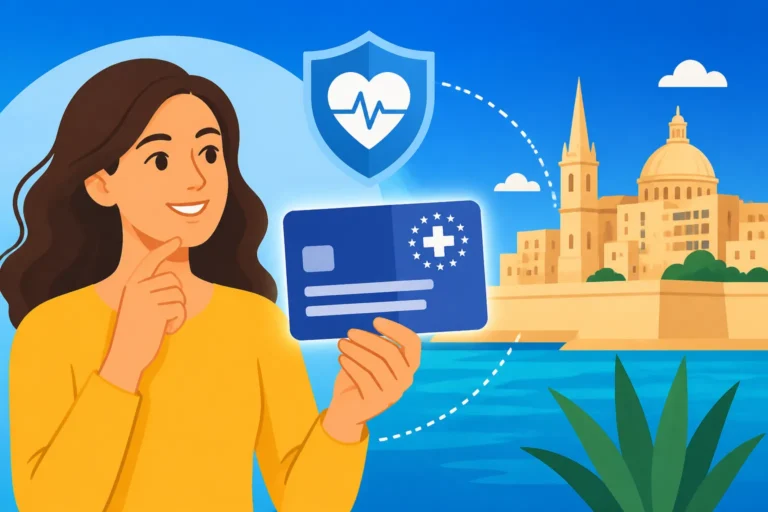
It is a common mistake to assume an EHIC (European Health Insurance Card) is enough for a residence permit. It is not. The EHIC is for temporary stays. For residency, Identità requires a full private policy or a Transfer of Entitlement (like the S1 form for retirees). If you don't have those, you are back to square one: buying a private policy.
What Must Your Policy Cover (The Identità Checklist)
Not all insurance is created equal. Some applicants buy the cheapest "travel insurance" they could find online, only to have it rejected because it didn't meet the "Private Health Insurance" standards required for a residence permit. Identità isn't looking for a policy that just covers lost luggage and flight delays; they are looking for medical indemnity.
When choosing a policy, you need to ensure the "Table of Benefits" includes specific pillars. If these aren't clear, you should ask your provider for a "Letter of Confirmation" that explicitly states the policy meets Maltese residency requirements. This one extra document can save you hours of back-and-forth emails with government officials.
The Inpatient and Outpatient Requirement
A standard requirement for most Maltese residence permits is "Full Inpatient and Outpatient" cover. Inpatient refers to anything that requires you to be admitted to a hospital (surgery, overnight stays), while outpatient refers to doctor visits, specialists, and diagnostic tests that don't require a hospital bed.
Some permits, particularly for TCN workers, might occasionally accept "Inpatient Only" cover, but this is becoming rarer. It is always safer to go for a comprehensive plan. If you are looking at Private Healthcare and Insurance in Malta: When You Need Cover, you’ll see that having outpatient cover is actually a huge benefit for you personally, as it allows you to skip the long queues at the public health centers and see a private GP within hours.
Repatriation and Emergency Evacuation Clauses
This is a big one for the Nomad Residence Permit and certain investor visas. The policy must state that it covers the cost of transporting you back to your home country in the event of a serious medical emergency or death. While it’s a grim thought, it’s a standard box that Identità needs to tick.
International providers like SafetyWing include these clauses as standard in their nomad-focused policies. This is why they are so often recommended in expat circles. A local Maltese "Basic" plan might not include international repatriation, which would lead to an automatic rejection of a Nomad Residence Permit application. Always double-check the "Emergency Medical Evacuation" limit on your policy.
| Permit Type | Insurance Requirement | Duration Needed | Public System Access |
|---|---|---|---|
| Single Permit (TCN Work) | Full Private Policy | Length of Contract | After first contributions |
| Nomad Residence Permit | International Health Cover | Full duration of stay | No (Private only) |
| EU Self-Sufficient | Comprehensive Sickness Insurance | Indefinite | No (Unless S1 holder) |
| Student Permit | Basic or Full Private Policy | Duration of studies | Limited |
| Investor/MPRP | Premium International Cover | Indefinite | No |
Public vs. Private Healthcare Access
One of the most frequent questions I get is: "If I'm paying taxes, why do I still need private insurance?" It’s a fair point, and it can feel like you’re being double-charged. However, in Malta, "Entitlement" and "Residency" are two different bureaucratic tracks that eventually meet, but they don't start together.
Even if you are entitled to public care, you will quickly find that Healthcare in Malta for Foreign Residents: The Complete System Guide (2027) emphasizes the value of having both. The public system (Mater Dei) is excellent for emergencies, but for everything else, the waiting lists can be soul-crushing. Private insurance isn't just a permit requirement; it’s your "fast pass" to seeing a specialist.
Social Security Contributions and the Gap Period
When you start working, your employer will deduct Social Security (NI). In theory, this entitles you to free healthcare. However, until you have your physical eResidence card and have registered with the Entitlement Unit, you may still be asked to pay at the hospital. This is why Do New Arrivals Pay for Hospital Care in Malta? is such a vital topic to understand.
Your private insurance acts as your safety net during this "Gap Period." Identità knows that the entitlement process takes time, so they insist on private cover to ensure you are protected from the moment you apply until the system recognizes you as a contributor.
Can I Use Private and Public Healthcare at the Same Time?
Absolutely. In fact, most veteran expats do this. They use the public system for major issues and the private system for routine specialist visits. When you are applying for your permit, you can mention that you have Can I Use Private and Public Healthcare at the Same Time in Malta? as part of your overall healthcare strategy.
Having a private policy like SafetyWing allows you to choose. If the queue at the local health center is too long, you can simply book a private appointment and claim it back (depending on your plan) or pay the relatively low local private fees, knowing that your "big" risks are covered by your policy for permit purposes.
Choosing the Right Provider for Your Permit
When it comes to the actual purchase, you have two main routes: local Maltese insurers or international providers. Local companies like GasanMamo or Atlas are very familiar with the Identità requirements and offer "Plan Hospital" or "Residency" policies. However, these can sometimes be rigid and require a lot of paperwork.
International providers, on the other hand, offer more flexibility for people who travel or who haven't fully committed to Malta for the next ten years. For many, the choice comes down to how much they value a digital-first experience versus having a local office they can walk into.
Why International Options Like SafetyWing Are Popular
SafetyWing has carved out a niche because they understand the "modern expat" lifestyle. Their policies are often more affordable for younger residents and can be started or stopped with much more ease than traditional annual contracts. For a nomad or someone on a short-term project, this is a lifesaver.
When you use SafetyWing for your permit, you get a visa letter immediately. This letter is designed to satisfy immigration officers. Since the core requirement for the permit is showing that you won't be a burden on the Maltese state, a globally recognized brand that explicitly mentions coverage in Malta usually passes the test without issue.
Cost Expectations and Common Pitfalls
Don't be fooled by "Too Good to be True" prices. If a policy costs €50 for a whole year, it is almost certainly a basic travel policy that will be rejected by Identità. For a proper residency-compliant policy, you should expect to pay a few hundred euros a year at the very minimum, depending on your age and health status.
A common pitfall is the "Maternity" clause. Some permits for long-term residency might require the policy to not exclude pregnancy, though this is often more of a concern for private schemes than basic residency permits. Always read the exclusions. If "Malta" is listed as an excluded territory (which sometimes happens with US-based global plans), you’re in trouble.
Step-by-Step: Submitting Your Insurance for Your Permit
Once you have your policy, the final hurdle is the submission itself. This is the moment of truth. You need to ensure your documentation is presented in a way that the Identità officer can easily verify. They handle hundreds of these a day; make their life easy, and your application will go through faster.
Document Verification and the Confirmation Letter
Don't just hand over a 50-page policy booklet. The officer won't read it. Instead, provide the "Certificate of Insurance" and, if possible, a one-page "Summary of Cover" or a "Visa Letter." This summary should highlight your name, the policy dates (which must cover the duration of the permit you are applying for), and the fact that it includes inpatient/outpatient care in Malta.
If you are using a digital provider, ensure you have a high-quality printout. Paper is still king in Maltese bureaucracy.
Renewing Your Permit and Insurance Continuity
Your residence permit is usually valid for one to three years. When it comes time to renew, you will need to show that you have had continuous health cover. If there is a gap in your insurance history, Identità may ask questions. It is vital to keep your Healthcare on a Visa-Based Permit in Malta: Nomads, Retirees, and Investors status active by renewing your policy before it expires.
If you switch providers—for example, moving from a local Maltese plan to SafetyWing—keep the records of both. This proves to the authorities that you have remained covered the entire time you have lived on the islands. Continuity is a sign of a "good" resident in the eyes of the immigration office.
Disclaimer
The information provided in this guide is for educational and informational purposes only and does not constitute legal or professional medical advice. Immigration rules and healthcare regulations in Malta are subject to change, and you should always consult with the official Identità website or a qualified legal professional before making any applications or purchasing insurance.