Emergency Medical Care in Malta: 112, A&E, and Urgent Help
When you are suddenly faced with a medical crisis in a foreign country like Malta, the panic isn't just about the health issue—it is about not knowing where to turn or how the system will react. I have personally stood in the Mater Dei waiting room at 2 AM, feeling completely lost and overwhelmed by the administrative silence. This guide explains exactly how to navigate 112, A&E, and urgent help.
Understanding the Emergency Response System in Malta
The first thing you need to realize about Malta is that its small size is both a blessing and a curse. On one hand, you are never technically "far" from a hospital; on the other hand, the island’s notorious traffic can make a three-kilometer journey feel like an odyssey. When an emergency strikes, your primary point of contact is the universal European emergency number, 112. This is the gateway to the ambulance service, the police, and the Civil Protection Department.
The 112 Emergency Number and What to Expect
When you dial 112, you will be connected to a central dispatch center. I remember the first time I had to call; I was worried about a language barrier, but the operators are highly trained and fluent in both Maltese and English. You need to stay calm and provide your exact location. In Malta, street names can be repetitive across different villages (there is a Triq San Guzepp in almost every town), so always specify the locality and look for a nearby landmark like a parish church or a specific pharmacy.
The operator will ask a series of questions to determine the severity of the situation. This is not meant to delay help but to decide which type of ambulance to send and what equipment might be necessary. They will guide you through basic first aid if needed. It is vital to stay on the line until they tell you to hang up. If you are a digital nomad or a traveler who hasn't yet integrated into the local system, having a plan like SafetyWing can provide peace of mind, as they understand the complexities of international medical emergencies and can help coordinate with local providers if the situation escalates.
Language and Communication During a Crisis
While English is an official language, the high-stress environment of an emergency room can sometimes lead to a "Maltese-first" approach among staff. Do not let this intimidate you. If you don't understand what is being said, politely but firmly ask for a clarification in English. Most doctors and nurses are exceptionally proficient in English, having completed much of their training in the UK or using English-language textbooks.
In some cases, you might encounter medical jargon that feels foreign. If you are dealing with a long-term condition and find yourself in A&E, it helps to have your medical history written down in English. This bridges the gap when you might be too distressed to explain your situation clearly. For those still waiting on their residency paperwork, you might worry about being understood as a "foreigner" rather than a resident. This is where knowing How Do I Get Care If I Don't Speak Maltese? can be a lifesaver, as it gives you the confidence to navigate these interactions.
Dispatch and Response Times
Ambulance response times in Malta can be a point of frustration for many expats. Because the roads are narrow and often congested, ambulances sometimes struggle to weave through traffic. The "emergency lane" concept is not always respected by local drivers. However, the dispatchers prioritize life-threatening calls—such as heart attacks, strokes, or major trauma—ensuring that the most critical cases get the fastest response.
If you are in a situation that is urgent but perhaps not life-threatening (like a broken bone or a deep cut), you might find that an ambulance takes longer than expected. In these instances, if you have access to a car and the patient can be safely moved, many locals choose to drive directly to the hospital. However, never attempt this for chest pains or head injuries. Understanding What Number Do I Call for an Ambulance in Malta? is only half the battle; knowing when to wait for professional paramedics and when to take the initiative is a skill you develop after living here for a while.
Mater Dei Hospital: The Heart of Emergency Care
Mater Dei is the primary acute general hospital in Malta, located in Msida. It is a massive, state-of-the-art facility that serves the entire population of the main island. For any major emergency, this is where you will end up. The hospital is impressive, but for a newcomer, its scale can be daunting, and the crowds in the emergency department can be quite a shock.
Locating the Accident and Emergency Department
The Accident and Emergency (A&E) department at Mater Dei has its own separate entrance, distinct from the main hospital foyer. If you are arriving by car, follow the signs marked "Emergenza." There is a drop-off point right at the door, but you cannot park there. You will need to move your car to the multi-story car park nearby once the patient is admitted. Frustrated expats often get their cars towed or fined because they left them in the ambulance bay during a moment of panic.
Once inside, you will find a registration desk. This is where you provide your ID card or passport. If you are a resident, your ID card number is the key to your medical records. If you are a visitor or a new expat, you will still be treated, but the administrative process might be a bit more involved. This is another area where having a clear insurance policy, such as SafetyWing, is helpful, as they can often assist with the necessary documentation or financial guarantees that public hospitals sometimes request from non-residents.
The Triage Process Explained
Mater Dei uses a color-coded triage system to ensure that the most critical patients are seen first. When you arrive, you will first see a triage nurse who will take your vitals and ask about your symptoms. They will then assign you a category:
- Red: Immediate, life-threatening (seen instantly).
- Orange: Very urgent (seen within minutes).
- Yellow: Urgent (target within an hour).
- Green: Less urgent (expect a long wait).
- Blue: Non-urgent (expect a very long wait).
It is a common frustration for foreigners to see people arriving after them but being seen sooner. This isn't favoritism; it is the triage system at work. If your condition is "Green" or "Blue," you are in for a wait. It is quite common to spend six to ten hours in the waiting room on a busy Monday night. For more detail on how this facility operates, I recommend reading Mater Dei and Beyond: A Guide to Malta's Public Hospitals and Health Centres.
Waiting Times and Patient Flow
The waiting room at Mater Dei A&E is often a microcosm of Maltese life—noisy, crowded, and emotionally charged. Because Malta lacks a robust network of 24-hour private urgent care clinics, many people head to A&E for minor issues that could be handled elsewhere. This clogs the system and leads to the infamous waiting times.
While you wait, there are basic amenities like vending machines and a small cafeteria, but the environment is far from comfortable. I always tell my friends to bring a power bank for their phone and a bottle of water. If you are a non-EU resident, you might be asked about your entitlement to free care while you wait. Knowing What Does Public Healthcare Actually Cost in Malta? beforehand can help you handle these questions without added stress during a medical crisis.
Urgent Care Beyond Mater Dei
Not every medical issue requires a trip to the main hospital. In fact, if you go to Mater Dei with a minor ailment, you are contributing to the congestion and will likely wait much longer than necessary. Malta has a network of public health centres and private clinics that handle urgent but non-life-threatening cases.
Primary Health Centres and Urgent Clinics
Several public health centres across the island offer 24/7 or extended-hours GP services. These are excellent for things like high fevers, minor infections, or small cuts that need stitches. The health centres in Mosta, Paola, and Floriana are generally the ones with the most comprehensive urgent care hours.
When you go to a health centre, you will need your Maltese ID card or your passport. The wait is usually much shorter than at Mater Dei, often between one and three hours. However, keep in mind that these centres have limited diagnostic equipment. If the doctor suspects something serious, they will likely refer you to Mater Dei anyway. If you are unsure which one is closest to your home, check out Which Health Centre Do I Go to After Moving to Malta? for a full list of locations and services.
Private Emergency Options
If you have private insurance or are willing to pay out-of-pocket, there are private hospitals like St. James Hospital (with branches in Sliema and Zejtun) that offer "Immediate Care" units. These units are generally open until late (often 10 PM or midnight, with some offering 24/7 services depending on the location). The advantage here is the speed; you are often seen within thirty minutes in a much calmer environment.
The cost for a private urgent care consultation usually starts around €30 to €60, plus the cost of any tests or medication. For expats who are used to faster service, this is often the preferred route for non-life-threatening issues. If you are traveling or working as a nomad, SafetyWing often covers these types of urgent care visits, making the private route even more accessible and less of a financial burden. For more on the private side of things, see Private Healthcare and Insurance in Malta: When You Need Cover.
Gozo General Hospital: Emergency Care on the Sister Island
If you are staying on Gozo, the situation is different. Gozo General Hospital in Victoria is the only hospital on the island. It handles all emergencies for Gozitans and visitors alike. While it is smaller than Mater Dei, it is well-equipped for most emergencies. I’ve found the staff there to be incredibly friendly and the waiting times generally shorter than on the main island.
However, for very specialized care—such as major cardiac surgery or advanced neurosurgery—patients are often stabilized in Gozo and then transferred to Mater Dei. This can happen via the Gozo Channel ferry or, in critical cases, by helicopter. If you are living or vacationing in Gozo, it is vital to know What Should I Do in a Medical Emergency on Gozo? because the logistics of island-to-island transfer add an extra layer of complexity to your care.
Ambulance Services and Medical Transport
Ambulances in Malta are primarily operated by the government through the Emergency Medical Services (EMS) department based at Mater Dei. However, there is also a secondary market of private ambulances that serve a different purpose.
Public Ambulance Services
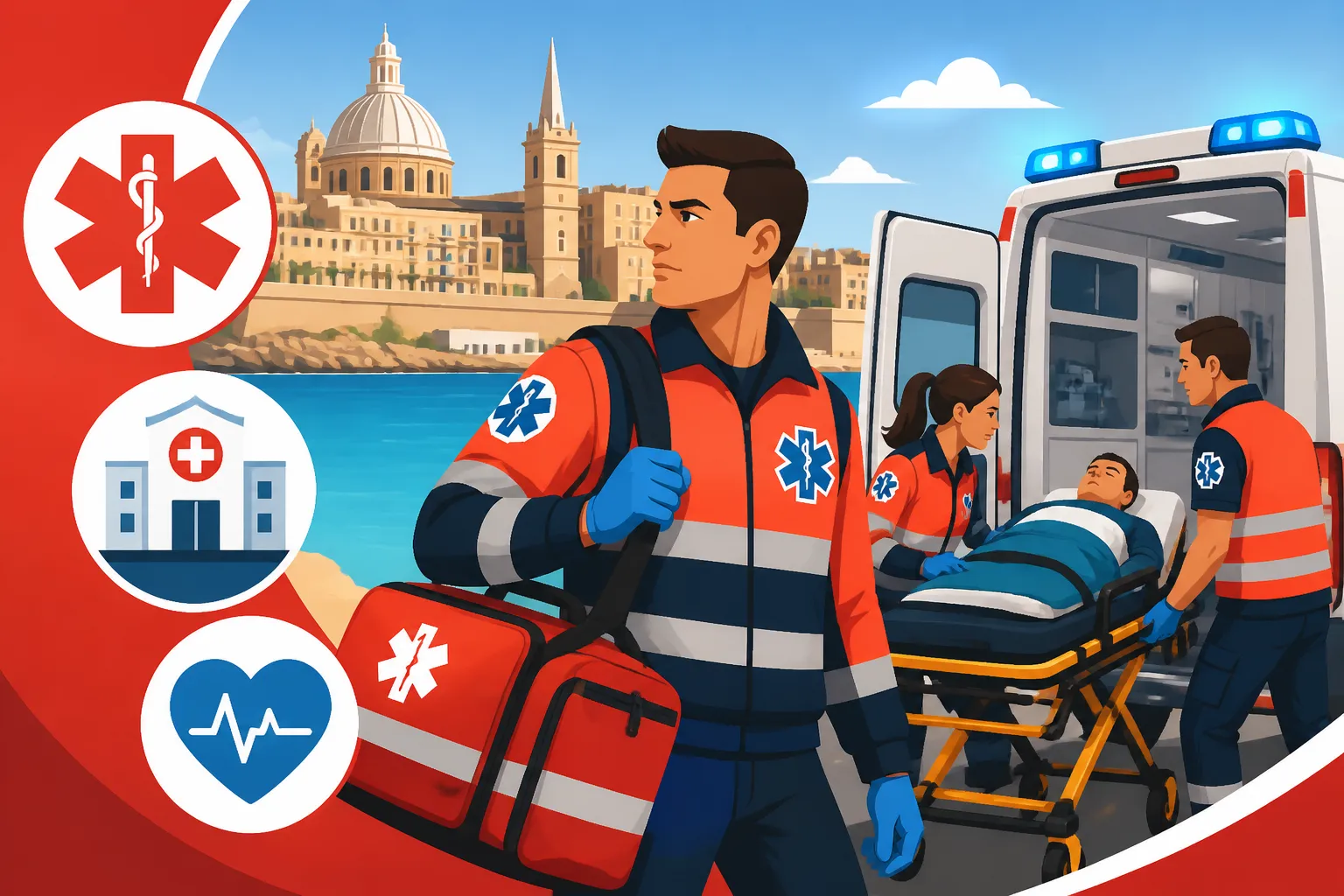
Public ambulances are staffed by highly trained paramedics and, in some cases, an emergency doctor for high-acuity calls. These vehicles are essentially mobile intensive care units. When you call 112, this is what will arrive. The service is free at the point of use for anyone in a life-threatening situation, though non-residents may be billed later for the transport and hospital stay if they do not have a reciprocal agreement or insurance.
The paramedics will assess the patient on-site and decide whether they need to go to the hospital. If they do, they will take you to the nearest appropriate facility, which is almost always Mater Dei. For more on the specific costs and who is eligible for free transport, read Is the 112 Emergency Line in Malta Free to Call? to avoid any surprises.
Private Ambulances and Transport
Private ambulance companies like the St. John Ambulance or various private hospital fleets operate in Malta. These are generally not used for 112 emergency calls. Instead, they are used for planned medical transport, such as moving a patient from a public hospital to a private one, or transporting an elderly person to a medical appointment.
You can book these services yourself if you need non-urgent medical transport. They are also frequently used for events like football matches or festivals. If you find yourself needing to move between facilities for a non-urgent reason, these private services offer a more comfortable and scheduled alternative to public transport.
Air Ambulance and Gozo Transfers
The helicopter transfer between Gozo and Malta is a critical link for the sister island. This service is operated by the military (Armed Forces of Malta) or a contracted private provider. It is reserved for patients whose lives are at risk and who cannot wait for the ferry.
The landing pad at Mater Dei is located right near the A&E department, allowing for rapid transfer. It is a noisy, dramatic sight, but it is a reminder of how integrated the national health system is. If you're interested in the logistics of this, How Does the Air Ambulance Between Gozo and Malta Work? provides a fascinating look at this high-stakes service.
Costs and Entitlement for Emergency Care
One of the biggest anxieties for expats is the bill. Malta’s healthcare system is based on social security contributions, but emergency care has its own set of rules.
Who Gets Free Emergency Care?
In a true life-or-death emergency, the Maltese system prioritizes saving lives over checking bank balances. You will be treated regardless of your status. However, once you are stabilized, the "entitlement" question will arise. Generally, free care is available to:
- Maltese citizens.
- EU citizens with a valid European Health Insurance Card (EHIC).
- British citizens (due to a post-Brexit reciprocal agreement).
- Non-EU residents who are employed and paying social security in Malta.
If you fall into these categories, most of your emergency care will be free. However, there are nuances. For instance, if you are an EU citizen but have been living here for six months without registering for residence, your EHIC might not be accepted. You can find more details on this at Health Entitlement in Malta: How Social Security Contributions Unlock Free Care.
Costs for Third-Country Nationals and Tourists
If you are a tourist from a non-EU country (like the US, Canada, or Australia) and you don't have a reciprocal agreement, you will be charged for your care. A single night in Mater Dei can cost over €600, and surgery or intensive care can quickly run into the tens of thousands.
The hospital will issue an invoice which you are expected to pay before discharge or shortly thereafter. This is why travel insurance is non-negotiable. Companies like SafetyWing are designed for exactly these scenarios, providing coverage that handles these high costs so you aren't left with a debt that ruins your stay in Malta. For a deeper dive into the numbers, check What Public Healthcare Actually Cost in Malta?.
The Role of Private Insurance
Even if you are entitled to public care, many expats choose to maintain private health insurance. In an emergency, private insurance allows you to bypass the public system for non-life-threatening issues by using private hospitals. It also covers things like private rooms if you are admitted, which are much more comfortable than the 6-8 bed wards common in Mater Dei.
If you are brought to Mater Dei in an emergency but have private insurance, you can sometimes request a transfer to a private facility once you are stable. Your insurer will coordinate this. It’s always a good idea to keep your insurance card in your wallet. If you are still choosing a provider, Choosing a Private Health Insurer in Malta: Cover, Costs, and Claims can help you compare the local and international options.
Specialized Emergency Situations
Not every emergency is a physical injury. Sometimes you need a specific kind of help that a general A&E might not be the best place for.
Dental Emergencies
Tooth pain can be excruciating, but Mater Dei’s dental department only handles major trauma (like a broken jaw) or severe infections that risk the airway. For a standard toothache or a lost filling on a Sunday, you will need a private emergency dentist.
Many private dental clinics offer emergency slots, and there is usually a "dentist on call" listed in the Sunday newspapers or online. Expect to pay a premium for a weekend or late-night appointment. For more on where to find these, see Where Can I Get an Emergency Dentist Appointment in Malta?.
Mental Health Crisis Support
If you or someone you know is experiencing a mental health crisis, Malta has dedicated services. While you can go to Mater Dei A&E, they will likely call in a psychiatric liaison team. For more direct help, Mount Carmel Hospital is the primary psychiatric facility, though it is often criticized for its aging infrastructure.
A better first step for many is the 24/7 crisis lines like "1770" (Richmond Foundation) or the government’s "179" support line. These services are staffed by professionals who can talk you through a crisis or direct you to the right medical help. For a full guide on these services, look at Mental Health Support in Malta: Services, Therapy, and Mount Carmel Hospital.
Pediatric Emergencies
If your child has an emergency, you will still go to Mater Dei, but they will be treated in the Paediatric Emergency Department (NPICU/Fairyland). This is a much more child-friendly environment than the adult A&E. The staff here are specialists in dealing with children and are generally very empathetic to stressed parents.
I’ve found that pediatric cases are often triaged quite quickly. However, for minor things like a high fever without other symptoms, you might find it faster to see a private pediatrician. Many have clinics in local pharmacies. You can find more about this in Family and Children's Healthcare in Malta: Maternity, Well-Baby, and Beyond.
Practical Tips for Navigating Maltese Medical Emergencies
Living in Malta requires a bit of local "know-how" that you won't find in an official manual. Here are some veteran tips for when things go wrong.
Finding Pharmacies on Sundays and Holidays
If you need urgent medication but it's a Sunday or a public holiday, most pharmacies will be closed. However, there is always a roster of pharmacies that remain open from 9 AM to 12 PM (and sometimes in the afternoon). This roster is published in the local newspapers, on the pharmacy doors, and on various local websites.
Be prepared for long lines at the rostered pharmacy. If you need a prescription filled, ensure you have a valid script from a Maltese-registered doctor, as pharmacists here are quite strict. If you are just looking for basic meds, Buying Over-the-Counter Medicine at a Maltese Pharmacy explains what you can get without a doctor.
Navigating Traffic and Logistics
As mentioned, traffic is your biggest enemy in an emergency. If you are driving someone to the hospital during rush hour (7 AM – 9 AM or 4 PM – 6 PM), it might be faster to call an ambulance even for a secondary emergency, as they can use sirens to bypass the gridlock.
If you are using a ride-sharing app like Bolt or Uber to get to the hospital, tell the driver it is an emergency. Most are very helpful and will try to find the quickest route. However, for anything serious, always call 112. The peace of mind of having a paramedic in the back of the vehicle is worth the potential wait for the ambulance to arrive.
| Emergency Contact | Number | Purpose |
|---|---|---|
| General Emergency | 112 | Police, Ambulance, Fire |
| Health Command Centre | 21244114 | Non-emergency medical queries |
| Crisis Resolution Malta | 99339966 | 24/7 Private Mental Health Crisis |
| Richmond Foundation | 1770 | Mental Health Support |
| Supportline | 179 | General Support & Crisis |
| Mater Dei Hospital | 25450000 | Main Switchboard |
| Gozo General Hospital | 21561600 | Gozo Main Switchboard |
Identifying Medical Locations
I highly recommend that you spend a Saturday afternoon locating your nearest Health Centre and the route to Mater Dei from your house. Do this when you are not in a panic. Look for the "Emergenza" signs. Know which pharmacies in your village usually take part in the Sunday roster.
In Malta, we often rely on local landmarks. Your "nearest" health centre might not be the one in your town, but the one in the neighboring village. For example, if you live in Pembroke, your 24/7 health centre is in Gzira or Floriana. Knowing How Do I Register with a Health Centre in Malta? before you are sick makes the whole process much smoother.
Being prepared is the best way to handle the stress of a medical emergency in Malta. Whether it is keeping your SafetyWing details handy or knowing the shortcut to Mater Dei, these small steps can make a massive difference in a crisis.
Healthcare in Malta Disclaimer
The information provided in this article is for general informational purposes only and does not constitute professional medical or legal advice. While we strive to provide accurate and up-to-date information regarding the Maltese healthcare system, policies and contact details can change. Always consult with a qualified healthcare provider or the relevant Maltese authorities (such as the Ministry for Health or Identità) for specific advice regarding your medical situation or entitlement to care. In the event of a medical emergency, immediately dial 112.