Sickness Benefit in Malta: Your Rights When You Can’t Work
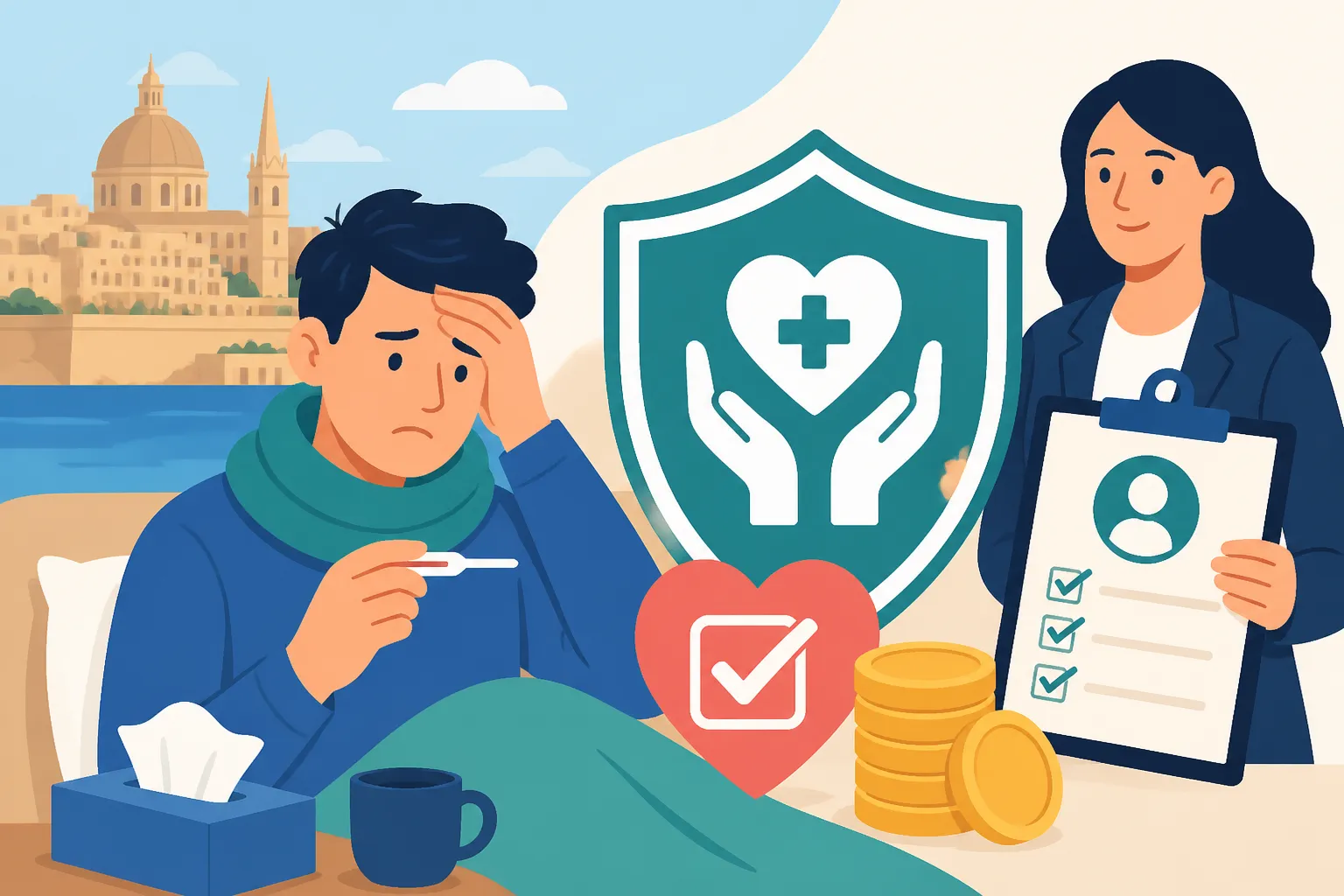
Waking up with a pounding headache and a fever in your Maltese apartment is stressful enough without the added anxiety of wondering if your paycheck will survive the week. I still remember the first time I caught a nasty bout of the flu in Sliema and spent three days staring at a blue medical form, terrified I’d lose my income because I didn't understand the system. This guide breaks down exactly how the Sickness Benefit in Malta works, how to navigate the paperwork, and what your rights are when you simply cannot work.
Understanding the Maltese Sickness Benefit System
The first thing you need to realize about Malta is that the social security system is built on a "contributory" model. This isn't a generic handout; it is a safety net you have been paying into every single month through your Class 1 or Class 2 contributions. If you look at your payslip, that "NI" deduction is exactly what funds this benefit. However, the transition from being a healthy worker to a benefit recipient isn't automatic, and it requires a bit of a bureaucratic dance.
The Philosophy of Social Security in Malta
In Malta, the state views sickness benefit as a way to replace a portion of your income when you are temporarily unfit for work due to illness or injury. It is important to distinguish this from your "Sick Leave" provided by your employer. Many expats get confused here: your employer usually pays your full salary for a certain number of days per year, but the Sickness Benefit is a government payment that kicks in to support you (and sometimes offset your employer's costs) during that time.
The system is designed to be robust but strict. It relies heavily on the "Blue Certificate" system, which is the official medical evidence required by the Department of Social Security. Without this specific piece of paper, the state doesn't officially recognize your illness, regardless of how many days you've spent in bed.
Employed vs. Self-Employed Realities
If you are an employee, your HR department will usually handle the heavy lifting regarding the deduction of benefits from your salary, but the responsibility to see a doctor remains yours. For the self-employed, the stakes are even higher. You are both the employer and the employee, meaning if you don't file your paperwork correctly, there is no backup salary waiting for you.
Many freelancers have ignored their Social Security Contributions in Malta: Classes, Rates, and Benefits only to realize too late that they weren't entitled to a cent when they needed surgery. Ensuring you are up to date with your Class 2 contributions is the only way to unlock these payments.
Why Your NI Contributions Matter
To qualify for the Sickness Benefit, you must meet the contribution test. Generally, this means you must have paid at least 50 social security contributions since you started working in Malta, and at least 20 of those must have been paid or credited in the two years prior to your claim.
This can be a major hurdle for newcomers. If you’ve only been in the country for three months, you might find yourself in a "contribution gap." In these scenarios, having a private backup like SafetyWing is absolutely essential. While the state system is excellent for long-term residents, the initial "waiting period" of contribution history can leave many expats vulnerable during their first year on the island.
Eligibility Criteria: Do You Qualify for Support?
Not everyone who feels under the weather is eligible for state support. The criteria are quite specific, and failing to meet even one can lead to a rejected claim. The Department of Social Security looks at your employment status, your age (you must be under the pensionable age), and, most importantly, your contribution record.
The Contribution Test in Detail
The "Two-Year Rule" is the most common reason for claim denials among the expat community. The department looks at the "Contribution Year," which is usually the calendar year preceding the year of the claim. If you haven't been working and paying NI consistently, the system might flag you as ineligible.
For those moving from within the EU, there is some relief. Under EU coordination rules, you may be able to aggregate your periods of insurance from your home country to meet the Maltese requirements. This involves getting an S1 form or similar documentation from your previous social security office, which can be a slow process. Understanding How Malta's Public Healthcare Works: Entitlement, Contributions, and Costs can help you see where these contributions fit into the larger medical landscape.
Residency and Permit Requirements
Your right to sickness benefit is also tied to your legal right to reside and work in Malta. If you are on a Single Permit, your entitlement is usually straightforward as long as you are employed. However, if you are a digital nomad or a retiree, the rules change significantly.
Nomad Residence Permit holders, for instance, often do not pay local NI because they are employed by a foreign entity. In this case, you are entirely excluded from the Maltese Sickness Benefit. This is why many nomads choose SafetyWing to ensure they have coverage that travels with them, regardless of their local NI status. Without it, a week-long illness could mean a week of zero income and high medical bills.
The Waiting Period and The Three-Day Rule
One of the most frustrating aspects of the Maltese system for new arrivals is the "Three-Day Rule." By law, the first three days of any sickness claim are generally not paid by the Social Security Department. These are considered "waiting days."
In many employment contracts, the employer covers these first three days at full pay as part of your statutory sick leave. However, if you are self-employed, those first three days are simply unpaid. It’s a harsh reality that requires having a small emergency fund or private insurance to bridge the gap.
The Step-by-Step Application Process
If you are too sick to work, the last thing you want to do is navigate a government portal. But in Malta, timing is everything. If you miss the filing deadline, you lose the money. It is as simple and brutal as that.
Getting the Medical Certificate (The NI 13)
The journey begins with a visit to a General Practitioner. You must ask specifically for the "Blue Certificate," officially known as the NI 13. This is a three-part carbon-copy form (though it is increasingly being digitized).
The doctor must fill out the date they examined you, the nature of your illness, and the expected duration of your absence. It is wise to check that the doctor has signed and stamped the form before leaving the clinic. A missing stamp is a one-way ticket to a "rejected" status. If you are unsure where to find a doctor, you should look into Registering with a Health Centre and Choosing a GP in Malta to ensure you have a professional ready when illness strikes.
Submission Deadlines and the 10-Day Window
You have exactly 10 days from the first day of your illness to get that certificate to the Department of Social Security. If you submit it on day 11, the department will only pay you from the day they received it, meaning you lose the first 10 days of benefits.
When I was first here, I thought "10 days" meant business days. It does not. It means 10 calendar days. If you are stuck in bed with a high fever and can't get to a post office or a district office, you can now submit the certificate online through the myHealth portal or the Social Security website. Knowing How Do I Get a Sick Certificate from a Doctor in Malta? is the most critical piece of knowledge you can have before you actually get sick.
Digital vs. Paper Submissions
While the old-school blue paper forms are still widely used, the Maltese government has made a massive push toward digitalization. If your doctor uses the electronic system, the certificate is sent directly to the department.
However, you should always ask for a printed copy for your own records and to give to your employer. Your employer needs this to justify your absence and to calculate your pay. If you are an employee, you are technically required to notify your employer on the first day of sickness, often within an hour of your start time.
Rates and Payments: How Much Will You Receive?
Let’s talk numbers. The Sickness Benefit in Malta is not intended to be a full salary replacement. It is a daily rate that varies based on your personal circumstances—specifically, whether you are a "married person" or a "single person."
Daily Rates for 2026
The rates are adjusted annually based on the Cost of Living Adjustment (COLA). While the exact figures can shift slightly, the structure remains consistent. Below is a representative table of what you can expect for daily sickness benefit rates in 2026.
| Status of Applicant | Daily Rate (Estimated 2026) | Weekly Total (6 Days) |
|---|---|---|
| Married Person (supporting a spouse) | €24.50 | €147.00 |
| Single Person / Other | €15.90 | €95.40 |
Note: Social security benefits are usually paid for a six-day week (Monday to Saturday). Sundays are not included in the calculation.
Married vs. Single Rates
The department defines a "married person" as someone who is maintaining a spouse who is not employed full-time. If both spouses work, they are usually both treated at the "single person" rate for their own individual claims.
This distinction often catches expats by surprise. If you are living with a partner but are not legally married or in a civil union, you will be categorized as "Single" for the purposes of this benefit. It is vital to ensure your Getting Your Maltese ID Card Number: The Key to Accessing Healthcare is correctly registered with your marital status to avoid payment errors.
How Long Does Sickness Benefit Last?
You cannot stay on sickness benefit indefinitely. There is a "cap" on the number of days you can claim in a single year. Generally, you are entitled to 156 days of sickness benefit per year. This can be extended to 312 days in exceptional circumstances involving major surgery or chronic illness, but this usually requires an evaluation by a medical board.
If you hit your 156-day limit, the benefit stops. This is the "danger zone" for many workers. If you are still too sick to work after five months, you may need to transition to an Invalidity Pension, which is a much more complex process involving rigorous medical assessments.
Managing Your Sick Leave with Your Employer
Your relationship with your employer during an illness is governed by the Employment and Industrial Relations Act. While the state provides the sickness benefit, your employer provides "Sick Leave."
Employer-Paid Sick Leave (The Sick Pay Benefit)
In Malta, most full-time employees are entitled to a certain amount of paid sick leave per year (often two weeks or 10 working days, though this varies by industry and collective agreement). During this period, your employer pays your full salary.
However, there is a catch: the employer is legally allowed to deduct the amount of the Social Security Sickness Benefit from your salary. So, if your salary is €100 a day and the sickness benefit is €15, your employer pays you €85, and the government sends you the €15. This prevents "double dipping." For more on this, check Am I Entitled to Sick Pay When I'm Ill in Malta?.
What Happens When Your Statutory Sick Leave Runs Out?
Once you have exhausted your employer's paid sick leave, you enter "half-pay" or "unpaid" leave. At this stage, the Sickness Benefit from the government becomes your primary source of income.
This is where things get financially tight. If your rent in St. Julian's is €1,200 a month, a government benefit of roughly €400 a month isn't going to cover the bills. This is a massive pain point for expats who are used to more generous sick pay schemes in Northern Europe. Supplementing your protection with SafetyWing can provide a much-needed buffer during these extended recovery periods.
Verification and Medical Boards
Don't be surprised if the Department of Social Security sends a doctor to your house. This is a standard procedure in Malta to verify that the person claiming the benefit is actually at home and actually sick.
If the government doctor visits and you aren't home (and you don't have a valid medical reason for being out, like a pharmacy visit), your benefit can be suspended immediately. In cases of long-term illness, you will be summoned to a Medical Board at the Social Security offices in Valletta. These doctors will review your file and decide if you are fit for "light duties" or if you should remain on benefit.
Common Pitfalls and Troubleshooting for Expats
Navigating the system as a foreigner adds another layer of complexity. Language barriers are rarely the issue (most doctors and civil servants speak excellent English), but the "way things are done" can be confusing.
The Address Headache
One of the most common reasons for missing payments or verification visits is an outdated address. If the Department of Social Security has your old address in Msida but you’ve moved to Mosta, the visiting doctor will report you as "not found."
Always ensure your address is updated with Identità. If you’ve recently moved, follow the steps in How Do I Update My Address with Identità in Malta? as soon as possible. The social security system pulls data from the national ID database, so if one is wrong, they are all wrong.
Missing the 10-Day Deadline
If you realize on day 12 that you haven't submitted your certificate, don't give up, but prepare for a loss. You should still submit the certificate immediately.
The department is extremely strict about the 10-day window. People have tried to appeal based on the fact that they were "too sick to walk to the post office," and the department's response is usually that a friend or relative should have done it, or it should have been done online. In 2026, with the widespread availability of digital filing, "I couldn't get to the office" is no longer considered a valid excuse.
Dealing with Payment Delays
The government doesn't pay you daily; they pay in batches. It usually takes about two to three weeks after the submission of your certificate to see the money hit your bank account.
If you haven't received payment after a month, your first step should be to check the "Social Security" tab on the myHealth portal. It will show you the status of your claim. If it says "Pending Contributions," it means they are still verifying your NI history. If it says "Rejected," there is usually a reason code provided. You can also visit a local "servizz.gov" hub, which are located in almost every major town, to get a face-to-face update on your claim.
Private Alternatives and Safety Nets
If there is one thing I’ve learned from living in Malta, it’s that the state system is a great foundation, but it is rarely enough for a comfortable life if things go seriously wrong.
Why State Benefits Might Not Be Enough
As we saw in the rates table, the maximum you can expect is around €147 per week. In today's economy, that barely covers a week's worth of groceries and utilities, let alone rent or a mortgage. For expats who moved to Malta for high-paying roles in iGaming or Fintech, the drop from a full salary to the state sickness benefit is a financial cliff.
Private income protection is often overlooked until it's too late. While the public system handles the basics, it doesn't account for the "expat cost of living"—the need for private flights home in an emergency, the preference for private hospitals to avoid wait times, or the sheer cost of Maltese rent.
SafetyWing for Nomads and Expats
For many of us, especially those in the "Nomad" or "Freelance" category, the state system is either inaccessible or insufficient. This is where SafetyWing shines. It offers the flexibility that a rigid national system lacks.
If you are a digital nomad working from a cafe in Valletta, SafetyWing covers you globally, which is something the Maltese Sickness Benefit will never do. If you get sick and decide you’d rather recover at home in the UK, Germany, or the US, SafetyWing travels with you. It acts as a comprehensive bridge, ensuring that while the Maltese government figures out your NI contributions, your medical bills and emergency costs are already handled.
Transitioning to Long-Term Care
If an illness turns into a permanent condition, the transition from Sickness Benefit to an Invalidity Pension is a significant life event. This requires five years of contributions and a permanent inability to work.
During this transition, having a private safety net is the difference between staying in Malta and being forced to leave. Most expats find that a combination of the public system (for the basics) and a private plan like SafetyWing (for the big stuff) provides the best peace of mind. You can read more about long-term options in Healthcare in Malta for Foreign Residents: The Complete System Guide (2027) to build a full picture of your protection.
Sickness Benefit in Malta Disclaimer
The information provided in this guide is for informational purposes only and does not constitute legal or financial advice. While every effort has been made to ensure the accuracy of the rates and regulations for 2026, social security laws and benefits are subject to change by the Maltese Government. Always consult with the Department of Social Security or a qualified legal professional regarding your specific case and eligibility. The author is an expat sharing personal experiences and research, not a government official.