What Public Healthcare Costs in Malta: Free Services and Paid Extras
Navigating the administrative maze of a new country is exhausting, but nothing spikes the pulse quite like a medical bill you didn't expect. When I first moved here, I spent weeks terrified that a simple trip to the health centre would drain my savings because I hadn't received my residency card yet. This guide clarifies exactly what public healthcare costs in Malta, which services are free, and where you’ll definitely need to reach for your wallet.
Understanding Health Entitlement in Malta
One of the biggest misconceptions I see among new arrivals is the belief that simply landing at Luqa airport or holding a rental contract gives you immediate access to free healthcare. In reality, the Maltese public system is based on your status as a taxpayer or a specific beneficiary. If you aren't paying into the system, the "free" part of public healthcare quickly disappears.
The Role of Social Security Contributions
In Malta, your right to free healthcare is primarily tied to your Social Security contributions. Whether you are an employee or self-employed, a portion of your weekly income—referred to locally as "NI" (National Insurance)—is deducted. This is the "key" that unlocks the door to the public system. When you start working, your employer handles these deductions, and this is what theoretically entitles you to treatment at Mater Dei or any regional health centre.
However, just paying the contribution isn't always enough to prove your status at the front desk. For many expats, the transition period between starting a job and receiving a physical eResidence card can be a grey area. During this window, many of my friends have relied on flexible options like SafetyWing to ensure they aren't hit with massive bills if an emergency happens before the Maltese bureaucracy catches up with their paperwork. You can read more about the foundation of this system in our guide on How Malta's Public Healthcare Works: Entitlement, Contributions, and Costs.
The Entitlement Unit and Your Certificate
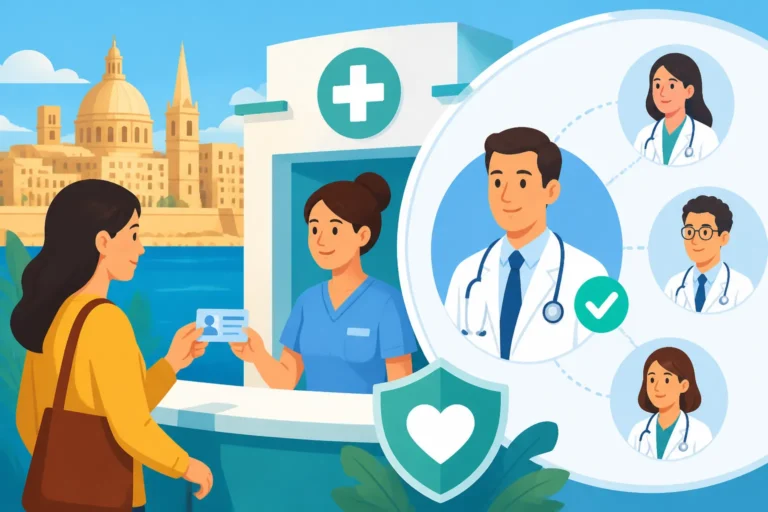
To formalize your right to free care, you often need to interact with the Entitlement Unit. This is a specific office within the Ministry for Health that confirms whether you are eligible for free treatment based on EU regulations or your employment status in Malta. They issue certificates that act as proof for hospitals. Without this proof, even if you have a Maltese ID number, the hospital might still send you an invoice.
I remember the first time I had to visit the Entitlement Unit in Gzira. I was armed with my work contract, three months of payslips, and my passport. It felt like an interrogation, but once that certificate was in my hand, the relief was immense. If you are an EU citizen, your EHIC can cover you for immediate, necessary care, but it isn't a long-term solution once you become a resident. For a deeper dive into the paperwork, check out Health Entitlement in Malta: How Social Security Contributions Unlock Free Care.
Who Qualifies for Free Public Care
Generally, free public healthcare is available to:
- Maltese citizens and their dependents.
- EU/EEA citizens who are working and paying NI in Malta.
- Non-EU citizens (Third Country Nationals) with a valid work permit who are paying NI.
- Pensioners from EU countries who have transferred their rights via an S1 form.
- Asylum seekers and those with specific humanitarian status.
If you fall outside these categories—for instance, if you are here on a tourist visa or your work permit is still "in process"—you are technically a private patient. In these cases, the "public" hospital will charge you at rates that, while lower than in the US, can still be a significant shock to the system.
Primary Care Costs at Health Centres
Primary care is the frontline of the Maltese medical system. These are the regional hubs where you go for everything from a flu shot to a stitched-up finger. For entitled residents, these services are largely free at the point of use, provided you have your ID card or documentation ready.
General Practitioner Services
Every major region in Malta has a primary health centre, such as those in Mosta, Floriana, or Paola. If you have your entitlement sorted, seeing a GP at these centres costs zero Euro. You don’t even need an appointment for basic consultations; you simply walk in, take a number, and wait. The wait times can be legendary—I once spent three hours reading a very old magazine in the Mosta health centre—but the care itself is competent and free.
It’s important to note that you cannot "register" with a specific doctor in the public system like you might in the UK. You see whoever is on duty. If you want a consistent family doctor who knows your history, you’ll usually need to visit a private pharmacy-based clinic and pay out of pocket, which typically costs between €15 and €30. To understand the layout of these hubs, see our guide on Mater Dei and Beyond: A Guide to Malta's Public Hospitals and Health Centres.
Specialist Clinics and Referrals
Health centres also host specialist clinics for things like diabetes, cardiology, and orthopaedics on specific days. Accessing these is free for entitled residents, but you usually need a referral from a GP first. If a GP at the health centre decides you need to see a specialist, they will handle the internal paperwork.
The "cost" here isn't monetary—it's time. Waiting lists for non-urgent specialist appointments in the public sector can stretch for months. This is exactly why many expats choose to maintain a policy with SafetyWing or local private insurers; it allows them to skip the public queue and see a private specialist in a matter of days for a relatively small consultation fee. For more details on the registration process, look at Registering with a Health Centre and Choosing a GP in Malta.
Nursing and Triage Services
If you need a wound dressed, a blood test (with a referral), or a quick check of your blood pressure, the nursing stations at the health centres are remarkably efficient. These services are free for those with entitlement. I’ve found that for minor issues, the nurses are often the unsung heroes of the Maltese system, providing quick care that prevents you from having to wait for a doctor.
| Service Category | Public Cost (Entitled) | Public Cost (Non-Entitled) |
|---|---|---|
| GP Consultation | €0 | ~€35 – €50 |
| Blood Tests | €0 | €5 – €50 (varies by test) |
| Nursing (Dressing) | €0 | ~€15 |
| A&E Visit (Urgent) | €0 | €100+ (depending on tests) |
| Specialist Visit | €0 | €60 – €120 |
| X-Ray | €0 | €40 – €80 |
Hospital Care and Emergency Services
Mater Dei is the primary acute general hospital for the islands. It is a state-of-the-art facility, but its popularity means it is always busy. Knowing the costs associated with hospital care is vital, especially since "emergency" is defined strictly by the hospital staff.
Emergency Department (A&E) and Ambulance Costs
For anyone entitled to Maltese healthcare, an ambulance ride and emergency treatment at Mater Dei's Accident & Emergency department are free. However, if you show up at A&E with a minor ailment that could have been treated at a health centre, you may face a long wait as you are triaged to the bottom of the list.
For non-residents or those without entitlement, the costs for an emergency visit can accumulate quickly. You will be billed for the ambulance, the initial consultation, any diagnostic imaging (like CT scans), and any medication administered. This is one of the most common ways newcomers get hit with unexpected "paid extras." Even if you are in the process of getting your ID card, having a basic insurance plan can save you from a €500 bill for a simple emergency room visit.
Inpatient Stays and Surgical Procedures
If you are admitted to Mater Dei as an inpatient, the public system covers your bed, meals, nursing care, and the surgery itself. There are no "co-pays" or daily room rates for entitled patients. This is the jewel in the crown of the Maltese system; if you are seriously ill, you will not be bankrupted by your recovery.
However, the "extras" in a public hospital are minimal. You are in a shared ward (often 6 to 8 beds), and privacy is limited. If you want a private room or the ability to choose your surgeon, you have to go through a private hospital like St. James or DaVinci, where you will pay for every single aspirin and bandage used. For more on how the hospitals operate, see Healthcare in Malta for Foreign Residents: The Complete System Guide (2027).
Outpatient Specialist Consultations
After a hospital stay, you might need follow-up appointments. In the public system, these are free at the hospital’s outpatient clinics. The downside is that these clinics are often incredibly crowded. You might be told to arrive at 8:00 AM, only to be seen at 11:30 AM because forty other people were given the same slot. Again, while the financial cost is zero, the time cost is significant.
Medication and the POYC Scheme
Medicine is where the Maltese system transitions from "completely free" to "it depends." While hospital-administered drugs are free, the medication you take home from a pharmacy usually isn't, unless you qualify for a specific scheme.
Free Medicines for Chronic Conditions (Schedule V)
Malta operates the "Schedule V" scheme, often called the "Yellow Card." If you suffer from a chronic illness listed by the government—such as asthma, hypertension, or diabetes—you are entitled to receive your specific maintenance medications for free, regardless of your income.
To get this, a consultant must fill out the application for you. Once approved, you are enrolled in The POYC Pharmacy of Your Choice Scheme: How to Collect Free Medicines. This allows you to pick up your monthly prescriptions from a local pharmacy near your home for free, rather than trekking to a central hospital. It is a brilliant system, but it only applies to the specific drugs listed on your card.
Paying for Prescriptions Privately
If you have a short-term illness—say, a chest infection that requires antibiotics—you will almost always have to pay for those medicines yourself. Even if a public GP writes the prescription, you take it to a private pharmacy and pay the market price.
Prices for medication in Malta are regulated, so they don't vary much between pharmacies, but they aren't necessarily "cheap" compared to some other EU countries. A standard course of antibiotics might cost you between €10 and €25. It’s a common surprise for expats who come from countries where all prescriptions are free or have a low flat rate.
Over-the-Counter Costs at Pharmacies
Pharmacies in Malta are the heart of the community. Beyond prescriptions, you’ll find that many over-the-counter (OTC) medications like paracetamol or cough syrup are readily available. These are never subsidized. Expect to pay around €3 to €5 for basic painkillers. One tip I always give newcomers: check if the pharmacy has a "generic" version of the drug, as the branded versions imported from the UK or Italy can be double the price.
Dental, Vision, and Specialized Extras
This is the section where the "Public Healthcare is Free" narrative usually breaks down. For most residents, dental and vision care are almost entirely private affairs.
Public Dental Care Limitations
The public dental clinic at Mater Dei or the regional health centres is generally reserved for emergencies (like a severe abscess or a broken jaw) and specific groups like children, pensioners, or those on low incomes. For the average working expat, if you have a toothache or need a filling, you cannot use the public system.
You will need to visit a private dentist. Fortunately, private dental care in Malta is of a high standard and relatively affordable compared to Northern Europe or North America. A check-up usually costs around €25-€35, and a filling might be €50-€80. For a breakdown of what to expect, read Dental Care in Malta: Public Provision, Private Dentists, and Costs.
Eye Exams and Corrective Lenses
Similarly, vision care is largely outside the public purse. While you can get a specialist referral for a serious eye disease like glaucoma, standard eye tests for glasses or contacts are done at private opticians.
Many opticians offer free eye tests if you buy your frames or lenses from them, but if you just want the prescription, you'll pay a small fee. The cost of glasses varies wildly, but it is an out-of-pocket expense for almost everyone.
Mental Health and Therapy Services
Mental health support is available through the public system, centered around Mount Carmel Hospital and various community clinics. While the psychiatric services are free for entitled residents, the waiting lists for talk therapy or counseling can be extremely long.
Because of this, many people seek private therapists. Private therapy sessions in Malta typically cost between €40 and €60 per hour. If you’re struggling and need immediate support, check out our resource on Mental Health Support in Malta: Services, Therapy, and Mount Carmel Hospital.
Bridging the Gap with Private Insurance
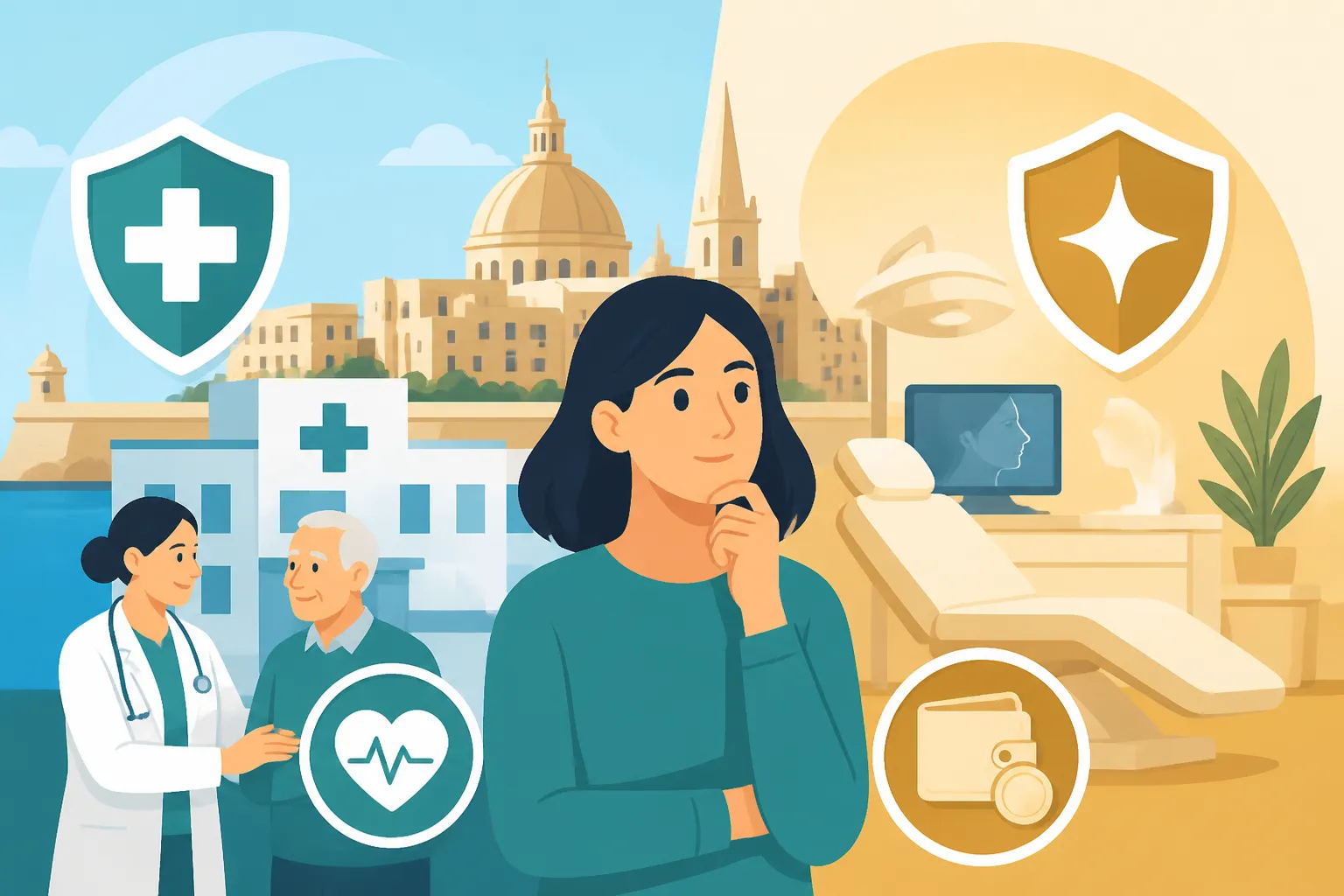
After a few months in Malta, most expats realize that while the public system is a great safety net for major trauma, the "paid extras" and the long wait times for specialist care make the system feel incomplete.
When Public Care Isn't Enough
The reality is that "free" healthcare often comes with a cost in terms of convenience and speed. If you need a diagnostic scan like an MRI, the public waiting list might be six months. If you pay privately, you can often get it done the next day at a cost of roughly €200-€300.
This is where having a hybrid approach works best. You use the public system for your GP visits and emergency needs, but you keep a private policy for everything else. For digital nomads or those on a budget, SafetyWing offers a middle ground that provides a safety net while you navigate the local system's quirks.
Why Expats Often Choose Hybrid Coverage
The Maltese government actually requires some permit holders—like those on the Nomad Residence Permit—to have private health insurance as a condition of their stay. This ensures that they don't put undue pressure on the public system while they aren't contributing as much in NI.
Even for those of us who pay NI, having that private backup means we can choose our own doctors, get seen faster, and access private hospitals where the rooms feel more like hotels and less like military barracks. It's about buying peace of mind in a system that can sometimes feel overwhelmed. For more info on permit requirements, see Private Health Insurance Requirements for Non-EU Permit Holders in Malta.
Summary of Potential Paid Extras
Even if you have full entitlement, here is a quick checklist of things you should expect to pay for:
- GP visits at pharmacies: €15–€30 (if you don't want to wait at a Health Centre).
- Most non-chronic medications: Market price at the pharmacy.
- Private specialist consultations: €60–€100 per visit.
- Routine dental work: Fillings, cleanings, and extractions.
- Glasses and contact lenses: Unless you have a specific visual impairment card.
- Physiotherapy: Public sessions are free but limited; private is usually €30–€50.
Living in Malta is a beautiful experience, but the healthcare system has its own rhythm. Once you understand that "public" doesn't always mean "zero cost," you can plan your budget—and your health—much more effectively.
Disclaimer
This guide is intended for informational purposes only and does not constitute legal or medical advice. Healthcare regulations and costs in Malta are subject to change. Always verify your specific entitlement status with the Entitlement Unit or your employer.