Which Family Members Can Join Me on a Maltese Work Permit?
Moving to a new country for work is an exhilarating milestone, but the joy of a fresh start in the Mediterranean often feels hollow if your loved ones are left behind. Navigating the bureaucratic maze of family reunification in Malta is notoriously complex and emotionally taxing. This guide breaks down exactly which family members qualify to join you, the strict financial thresholds you must meet, and the realistic timeline for bringing your family home to the islands.
Understanding Family Reunification in Malta: Who Qualifies?
When you first land a job in Malta, your focus is naturally on your own Single Permit. However, as any veteran expat will tell you, the definition of "family" in the eyes of Identità (formerly Identity Malta) is quite specific. It is not enough to simply have a relative you want to support; you must satisfy the legal criteria set out in the Family Reunification Regulations. These rules are designed to ensure that the primary breadwinner can support their dependents without becoming a burden on the Maltese social assistance system.
The Core Definition of Immediate Family
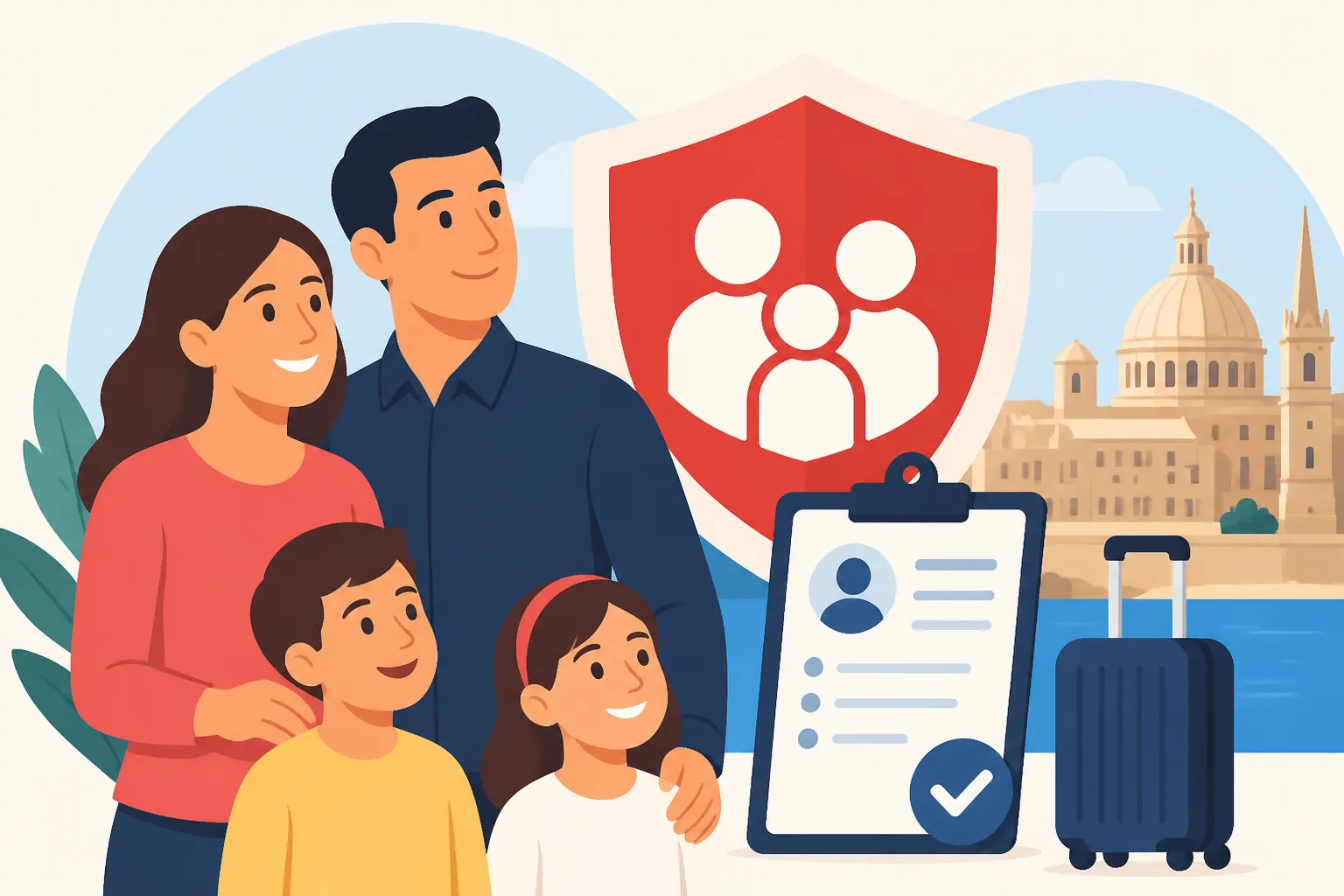
In the context of the Maltese work permit, the most straightforward category of family members includes your legal spouse and your minor, unmarried children. If you are a Third Country National (TCN) working on a standard Single Permit, you are generally viewed as the "sponsor." To bring your family, you must usually have a reasonable prospect of residing in Malta permanently.
This typically means you should have already resided in Malta for at least twelve months before your family members can apply to join you. This "waiting period" is one of the most significant frustrations for new arrivals, often leading to a year of long-distance relationships and expensive flights. However, for those under the Key Employee Initiative or the Specialist Employee Initiative, these rules are often more flexible, allowing for much faster family integration.
Eligibility for Spouses and Partners
To bring a spouse to Malta, you must be legally married, and both of you must be at least 21 years of age. Malta recognizes civil marriages and, importantly, civil unions or registered partnerships, including same-sex unions. If you are considering Can I Bring My Spouse to Malta on My Residence Permit?, the answer is a resounding yes, provided you can prove the validity of the relationship through apostilled or legalized marriage certificates.
For those in long-term stable relationships who are not legally married, the path is significantly steeper. You may find yourself asking Can I Bring My Unmarried Partner to Malta?. While it is possible under the "Policy regarding the Granting of Residence Permits to Third Country Nationals in a Stable Relationship," you must provide exhaustive evidence of a relationship lasting at least two years. This often includes joint bank accounts, shared lease agreements from your previous country, and even sworn affidavits. During this transition, many partners use platforms like iTalki to brush up on their English or learn basic Maltese phrases, which can help them integrate faster once they arrive and eventually look for work themselves.
Requirements for Children and Dependents
Children under the age of 18 are the most common dependents brought to Malta. They must be unmarried and under the legal custody of the sponsor. If you are a single parent, you will need to provide legal documentation proving you have sole custody or written, notarized consent from the other parent allowing the child to live in Malta.
The question of Are My Children Covered by Maltese Healthcare Through Me? is a vital one. Generally, once your children are registered as dependents on your permit, they can access the public healthcare system, provided you are paying your social security contributions. For older children—those over 18—they must be unmarried and unable to provide for their own needs due to their state of health or if they are still in full-time education and financially dependent on you. Bringing adult children is much more difficult and is handled on a case-by-case basis, requiring extensive medical or financial proof.
The Financial and Housing Thresholds You Must Meet
Once you identify who qualifies, the conversation shifts from emotion to cold, hard math. Malta does not allow family reunification simply because you have a job; you must prove you earn enough to maintain a decent standard of living for every person under your roof. This is where many applications hit a wall, as the requirements are indexed to the national median wage.
Income Requirements: The Stability and Regularity Test
The "Stability and Regularity" test is the benchmark Identità uses to assess your financial health. As the sponsor, you must demonstrate an income equivalent to the median wage in Malta, plus an additional 20% for each family member you intend to bring. Because tax calculations can be tricky, especially when factoring in your specific tax bracket, many expats consult services like Taxes for Expats to understand their true net "take-home" pay. The authorities want to see that after you pay your rent and taxes, you still have enough to feed and clothe your family.
When calculating What Income Do I Need to Bring My Family to Malta?, you should look at your base salary. Overtime and bonuses are often viewed as "unstable" and might not be weighted as heavily by the adjudicating officers. You will need to submit several months of payslips and bank statements showing the consistent deposit of your salary. If your income is right on the edge of the threshold, it is wise to wait until you have received a salary increase or have a significant amount of savings to bolster your application.
Housing Standards: Beyond Just Having a Roof
Perhaps the most overlooked hurdle in the Family Reunification in Malta: Bringing Your Loved Ones process is the housing requirement. You cannot simply share a studio apartment with your spouse and two children. Malta requires "adequate accommodation" that meets the general health and safety standards of the country. This means your home must be large enough to accommodate the number of people living there without overcrowding.
You will need to provide a copy of your lease agreement, which must be registered with the Housing Authority. Furthermore, you are often required to obtain an architect’s certificate or a report from the health authorities confirming the property has a sufficient number of rooms and meets hygiene standards. This is a critical step in What Accommodation Do I Need to Reunite My Family in Malta?, as an unregistered lease or a property that doesn't meet the square-footage-per-person requirements will result in an immediate rejection. Newcomers are advised to secure a long-term, high-quality rental early, even if it feels expensive, because the "stability" of your housing is a major factor in the government's decision.
The Application Process and Practical Realities for Families
Assuming you meet the financial and housing criteria, the actual application process is a marathon of paperwork. You should be prepared for How Long Does Family Reunification Take in Malta? to be anywhere from six to nine months, though it can sometimes stretch longer if there are backlogs or missing documents.
Dealing with Identità and Processing Times
The process typically starts with the sponsor submitting the application through the official portal. You will need to provide legalized translations of all birth and marriage certificates. Dealing with the administrative side of Dealing with Identità: Applications, Biometrics, and the eResidence Card requires extreme patience. You’ll be visiting the offices in Msida for biometrics, and you must ensure that every single document is exactly as requested—no expired passports, no missing stamps.
During this long waiting period, your family members might be tempted to visit you on a tourist visa (Schengen 90-day rule). While this is allowed for many nationalities, they cannot "switch" to a family permit from within the country if their nationality requires an entry visa. They generally must wait for the "Approval in Principle" letter before they can legally move and apply for their residence card. Using a language learning app like iTalki during this waiting phase is a productive way for your spouse to prepare for the local job market, as many clerical or hospitality jobs require a high level of English proficiency.
Rights of Family Members: Working and Studying
One of the most frequent questions I get from expat couples is: Can My Spouse Work in Malta on a DependPermit? In Malta, a family member on a dependent permit does not have an automatic right to work. They must find an employer willing to apply for a separate work permit for them. However, the process is usually slightly easier than the initial Single Permit because they already have a right to reside in the country.
For the children, they have the right to education. If you are working and paying social security, your children can attend state schools for free. If you prefer private or international schools, you should budget for these early, as they are in high demand. Families also need to consider Family and Children's Healthcare in Malta: Maternity, Well-Baby, and Beyond as they settle in. Knowing that your family has access to the local health centers and Mater Dei hospital provides that essential peace of mind while you focus on your career.
Comparison of Family Permit Requirements
| Family Member | Eligibility Criteria | Documentation Needed | Work Rights |
|---|---|---|---|
| Legal Spouse | Married, 21+ years old | Marriage Certificate (Apostilled) | Requires separate Work Permit |
| Minor Children | Under 18, Unmarried | Birth Certificate, Custody proof | N/A (Full access to school) |
| Unmarried Partner | Relationship > 2 years | Joint bank/lease, Affidavits | Requires separate Work Permit |
| Adult Children | 18+, Dependent/Student | Medical reports or Enrollment proof | Case-by-case basis |
| Parents | Financial dependents | Proof of no other support | Very rare for Work Permits |
Life as an Expat Family in Malta: What to Expect
Moving the family is more than just getting the plastic ID card. It’s about adjusting to the reality of life on a small island. You will need to think about childcare, which is a major expense if you don't qualify for the free government scheme. Checking How Much Does Childcare Cost in Malta? before you move will help you set a realistic family budget. Life in Malta is wonderful for children—they grow up in a safe environment with constant access to the sea—but the initial year of settling in can be financially draining.
It is often advisable for families keep their financial lives organized by using professional tax advice. Services like Taxes for Expats can help you navigate the complexities of being a tax resident in Malta while perhaps still having financial obligations or assets in your home country. This ensures that you aren't hit with unexpected bills just as you are trying to pay for your child's first term at school.
Ultimately, while the rules for which family members can join you are strict, they are not impossible to navigate. If you stay organized, maintain the required income levels, and provide high-quality housing, your family will eventually be able to join you under the Mediterranean sun. The bureaucracy is the price of admission for a lifestyle that many find well worth the effort.
Disclaimer
The information provided in this guide is for educational and informational purposes only and does not constitute legal or professional immigration advice. Immigration policies in Malta are subject to frequent change by Identità and the Ministry for Home Affairs. You should always verify the latest requirements and financial thresholds with official government sources or a qualified legal professional before making life-altering decisions.