Transferring EU Health Rights to Malta with an S1 Form or EHIC
Navigating the Maltese healthcare system while waiting for your residence documents to be processed can feel like trying to sail through a Mediterranean gale without a compass. I remember standing in the queue at the Entitlement Unit, clutching a handful of papers and wondering if my EU rights actually meant anything once I stepped onto the island. This guide solves the confusion by breaking down exactly how to use the S1 form and your EHIC to secure your health coverage during your transition.
The Reality of Health Rights Transition in Malta
The moment you arrive in Malta with the intention to settle, you enter a "liminal space" regarding your healthcare. While the European Union guarantees certain reciprocal rights, the administrative implementation in Malta requires a specific set of steps that are rarely explained clearly at the airport. You aren't just a tourist anymore, but you aren't yet a fully registered resident with a Maltese ID card. This gap is where many newcomers face their first hurdle, often discovering that their home country's coverage doesn't automatically "follow" them without the right paperwork.
Why the EHIC Is Only a Temporary Fix
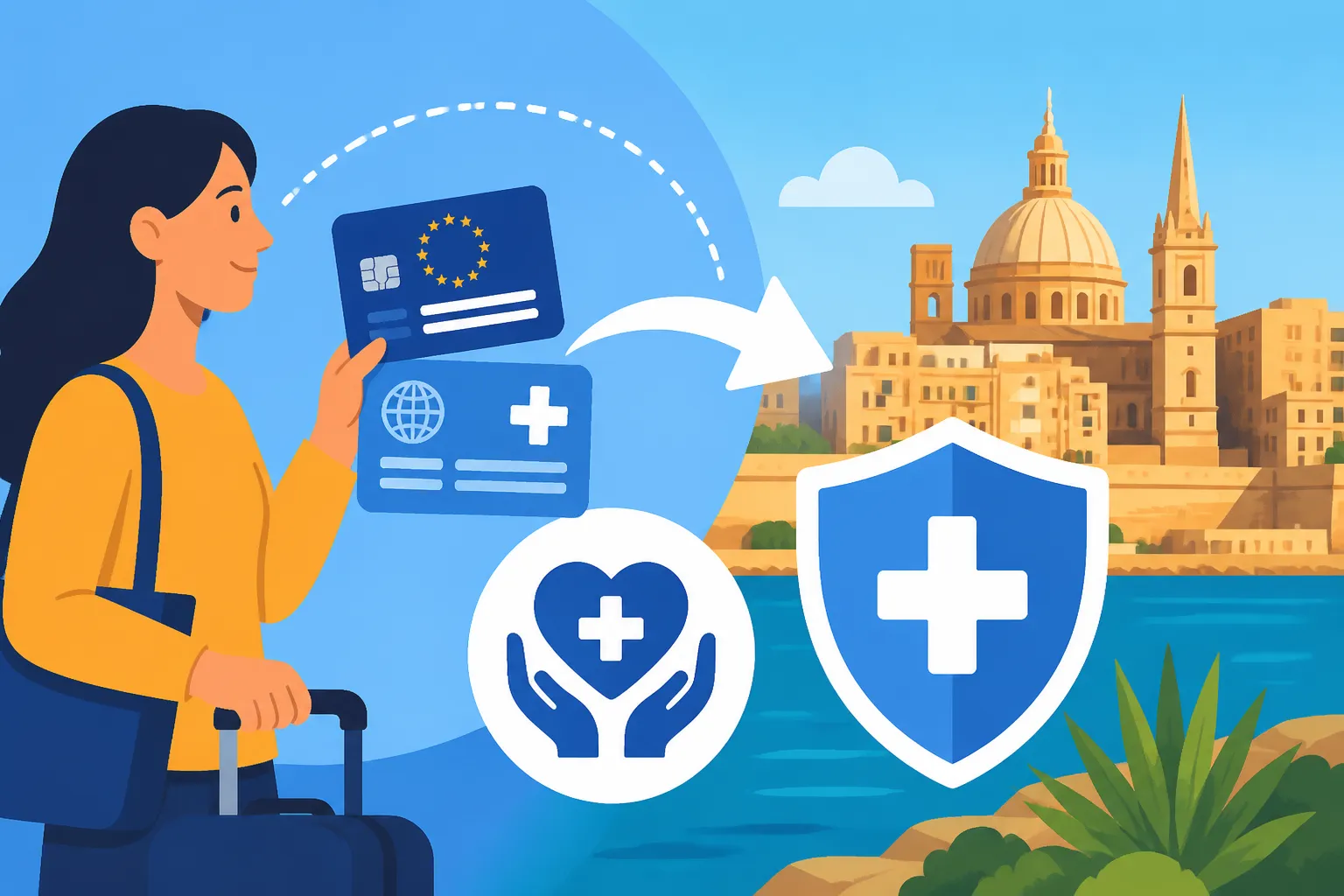
The European Health Insurance Card (EHIC) is designed for temporary stays—think holidays or short business trips. When you move to Malta permanently, the EHIC serves as your primary safety net for the first few weeks, but it is not a long-term solution. It covers "medically necessary" care, which means if you have a sudden accident or a severe flu, you can access Mater Dei Hospital or a local health centre. However, it does not cover elective surgeries, routine dental work, or long-term management of chronic conditions once you are considered a resident.
Many expats rely solely on their EHIC for months, only to be hit with a bill because they stayed past the "temporary" window. The Maltese authorities expect you to transition into the local system as soon as you are working or have established residency. Using your EHIC while settling in is a smart move, but you must understand its limitations. It won't help you with the Pharmacies and the POYC Scheme: Getting Medicines in Malta because that requires a local entitlement record.
The S1 Form: Your Golden Ticket for Long-Term Residency
For pensioners, posted workers, or those receiving certain state benefits from their home EU country, the S1 form is the most critical document in your move. Unlike the EHIC, the S1 form formally transfers your healthcare "credit" from your home country to Malta. It essentially tells the Maltese government: "Our citizen is living with you now, but we will still foot the bill for their healthcare." This is the key to unlocking the same rights as a local Maltese citizen without necessarily paying social security contributions here.
The S1 form is a paper document that you must request from your home country’s health authority before you leave. If you are already in Malta, you can still request it, but it often takes weeks to arrive by post. Once you have it, it doesn't automatically grant you rights; it must be registered with the Entitlement Unit in Malta. This registration process is what bridges the gap and ensures you are treated as a local in the eyes of How Malta's Public Healthcare Works: Entitlement, Contributions, and Costs.
Navigating the Administrative Labyrinth
The transition involves dealing with two different entities: your home country's health office and the Maltese Entitlement Unit. The biggest frustration I hear from newcomers is the "ping-pong" effect—Malta asking for a document your home country says they already sent, or vice versa. To avoid this, always keep physical copies of every form. Digital versions are gaining ground, but in the administrative offices of Gwardamanġa, a paper trail is still your best friend.
During this administrative limbo, it’s highly recommended to have a backup plan. Many expats use a flexible provider like SafetyWing to cover the gaps that neither the EHIC nor a pending S1 registration will bridge. SafetyWing provides that peace of mind when you’re caught between two systems, ensuring you aren’t paying out of pocket for private consultations while the Entitlement Unit processes your file.
Understanding the European Health Insurance Card in Malta
The EHIC remains the most misunderstood tool in the expat arsenal. In Malta, the card is widely recognized, but its application is strict. If you show up at a Health Centre with an EHIC, the staff will treat you, but they will also note that you are a visitor. Once you have applied for residency, the validity of your home country’s EHIC technically becomes questionable because you are no longer a "visitor" to that country either.
What the EHIC Actually Covers and What It Doesn't
In Malta, the EHIC grants you access to public healthcare on the same terms as a Maltese resident. This means emergency care at Mater Dei and Beyond: A Guide to Malta's Public Hospitals and Health Centres is free at the point of use. If you need an ambulance, you dial 112, and your EHIC will cover the cost of the emergency intervention. However, it’s vital to remember that the EHIC only covers public facilities. If you walk into a private clinic in Sliema or St. Julian's, your EHIC is useless, and you will be charged the full private rate.
Furthermore, the EHIC does not cover the cost of repatriation to your home country if you become seriously ill. It also doesn't cover non-urgent treatments. If you want to see a specialist for a nagging knee injury that you’ve had for years, the EHIC likely won’t cover it as "medically necessary" in the emergency sense. This is another area where supplementary coverage from SafetyWing can be invaluable, as it often fills the specialized needs that the basic EHIC mandates skip over.
Using the EHIC While You Wait for Your ID Card
The "waiting period" for a Maltese residence card can vary from a few weeks to several months. During this time, the EHIC is your primary proof of entitlement. When you visit a public health centre, you will be asked for your passport and your EHIC. The staff will make a copy of both. It is essential that your EHIC is still valid; if it expires while you are waiting for your Maltese ID, you might find yourself in a difficult position where you are asked to pay for services upfront and then claim them back later.
For those who are Using Your EHIC for Care While Settling Into Malta, the advice is simple: use it for emergencies and urgent needs only. Do not try to use it to start long-term treatments or to claim free chronic medication. The system is designed to catch these discrepancies. If you have an ongoing condition, you should ensure you bring enough medication from your home country to last at least three months, giving you enough time to get through the local registration process.
| Feature | EHIC (European Health Insurance Card) | S1 Form (Certificate of Entitlement) |
|---|---|---|
| Target User | Temporary visitors/Initial arrivals | Pensioners, posted workers, dependents |
| Duration | Short-term/Temporary | Long-term/Permanent |
| Coverage Scope | Medically necessary/Emergency care | Comprehensive (same as Maltese locals) |
| Registration | No registration needed in Malta | Must be registered with the Entitlement Unit |
| Access to POYC | Generally No | Yes, after full registration |
| Private Care | Not covered | Not covered |
The S1 Form: Deep Dive for Pensioners and Posted Workers
If you are moving to Malta and you are an EU/EEA pensioner, the S1 form is your primary route to a stress-free healthcare experience. It is the document that allows you to remain under your home country’s social security umbrella while benefiting from the Maltese system. This is particularly beneficial if you have worked your whole life in a country with a high contribution rate and want to retire in the Maltese sun without losing your healthcare rights.
Who Qualifies for an S1 Form?
Not everyone is eligible for an S1. You generally qualify if you fall into one of three categories:
- State Pensioners: If you receive a state pension from an EU/EEA country or the UK.
- Posted Workers: If your employer in another EU country has sent you to work in Malta for a specific period (usually up to two years).
- Dependents: If you are the spouse or child of someone who holds an S1, you may also be entitled to coverage through them.
It is a common mistake to think that being "self-sufficient" or a "digital nomad" automatically gives you an S1. If you are not receiving a pension or aren't a posted worker, you will likely need to look at Private Healthcare and Insurance in Malta: When You Need Cover or start paying local social security contributions to access the system.
How to Apply for and Register Your S1 in Malta
The process begins in your home country. You must contact your national health insurance provider (such as the NHS in the UK, CPAM in France, or the Krankenkasse in Germany) and request an S1 form for Malta. Once you receive the paper document, you must take it to the Entitlement Unit in Malta. The office is located at Ground Floor, Ex-Outpatients Block, St. Luke’s Hospital, Gwardamanġa.
When you go, you need to bring:
- The original S1 form (and a copy).
- Your passport or national ID card.
- Your Maltese residence card (if you have it) or your application "Blue Paper" receipt.
- Proof of your Maltese address (such as a rental agreement).
The Entitlement Unit will process your form and eventually issue a "Certificate of Entitlement." This certificate is the actual document that Maltese doctors and hospitals will look for in their system to confirm you are entitled to free care.
Common Pitfalls with S1 Registration
The most frequent issue is the lag time between submitting the S1 and it appearing in the Maltese system. I've known people who submitted their form in January and weren't "in the system" until March. During this gap, you might still be asked to pay if you visit a hospital. This is why it’s crucial to ask the Entitlement Unit for a temporary proof of submission.
Another pitfall is the expiration of the S1. While for pensioners the S1 is usually permanent, for posted workers, it has an expiry date linked to their contract. If you stay in Malta past this date without renewing the S1 or transitioning to the Maltese social security system, your healthcare rights will vanish overnight. Keeping a secondary insurance like SafetyWing during these administrative transitions ensures that if your S1 is delayed or rejected due to a technicality, you aren't left vulnerable.
Step-by-Step Guide to Registering for Health Entitlement
Once you’ve moved past the "visitor" phase, you need to formalize your status. This isn't just about having the S1 or EHIC; it’s about being recognized by the Maltese Ministry of Health. This process is handled by the Entitlement Unit, and understanding their workflow will save you hours of frustration.
Collecting Your Documentation for the Entitlement Unit
Don't even think about heading to Gwardamanġa without a folder of perfectly organized documents. The staff there are helpful but strict. You will need:
- Identity Proof: Your passport is the gold standard.
- Proof of Residency: This is where it gets tricky. If you don't have your eResidence card yet, you must show the receipt of your application from Identità.
- Social Security Evidence: If you are working, you need your latest payslip or a letter from your employer showing your Social Security number.
- The Core Document: Your S1 form or, if you are an EU worker, evidence that you are paying contributions in Malta.
If you are wondering How to Register for Health Entitlement with the Entitlement Unit in Malta, the secret is in the "Blue Paper." This is the receipt you get when you apply for your ID card. Even if the card isn't ready, that paper proves you are in the process of becoming a resident, which is often enough to get a temporary entitlement.
Visiting the Entitlement Unit in Gwardamanġa
The Entitlement Unit is tucked away in the old St. Luke’s Hospital complex. It’s not the most modern building, and the waiting room can get crowded. My advice is to arrive early—before 8:30 AM. There is a ticketing system, so grab your number and settle in. When your number is called, be prepared to explain your situation clearly: "I am an EU citizen, I have recently moved to Malta, and I need to register my S1 form" or "I am working here and need to confirm my entitlement."
The officers will check your documents and usually tell you that your record will be updated in "a few days." In my experience, "a few days" in Malta can mean anything from 48 hours to two weeks. Don't be afraid to ask for a contact email or phone number to follow up. You are looking for The Entitlement Unit: Sorting Out Your Right to Treatment in Malta to confirm that your "Health ID" is active.
Integrating with the Maltese Social Security System
If you are not using an S1 because you have found a job in Malta, your entitlement is linked to your Social Security (NI) contributions. Every month, a portion of your salary is deducted for "Class 1" contributions. These payments are what "buy" your right to the healthcare system. However, the health system and the social security system are different databases. Sometimes, you might be paying your taxes, but the health database doesn't know it yet.
To fix this, you may need to take your FS3 (annual tax summary) or your first few payslips to the Entitlement Unit to manually trigger your coverage. This is especially important if you need to access specialist care quickly. Once you are registered, you can start the process of Getting Your Maltese ID Card Number: The Key to Accessing Healthcare and linking it to your "myHealth" portal, which allows you to see your records and test results online.
Comparing Public Coverage and the Need for Supplementary Cover
While Malta’s public healthcare is excellent and ranked highly globally, it is not a "concierge" service. There are waiting lists, and the experience is very much that of a busy, high-volume public system. For many expats, the transition from a private or highly efficient system back home to the Maltese public system can be a bit of a culture shock.
When the Public System Isn't Enough
The public system is fantastic for life-saving surgery, emergency care, and chronic disease management. However, for "quality of life" issues—like a non-urgent hip replacement or specialized physiotherapy—the waiting lists at Mater Dei can be long. Furthermore, while the doctors are world-class, you don't always get to choose who you see, and you might see a different consultant at every visit.
For those who want faster access to specialists, private care is the only option. Private hospitals like St. James or DaVinci offer immediate appointments but at a significant cost. If you don't have private insurance, a single consultation with a specialist can cost between €60 and €150, and that’s before any tests or scans. Understanding What Public Healthcare Costs in Malta: Free Services and Paid Extras helps you budget for these inevitable gaps.
The Role of Private Insurance During the Transition
This is where supplemental insurance like SafetyWing proves its worth. During your first six months in Malta, you are in a high-risk zone for "administrative gaps." If you have an S1 that hasn't been processed, or if you've just started a job and your contributions haven't "hit" the health database, you are effectively uninsured for non-emergency care.
SafetyWing acts as a bridge. It’s designed for people who are between homes or settling into new ones. It covers you globally, so if you decide to pop over to Sicily for the weekend or head back home to visit family, you remain covered. Most importantly, it allows you to access private clinics for those urgent-but-not-emergency issues—like a sudden toothache or a strange rash—without waiting for the public system’s wheels to turn. Using Private Hospitals and Clinics in Malta: Faster Specialist Access becomes much more affordable when you have a policy backing you up.
Practical Tips for a Smooth Medical Transition
Moving your life to a new country is stressful enough without worrying about how to get your blood pressure medication or what to do if you twist your ankle. A little bit of foresight goes a long way in Malta, where "island time" can sometimes affect administrative speed.
Keeping Your Medical Records Accessible
Don't leave your medical history behind. Maltese doctors are very appreciative when a new patient arrives with a concise summary of their history, recent blood tests, and a list of current medications (using their generic names, not just brand names). Since Malta uses English as an official language, you usually don't need to translate these if they are already in English. If they are in another language, a professional translation of the most important summaries is a great investment.
Digital access is also key. Before you leave your home country, ensure you have login details for your current health portals. Once you are settled in Malta and have your ID card, you should immediately look into How Do I Register for Free Healthcare in Malta? and then sign up for the myHealth portal. This will eventually be where all your Maltese records are stored, making future transitions much easier.
Dealing with Pharmacies and Prescriptions
In Malta, pharmacies are the frontline of healthcare. Every village has at least one, and they are often the best place to get advice for minor ailments. However, if you are used to getting free or subsidized medication, you need to understand that until your entitlement is fully registered (especially under an S1), you will have to pay the full price for prescriptions.
Maltese pharmacies can also be strict about foreign prescriptions. While many will honor a clear prescription from an EU doctor for a short period, they will eventually insist on a prescription from a doctor registered in Malta. It is wise to suggest finding a local GP (General Practitioner) in your first month. You can find them at local health centres or, more commonly, in the back of the local pharmacy for a small fee (usually €10-€20). They can transcribe your foreign prescriptions onto Maltese forms, ensuring you can continue your treatment without interruption. If you're wondering Can I See a Doctor in Malta Before My Health Entitlement Is Approved?, the answer is yes, but you'll likely do it through these private pharmacy-based GPs while you wait for the public system to recognize you.
Disclaimer
The information provided in this guide is for informational purposes only and does not constitute legal or professional medical advice. Healthcare regulations and entitlement criteria in Malta are subject to change. Always consult with the Maltese Entitlement Unit or a qualified legal professional regarding your specific residency and health coverage status. Additionally, please consult a medical professional for any health-related concerns.