Family and Children’s Healthcare in Malta: Maternity, Well-Baby, and Beyond
Moving to a new country with a family often feels like trying to assemble furniture in the dark, especially when you are navigating a medical system that works differently than back home. I remember the panic of my first month in Sliema, staring at a toddler with a sudden 39-degree fever and realizing I had no idea which doctor to call or where the nearest open pharmacy was. This guide solves that confusion by walking you through every stage of family healthcare in Malta, from your first antenatal visit to finding the right pediatrician for your school-aged children.
Navigating the Maltese Maternity System
The journey of family healthcare often begins with pregnancy, and in Malta, you will find a system that is both deeply traditional and technologically advancing. Most expats find themselves standing at a crossroads: do they rely on the robust public system at Mater Dei Hospital, or do they opt for the privacy and speed of the private sector? Having seen both sides, I can tell you that the public care is medically excellent, but the private route offers a level of continuity that many foreigners find comforting during a vulnerable time.
Choosing Between Public and Private Care
If you are paying social security contributions in Malta, you are entitled to free maternity care at Mater Dei, which is the island’s main state-of-the-art hospital. However, many expats ask, Is Maternity Care Free in Malta? and the answer depends entirely on your residency status and work history. Public care follows a "shared care" model between your local health centre and the hospital. You will likely see different midwives and doctors throughout your journey, which can feel a bit impersonal if you are used to a single dedicated OBGYN.
On the other hand, private maternity care—often centered around St James Hospital or private clinics in Sliema and Birkirkara—allows you to choose your consultant. You will see the same face at every appointment, and they will likely be the one to deliver your baby. The downside is the cost, which can run into several thousand euros for a delivery. Many new arrivals choose to maintain a flexible insurance plan like SafetyWing during their first few months to ensure they have coverage while they wait for their Maltese social security paperwork to clear, as the public system can be strict about documentation before granting full entitlement.
Antenatal Visits and Mater Dei
Once your pregnancy is confirmed, usually by a GP at a local pharmacy, you will need to be registered with the Mater Dei maternity department. In the public system, your antenatals will alternate between the hospital’s Outpatients department and your regional Health Centre. Be prepared for some waiting; Mater Dei is a busy hub, and even with an appointment, you might find yourself waiting an hour or two. It is wise to bring a book and plenty of water, especially during the humid summer months.
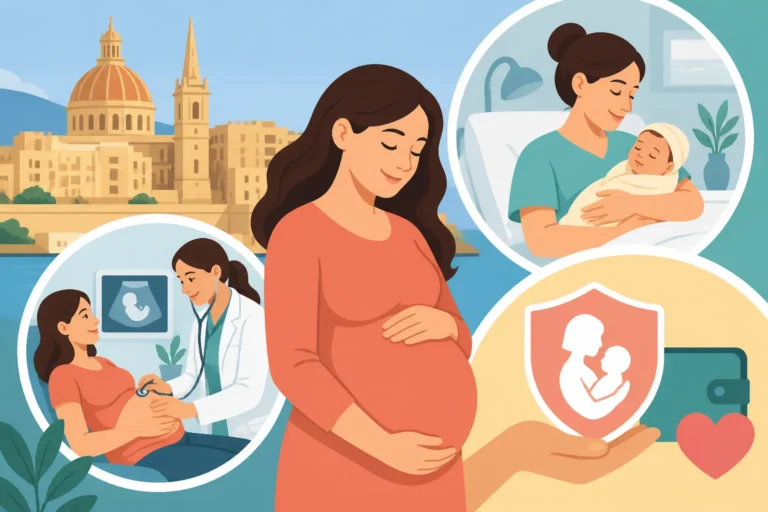
During these visits, you will undergo regular blood tests, ultrasounds (usually at 12 and 20 weeks), and glucose tolerance tests. The midwives at Mater Dei are legendary for their experience and no-nonsense approach. They will guide you through the "Parent Craft" classes, which are highly recommended for expats. These classes are a fantastic way to meet other parents-to-be and understand the specific protocols of a Maltese birth, such as what to pack in your "hospital bag" (which, in Malta, includes everything from baby clothes to your own water bottles).
Midwifery and Postnatal Support
After birth, the support shifts to the community. If you have a natural delivery at Mater Dei, you might be home within 24 to 48 hours. This is where the Midwifery Service (CommCare) comes in. A midwife will visit you at home to check on both you and the baby, assisting with healing and weight checks. For many expats living away from their extended families, these visits are a lifeline. They provide the professional reassurance that everything is progressing as it should.
Breastfeeding support is also a significant part of the postnatal phase in Malta. The breastfeeding clinic at Mater Dei is excellent, though it can be busy. If you find yourself struggling at 3 AM, there are private lactation consultants available who can visit your home. You should also look into Can I Get Breastfeeding Support Through Maltese Healthcare? to see what free resources are available in your specific locality, as some health centres offer specialized nursing support for new mothers.
The Public Health System for Families
Malta’s public healthcare is built on a foundation of "Health Centres" (known locally as the 'bereġ') and the central Mater Dei Hospital. For a family, understanding how to navigate these is the difference between a stressful afternoon and a smooth experience. The system is funded through taxation, but as an expat, your entry ticket into this system is your ID card and your record of social security contributions.
Health Entitlement and Social Security
Your right to access free care for your children is usually tied to your own employment or that of your spouse. If you are working and paying Class 1 or Class 2 contributions, your children are generally covered under your "umbrella." However, do not assume this happens automatically. You must register with the Entitlement Unit to ensure your children’s names are in the system. Many families get caught out at the pharmacy or the hospital because they hadn't finalized this administrative step.
It is vital to understand that Health Entitlement in Malta: How Social Security Contributions Unlock Free Care is not just about having a job; it’s about the "S1" forms for EU citizens or the specific "Health Entitlement" letter for third-country nationals. While you are waiting for these documents to be issued, having a reliable travel or expat insurance like SafetyWing is a smart move. It covers the gap so you don't end up paying private rates for a sudden childhood ear infection or a trip to the emergency room.
The Role of Health Centres
The Health Centres are the primary point of contact for non-emergency issues. Malta is divided into several catchment areas, and you must go to the one assigned to your town. For example, if you live in Pembroke or St Julian's, you will likely head to the Gzira Health Centre. These centres offer a range of services including GP consultations, nursing care, and even speech therapy. You don't usually need an appointment for a GP; you simply walk in, take a number, and wait.
For families, the Registering with a Health Centre and Choosing a GP in Malta process is slightly different than in many other countries. You don't "sign up" with one specific doctor who knows your family for years. Instead, you see whoever is on duty. While this ensures you are always seen on the day you visit, it lacks the continuity some parents prefer. Because of this, many expats choose to use the "Pharmacy Clinic" system for routine family illnesses, which I will explain in the pediatric section below.
Emergency Care for Children
In a true medical emergency, you have two main options: call 112 for an ambulance or head directly to the Paediatric Accident & Emergency (A&E) at Mater Dei. The 112 service is efficient, but keep in mind that Malta’s narrow streets and heavy traffic can sometimes delay response times. If you have your own transport and the situation is stable enough to drive, going directly to Mater Dei is often faster.
When you arrive at Mater Dei A&E, your child will be triaged. The "Paediatric Day Care" and emergency area are separate from the main adult A&E, which is a blessing. It is a much calmer environment designed specifically for children. If you are unsure whether your situation is a true emergency, you can call the What Number Do I Call for an Ambulance in Malta? guide or contact the "Primary Health Care" helpline for advice. Most emergency care for children is provided free of charge at the point of use, regardless of your immediate paperwork status, though you may be billed later if you aren't entitled to free care.
Well-Baby Clinics and Preventive Care
Malta places a high value on preventive care for children. From the moment your baby is born, they are entered into a national system of monitoring that tracks their growth, vaccinations, and developmental milestones. This is managed through the "Well-Baby Clinics" located within the various Health Centres.
The National Immunisation Schedule
Vaccinations in Malta are comprehensive and generally follow the European standards, but the schedule might differ slightly from your home country. The vaccinations provided under The National Immunisation Schedule for Children in Malta are free for all children residing on the island. You will be given a "Blue Book" (the parent-held child health record) shortly after birth or when you first register your child's health status. Do not lose this book! It is your child’s medical passport and will be required for school enrollment later on.
The schedule includes the 5-in-1 (DTaP-IPV-Hib), MMR, and Meningococcal vaccines, among others. While the core vaccines are free, some "optional" vaccines—like the Chickenpox or Rotavirus vaccines—may need to be purchased privately at a pharmacy and administered by your pediatrician. I remember being surprised that I had to go buy the vaccine myself and bring it back to the clinic in a cool bag; this is a very common Maltese "quirk" you should be prepared for.
Developmental Check-ups
The Well-Baby Clinics aren't just for jabs; they are for ensuring your child is hitting their milestones. These check-ups typically happen at 6 weeks, 8 months, 18 months, and 3 years. A pediatrician or a specially trained GP will check the baby’s hips, hearing, vision, and general motor skills. For an expat, these appointments are a great time to ask questions about local nutrition or climate-specific advice, such as how to handle the intense Maltese sun with a newborn.
If a developmental delay is suspected, the clinic will refer you to the Child Development Assessment Unit (CDAU). This is a specialized public service that provides multidisciplinary assessments. Be aware that waiting lists for the CDAU can be long. If you have insurance like SafetyWing or a private health plan, you might find it faster to seek an initial private assessment to get the ball rolling while you wait for the public system to catch up.
Feeding Support and Growth Monitoring
Growth monitoring is a standard part of every Well-Baby visit. Your child will be weighed and measured, and the results will be plotted in that all-important Blue Book. If there are concerns about growth or feeding, the health centre nurses are generally very supportive. Malta has a strong culture of supporting breastfeeding, but they are also realistic about formula feeding and will provide guidance on safe preparation and local brand availability.
For older children, the focus shifts to healthy eating and obesity prevention, which is a significant public health focus in Malta. You may find that your health centre offers "lifestyle" clinics for families to help navigate the abundance of pastizzi and sweets that seem to be at every Maltese social gathering. It’s all part of a holistic approach to keeping the "next generation" of islanders healthy.
Pediatric Care and Specialist Services
When your child is actually sick—not just needing a check-up—the way you access a pediatrician in Malta is unique. Unlike many countries where you are assigned a pediatrician through your insurance or a central clinic, in Malta, most families build a relationship with a private pediatrician who works out of a local pharmacy.
Finding a Private Pediatrician
In almost every town in Malta, the local pharmacy has a small clinic room in the back. These "Pharmacy Clinics" are the backbone of Maltese family medicine. You will find that a pediatrician visits the pharmacy at set times, usually in the evening or on Saturday mornings. You often don't even need a formal appointment; you just call the pharmacy in the morning, put your name on the list, and show up.
If you are wondering How Do I Find a Paediatrician for My Baby in Malta? the best advice is to ask your neighbors or join local expat Facebook groups. Everyone has a favorite. The cost of a private pediatric consultation is surprisingly affordable, usually ranging from €20 to €35. This is why many families—even those entitled to free public care—choose to go private for routine illnesses. It is faster, more convenient, and you get to see the same doctor every time.
Specialist Referrals at Mater Dei
If your child has a more complex or chronic condition that requires a specialist (like a pediatric cardiologist or neurologist), you will generally need to enter the public hospital system. Even if you see a private pediatrician, they can write a referral letter for the state system. This is a common way to "bypass" the initial GP wait at the health centre.
Understanding How the Specialist Referral System Works in Malta's Public Hospitals is key. Once your referral is sent to Mater Dei, you will receive an appointment letter by mail. This can take anywhere from a few weeks to several months depending on the urgency. If you feel the wait is too long, you can use your private insurance to see a specialist at a private hospital like St James, though any subsequent long-term treatment or surgery is often still moved back to Mater Dei due to its superior specialized equipment and ICU facilities.
School Health Services
Once your child starts school, the state provides an additional layer of health monitoring. The School Health Service conducts regular screenings for vision, hearing, and scoliosis. They also manage the "National School Immunisation Programme," where boosters are given on school grounds (with parental consent).
If your child attends a private or international school, these services are still available, though the coordination might be slightly different. In the public and church school sectors, the "school nurse" is a frequent visitor. They act as a bridge between the education and health systems, ensuring that children with chronic conditions like asthma or diabetes are properly supported during the school day.
Dental, Eye, and Mental Health for Children
Family healthcare isn't just about fevers and flu shots. In Malta, dental and vision care are handled through a mix of public provision and a very active private market. Mental health support for children is also an emerging priority, though it can be more challenging to navigate than physical health services.
Free Public Dental Care for Kids
Dental care is one area where the public system is quite generous for children. Kids under the age of 16 are entitled to free dental treatment at the dental departments of the various Health Centres and Mater Dei. This includes check-ups, fillings, and extractions. To find out more, check Is Dental Care Free for Children in Malta? for the latest age limits and service lists.
However, for orthodontic work (like braces), the criteria for free treatment are very strict and usually limited to severe functional cases. For most cosmetic or moderate orthodontic needs, families go to private dentists. Malta has an incredibly high density of dentists, and the quality of care is generally excellent. Many parents choose to take their children to a private dentist for regular cleaning to avoid the health centre queues, saving the public system for more significant procedures.
Vision Screenings and Opticians
Vision is screened at various intervals: first at the Well-Baby Clinic, then again through the school health system. If a problem is detected, you will be referred to the Ophthalmic Department at Mater Dei. However, as with many things, the wait times can be an issue.
Most Maltese families visit a private optician for an initial eye test. Many opticians have an resident ophthalmologist (an eye doctor) who visits once or twice a week. You can find more details in the Eye Care and Opticians in Malta: Exams, Glasses, and Costs guide. If your child needs glasses, there are dozens of shops in areas like Birkirkara and Valletta with a huge range of kid-friendly frames. While the eye test might be cheap or even free if you buy glasses, the frames and lenses themselves are a private cost.
Mental Health Support for Youth
If you are seeking mental health support for your child, the primary public route is the Child and Adolescent Mental Health Services (CAMHS). This is a specialized service located at Mt. Carmel Hospital or through outpatient clinics. Referrals usually come from your pediatrician or a school counselor.
The reality of mental health care in Malta is that the public sector is stretched thin. For issues like anxiety, ADHD assessments, or therapy, many expat families find it necessary to seek private psychologists or therapists. This can be expensive, and it is another area where having a robust insurance policy like SafetyWing can be helpful, especially if it offers coverage for specialist consultations. There are also NGOs like Richmond Foundation that offer support services for families navigating mental health challenges.
Costs, Insurance, and Administrative Tasks
The "boring" part of healthcare—the paperwork—is often what causes the most stress for families. In Malta, everything is connected to your residency status, and getting your "ducks in a row" early will save you a lot of heartache later.
Registering a Newborn for Healthcare
If your baby is born in Malta, the hospital will provide you with the necessary forms to register the birth with Identità (formerly Identity Malta). Once you have the birth certificate, you need to apply for the baby’s own eResidence card, even if they are just a few weeks old. This card number becomes their lifelong identifier in the health system.
You will also need to visit the Entitlement Unit (often located in St Luke’s Hospital grounds in Gwardamangia) to add the baby to your family’s health entitlement. For a step-by-step walkthrough, see How Do I Register a Newborn for Healthcare in Malta? to ensure you have all the original documents and photocopies required. Missing one stamp can result in a wasted trip, which is the last thing you want with a newborn in tow.
Private Insurance for Expats
Many expats ask if they need private insurance. While the public system is great, it is not always "fast." Private insurance provides a "fast-track" for specialist consultations, private hospital rooms, and elective surgeries. For families moving to Malta, it is often a good idea to start with a plan like SafetyWing. It is flexible, handles the "gap" before you are fully in the Maltese system, and provides peace of mind for those first six months when you are still figuring out where the health centres are.
Private insurance also covers the cost of seeing private pediatricians and specialists, which, while affordable individually, can add up if you have multiple children or a child with a chronic condition. It also allows you to use hospitals like St James, which many find more comfortable and "quieter" than the bustling Mater Dei.
Benefits and Financial Support for Families
Malta offers several financial benefits to help with the costs of raising a child. The "Maternity Benefit" and "Maternity Leave Benefit" are available to mothers who are employed or self-employed. There is also a "Children's Allowance" which is paid to the mother and is based on the family's income.
To claim these, you generally need to have been paying social security for a specific period. You can find the details in the How Do I Claim the Maternity Benefit in Malta? guide. These benefits are usually applied for online through the Social Security portal. It’s worth the effort to apply; even the minimum allowance is a helpful contribution toward the cost of nappies and clothes.
Local Tips for Healthy Living in Malta
Finally, living in Malta requires some adjustments to your daily health routine. The environment here is unique—very salty, very humid, and very sunny.
Dealing with Heat and Humidity
The Maltese summer (June to September) is no joke. Heatstroke and dehydration are real risks for young children. My rule of thumb is "indoor play between 11 AM and 4 PM." When you do go out, high-factor sunscreen is a must, even on cloudy days. Humidity can also make the heat feel much more intense, so ensuring your home has good ventilation or air conditioning is vital for a baby’s sleep and health.
In winter, the challenge is the dampness. Maltese houses are built to stay cool in summer, which means they can become cold and damp in winter. This often leads to mold, which can trigger respiratory issues in children. Using a dehumidifier in the winter months is a common "local secret" to keeping your family’s lungs healthy. You can find more tips in How Do I Cope with the Summer Heat and My Health in Malta? to prepare for the seasonal shifts.
Water Safety and Tap Water
A common question is Is Tap Water Safe to Drink in Malta? Technically, yes, it is safe and meets EU standards. However, it is desalinated seawater and has a very high mineral content and a distinct taste that many children find unpleasant. Most families either use a high-quality water filter or have large mineral water bottles delivered to their homes.
When it comes to the sea, Malta has some of the cleanest bathing waters in the EU. However, always check for jellyfish alerts (there are local apps for this). A "Mauve Stinger" sting can be very painful for a child. Most pharmacies sell "jellyfish sting" cream, and it’s a good idea to keep a tube in your beach bag alongside the sunscreen.
Building a Parent Support Network
Perhaps the most important "health" tip I can give you is to find your village. Being an expat parent can be isolating, and your mental health is just as important as your child’s physical health. Join groups like "Malta Mums" on Facebook or attend local baby-and-toddler classes.
These networks are where you will get the best "real-world" medical advice: which pediatrician is currently seeing patients, which pharmacy has the elusive brand of baby formula you need, and which health centre currently has the shortest queues. In Malta, "who you know" often helps you navigate "what you know," and having a group of fellow parents to message in the middle of the night can make all the difference in your expat journey.
| Service Type | Public System (Mater Dei / Health Centres) | Private Sector (Pharmacy Clinics / St James) |
|---|---|---|
| Cost | Free (for entitled residents) | Paid (€20-€50 for GP/Pediatrician) |
| Appointments | Often walk-in or long wait lists | Same-day or scheduled quickly |
| Continuity | Low (see whoever is on duty) | High (choose your own doctor) |
| Emergency | Full A&E and ICU facilities | Limited emergency services |
| Vaccinations | Free (National Schedule) | Paid (Optional vaccines) |
Medical Disclaimer
The information provided in this article is for general informational purposes only and does not constitute professional medical advice, diagnosis, or treatment. Always seek the advice of a qualified healthcare provider in Malta regarding any medical condition or the health of your children. Reliance on any information provided in this guide is solely at your own risk. The author is an expat sharing personal experiences and research, not a licensed medical professional. In case of a medical emergency, immediately dial 112.