How Much Does Private Health Insurance Cost in Malta?
Figuring out the cost of private health insurance in Malta often feels like trying to find a parking spot in St. Julian’s on a Saturday night—frustrating and filled with hidden turns. I remember sitting in my first apartment in Gzira, staring at my social security deductions and wondering why I still needed to pay for a separate private policy. This guide breaks down the actual costs, the various plan levels, and why having that extra layer of protection is often the difference between a quick recovery and months of waiting.
Why Private Coverage is Often Essential Despite the Public System
Most newcomers arrive under the impression that the public healthcare system is entirely free and accessible from day one. While it is true that How Malta's Public Healthcare Works: Entitlement, Contributions, and Costs outlines a system funded by your social security, the administrative reality is rarely that simple. When you first arrive, there is often a significant lag between your first paycheck and receiving your official entitlement. During this "grey period," you are technically responsible for your own medical costs unless you have a European Health Insurance Card, and even then, its use is limited to "necessary" rather than elective care.
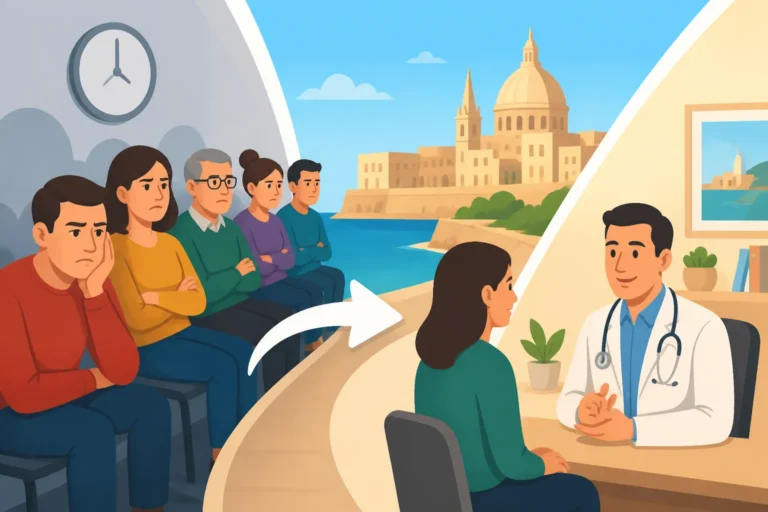
The most jarring realization for many expats is the length of the waiting lists for non-emergency procedures. While Mater Dei and Beyond: A Guide to Malta's Public Hospitals and Health Centres provides world-class emergency care, a simple diagnostic MRI or a specialist consultation for a nagging back issue can take months. Private insurance allows you to bypass these bottlenecks, giving you access to private hospitals where you can often see a specialist within 48 to 72 hours.
Furthermore, certain residence permits mandate private coverage. If you are here on a specific visa, you might find that Do I Need Private Health Insurance for My Maltese Residence Permit? is the first question your lawyer asks. For those moving as digital nomads, the requirements are even more specific. If you are a remote worker, understanding Why Nomad Residence Permit Holders Need Private Insurance in Malta is crucial, as the government requires proof of comprehensive cover that includes inpatient and outpatient care before they will even process your application.
Breaking Down the Cost Factors for Private Insurance
The cost of your premium in Malta is not a flat rate; it is a calculated risk based on several variables that the insurers weigh heavily. The most significant factor is almost always your age. In Malta, insurance premiums tend to stay relatively affordable until you hit the age of 40. After that, you will notice a steady climb in annual costs. For a healthy 30-year-old, a basic local plan might cost as little as 250 EUR to 350 EUR per year, but that same plan could easily double by the time you reach 55.
Another major price driver is the level of territorial coverage. You have two main choices: local plans and international plans. Local plans are designed specifically for the Maltese Islands. They cover treatments at local private facilities like St. James Hospital or DaVinci Health. International plans, on the other hand, cover you across Europe or even worldwide. If you are a frequent traveler or a digital nomad who spends months in other countries, an international provider like SafetyWing might be more cost-effective than buying a local Maltese policy plus separate travel insurance for every trip. SafetyWing is particularly popular among the younger expat crowd in Malta because it offers a flexible, subscription-based model that fits a mobile lifestyle.
Finally, your choice of "Outpatient" coverage will drastically change the price. Basic plans usually only cover "Inpatient" care—which means you are only covered if you are admitted to a hospital bed overnight. If you want the insurance to pay for your GP visits, specialist consultations, or physiotherapy, you must add an outpatient module. This can increase the premium by 50% or more, but it is often worth it if you prefer the convenience of Private Hospitals and Clinics in Malta: Faster Specialist Access for every minor ailment.
Average Cost Estimates for 2026
To give you a realistic idea of what to budget, I have put together a comparison of the different tiers of insurance currently available on the market. These figures are based on a healthy individual in their early 30s. Keep in mind that as you age or if you have pre-existing conditions, these numbers will shift upward.
| Plan Type | Estimated Annual Cost | Estimated Monthly Cost | Key Coverage Features |
|---|---|---|---|
| Basic Local (Inpatient Only) | €250 – €400 | €21 – €34 | Hospital stays, surgery, and basic tests in Malta only. |
| Mid-Tier Local (Inpatient + Outpatient) | €500 – €850 | €42 – €71 | Specialist consultations, GP fees, and diagnostic scans. |
| Comprehensive International | €1,200 – €2,500 | €100 – €210 | Worldwide or Europe-wide coverage, dental, and high limits. |
| Nomad/Expat Subscription | €500 – €900 | €42 – €75 | Flexible, monthly renewals, global travel coverage. |
For many of us who aren't ready to commit to a massive annual local contract, SafetyWing offers a middle ground that provides the necessary coverage for residence permits while remaining affordable. It is especially useful if you are still figuring out if Malta will be your "forever home" or just a two-year stint in the sun.
When you are looking at these prices, don't just look at the bottom line. Check the "excess" or "deductible." A plan that costs 200 EUR a year might have a 500 EUR excess, meaning you pay for almost everything out of pocket anyway unless something catastrophic happens. A lower excess is often worth considering for outpatient care because those 60 EUR specialist fees add up quickly when you are trying to solve a medical mystery.
The Difference Between Local and International Providers
Choosing between a local Maltese insurer and an international one is a decision that depends entirely on your lifestyle. Local providers like GasanMamo, Atlas, or Mapfre Middlesea have deep roots in the community. They have direct billing agreements with the major private clinics, meaning you often don't have to pay upfront and wait for a refund. This is a massive relief when you’re dealing with a 3,000 EUR surgery bill. You simply show your card, pay your small excess, and the hospital handles the rest with the insurer.
However, local plans can be quite rigid. They often have strict "pre-authorisation" requirements. If you don't call them before you go for a scan, they might refuse to pay. This is where international options often shine. Companies like SafetyWing are built for people who don't want to navigate a maze of local bureaucracy. Their claims processes are usually digital-first and much more intuitive for someone used to modern fintech apps. While they might not always have direct billing at every tiny clinic in Gozo, their flexibility for those who cross borders frequently is unmatched.
Another thing to consider is the "Moratorium" vs. "Full Medical Underwriting." Local Maltese companies often use full underwriting, meaning they will ask for your entire medical history and might exclude anything you've ever had a cough for in the past five years. International expat insurance sometimes offers a moratorium, where they simply don't cover pre-existing conditions for the first two years, but if you remain symptom-free, they might start covering them later. It is a nuanced area, and I highly recommend reading Private Healthcare and Insurance in Malta: When You Need Cover to understand which approach fits your medical history better.
Hidden Costs and What Isn't Usually Covered
Even with the best private insurance, there are "out-of-pocket" expenses that catch people off guard. Most private plans in Malta do not cover routine maternity care unless you have a very expensive, high-end premium that you’ve held for at least 10 to 12 months. If you are planning a family, you need to look into Maternity Care in Malta: Antenatal Visits, Birth, and the Maternity Benefit to see how the public and private systems interact, as a private birth can cost upwards of 5,000 EUR without specific maternity insurance.
Chronic conditions are another area where costs can spiral. Most private insurers will cover the initial diagnosis of a condition like diabetes or asthma, but once it becomes a "maintenance" issue, they may stop paying for the medication and routine check-ups. This is where the public system becomes your best friend. Through the Pharmacies and the POYC Scheme: Getting Medicines in Malta, the government provides free medication for many chronic conditions regardless of your private insurance status.
Lastly, pay attention to the "General Practitioner" (GP) fees. Many mid-tier private plans only reimburse a portion of the GP fee—perhaps 15 EUR out of a 20 EUR or 30 EUR visit. It sounds like a small amount, but if you have young children who catch every seasonal bug going around the school, those small gaps in coverage add up. If you have a family, it is worth checking Family and Children's Healthcare in Malta: Maternity, Well-Baby, and Beyond to see what services you can get for free through the local health centres to supplement your private policy.
How to Apply and Get the Best Rate
To get the best price, don't just take the first quote you get. Use a broker or spend an afternoon on the various local websites. Most of them have a "Quick Quote" feature that takes five minutes. If you are applying for a residence card, make sure the policy you choose meets the "full cover" requirements set by Identità (the agency responsible for residence permits). Some people buy cheap travel insurance only to have their residence application rejected because the policy didn't cover "all risks" in Malta.
When filling out your application, be brutally honest. If you hide a pre-existing condition to save 50 EUR on your premium, the insurer will likely find out when you make a claim, and they can void your entire policy. It isn't worth the risk. If you are worried about costs, consider a higher excess. Moving your excess from 0 EUR to 100 EUR can sometimes drop your annual premium by 20%.
For those who are just arriving and need something immediate and compliant, SafetyWing is a fantastic starting point. You can sign up online in minutes, which is a lifesaver if you realize on a Sunday night that your residence appointment is on Monday morning and you forgot your health cover. Once you are settled and understand How the Specialist Referral System Works in Malta's Public Hospitals, you can then decide if you want to stick with an international subscription or move to a long-term local contract.
Important Medical Disclaimer
This guide is intended for informational purposes only and is based on the personal experiences of expats living in Malta and general market research. Healthcare regulations, insurance policy terms, and government entitlement rules are subject to change. Always consult with a licensed insurance broker or a legal professional before purchasing a policy to ensure it meets your specific health needs and legal residency requirements. This content does not constitute medical or financial advice.