What Vaccinations Does My Child Need in Malta?
Moving to a new country with children involves a mountain of paperwork, but few things feel as high-stakes as ensuring their medical records align with local requirements. I remember the stress of sitting in a sun-drenched kitchen in Sliema, staring at my son’s immunization booklet from home and wondering if his "6-in-1" meant the same thing to a Maltese doctor as it did back in London. This guide solves the confusion by breaking down the specific vaccinations your child needs to follow the Maltese national schedule, how to access them, and what to do with those foreign records.
Understanding the National Immunisation Schedule for Children in Malta
The Maltese healthcare system is robust, and its approach to childhood immunization is proactive and highly organized. The National Immunisation Schedule for Children in Malta is designed to protect the community from infectious diseases that were once common on the islands. While vaccination in Malta is not strictly mandatory by law for everyday life, it is a practical necessity for anyone intending to enroll their children in the state, church, or independent school systems.
When you first arrive, you might find the terminology slightly different from what you are used to. Malta follows a schedule that is largely in line with European Centre for Disease Prevention and Control (ECDC) recommendations, but the timing of boosters can vary. The government provides these vaccines free of charge to all children who are entitled to public healthcare. If you are still waiting for your paperwork to be processed, you might consider a temporary solution like SafetyWing to ensure you have some level of health administrative support or coverage for private consultations while you navigate the state system.
Is Vaccination Required for School Entry?
Validation of your child's immunization status is a standard part of the school registration process in Malta. When you apply for a place at a local school, you will be asked to provide a copy of the child’s "Yellow Card" (the local immunization record) or a verified history from your home country. If there are gaps in the schedule—for example, if your home country does not routinely vaccinate against Meningitis ACWY but Malta does—the school health doctors will likely flag this during their routine screenings.
It is common for parents to feel a bit of "system shock" when they realize that the school health team actually visits schools to administer certain boosters. This is a very efficient way of ensuring high coverage, but it can be surprising for parents used to making private appointments for every single jab. You will always receive a consent form home in your child’s school bag before any vaccination takes place on school grounds.
The Role of the National Immunisation Service
The National Immunisation Service (NIS) is the body responsible for coordinating these efforts. They operate through various Health Centres across the islands. Whether you are living in the bustling North Harbour region or a quiet village in the South, you will be assigned to a specific Health Centre based on your residence. This is where the majority of the "heavy lifting" for your child’s health will happen.
If you are unsure where to start, Which Health Centre Do I Go to After Moving to Malta? is an essential resource to help you locate your primary point of contact. The nurses at these centres are incredibly experienced with expat families and are usually the ones who will "translate" your foreign records into the Maltese system.
The Maltese Vaccination Schedule: Age-by-Age Breakdown
Malta’s schedule is rigorous, starting almost immediately after birth. The government ensures that the most critical vaccines are administered during the first two years of life, which is the period of highest vulnerability.
Infancy: Birth to 12 Months
In the first year, your child will receive protection against a wide array of diseases. The most significant is the "6-in-1" vaccine, which covers Diphtheria, Tetanus, Pertussis (whooping cough), Polio, Haemophilus influenzae type b (Hib), and Hepatitis B. In Malta, this is typically given at 2, 4, and 6 months of age.
Another critical component is the BCG vaccine for Tuberculosis. While many Western countries have moved away from universal BCG vaccination, Malta maintains it for all newborns, usually administered at Mater Dei and Beyond: A Guide to Malta's Public Hospitals and Health Centres shortly after birth. If your child was born abroad and did not receive the BCG, the NIS might recommend a skin test and subsequent vaccination depending on the child’s age and your previous residence.
Toddlerhood and Early Childhood: 12 Months to 5 Years
Between the first and second birthday, the focus shifts to the MMR vaccine (Measles, Mumps, and Rubella). The first dose is typically given at 13 months. This is also the time when the Hib booster and the Meningitis C vaccine are administered.
It is worth noting that while some countries combine the MMR with the Varicella (Chickenpox) vaccine, in Malta, the Varicella vaccine is currently not part of the mandatory free national schedule, though it is frequently recommended by private pediatricians. If you want your child to have the Chickenpox vaccine, you will likely need to purchase it at a pharmacy and have a doctor administer it privately. During these transitions, Children's Health in Malta: Well-Baby Clinics, Vaccinations, and School Health can provide a more detailed look at the developmental milestones checked alongside these vaccinations.
Adolescence: 10 to 16 Years
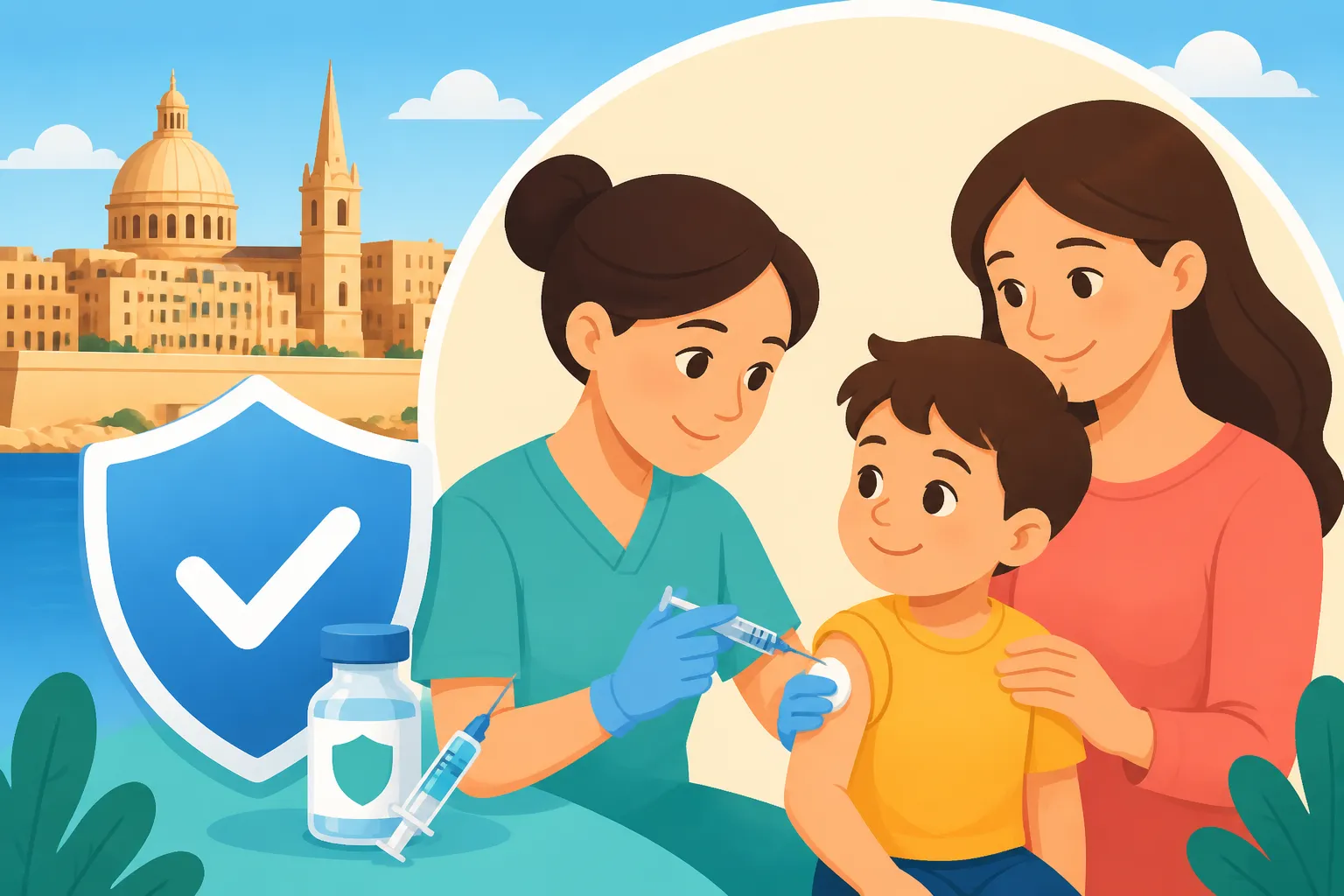
As children move into their teenage years, the schedule includes critical boosters and new vaccines. Around the age of 12, children are offered the HPV vaccine (Human Papillomavirus), which is now available for both boys and girls in Malta. This is a major step in preventing future cancers and is usually administered through the school health system.
The final "school leaver" boosters for Tetanus, Diphtheria, and Polio (Td/IPV) are generally given between ages 13 and 15. At this stage, the Meningitis ACWY vaccine is also administered to protect against several strains of meningococcal disease that can be particularly dangerous for teenagers and young adults.
| Age | Vaccine | Protection Against |
|---|---|---|
| Birth | BCG | Tuberculosis |
| 2 Months | 6-in-1 (DtaP-IPV-Hib-HepB) | Diphtheria, Tetanus, Pertussis, Polio, Hib, Hep B |
| 4 Months | 6-in-1 (DtaP-IPV-Hib-HepB) | Diphtheria, Tetanus, Pertussis, Polio, Hib, Hep B |
| 6 Months | 6-in-1 (DtaP-IPV-Hib-HepB) | Diphtheria, Tetanus, Pertussis, Polio, Hib, Hep B |
| 13 Months | MMR (Dose 1) | Measles, Mumps, Rubella |
| 13 Months | Hib / Men C | Hib and Meningitis C |
| 3-4 Years | MMR (Dose 2) / DTaP-IPV | Booster for MMR, Polio, and Diphtheria |
| 12 Years | HPV (2 Doses) | Human Papillomavirus |
| 12 Years | Meningitis ACWY | Multiple strains of Meningitis |
| 13-15 Years | Td-IPV | Tetanus, Diphtheria, and Polio Booster |
Navigating the Logistics of Vaccination
Getting your child vaccinated in Malta requires a bit of administrative preparation. You cannot simply walk into a hospital and demand a jab; there is a process involved that begins with your residence status.
Registering and Accessing Free Services
To access the free national immunisation program, your child must be entitled to public healthcare. This usually means that at least one parent is working in Malta and paying social security contributions. You will need to show your child's eResidence card or, at the very least, evidence that you have applied for it. For new arrivals, Health Entitlement in Malta: How Social Security Contributions Unlock Free Care explains how your employment status translates into medical rights for your family.
Once you are registered, you can visit the Immunisation Clinic at your local Health Centre. These clinics often operate on a walk-in basis during specific hours, but it is always wiser to call ahead. The nurses will review your child's previous records and create a Maltese immunization file. If you are in between jobs or your residency is in a "grey area," a plan from SafetyWing can provide a safety net for other medical needs while you sort out the specifics of state entitlement.
Dealing with Foreign Records
One of the biggest hurdles for expat parents is the translation and verification of records. If your records are not in English or Maltese, you will likely need a certified translation. The nurses at the Health Centre are the first point of contact for this. They will compare your child's history against The National Immunisation Schedule for Children in Malta and identify any "catch-up" doses needed.
Don't be surprised if the nurse suggests a different timeline than what you were expecting. Malta's climate and its position as a Mediterranean hub mean that the local health authorities have specific reasons for their scheduling. If you want a second opinion, you can always consult a private pediatrician, though you will have to pay for the consultation and any vaccines not covered by the state. For those looking for private options, Private Healthcare and Insurance in Malta: When You Need Cover provides insight into how the private sector operates.
The "Yellow Card"
Once your child starts their vaccination journey in Malta, they will be issued a small yellow foldable card. This is your most important medical document for the child. Every vaccine they receive at a Health Centre or through a school program will be recorded here. Keep this card safe! You will need it for school registration, summer camps, and even some sports clubs. If you lose it, you can get a replacement from the NIS, but it involves an administrative process that is best avoided.
Additional Vaccinations and Health Considerations
Beyond the standard schedule, there are other vaccinations you might want to consider for your child while living in Malta.
Seasonal Flu and COVID-19
Malta offers seasonal flu vaccines every autumn, usually starting in October. These are free for children and are highly encouraged, as the "flu season" on the islands can be quite intense due to the high humidity and close-knit social structures. Clinics are set up in Health Centres and Local Councils to make this as easy as possible.
Regarding COVID-19, Malta has historically followed EMA guidelines closely. Vaccination for children is available, though the age requirements and booster recommendations change based on current health advice. You can usually book these online through the national health portal. For help with the digital side of things, Booking Appointments and Using myHealth Online in Malta is a great tutorial for managing your family's health profile digitally.
Private Vaccines: Varicella and Meningitis B
As mentioned earlier, some vaccines that are common in other countries are not yet on the free list in Malta. The most notable are Varicella (Chickenpox) and Meningitis B. Many expat parents choose to pay for these privately.
To do this, you will need to:
- Visit a private pediatrician to get a prescription.
- Purchase the vaccine from a local pharmacy (ensure they have it in stock and that you can transport it cold).
- Return to the pediatrician for the administration.
This can be a bit of a "trek" across the island, but for many, the peace of mind is worth the cost. Always keep the receipt and a record of the batch number to give to the Health Centre nurse later so they can update the child's official file. If you are worried about the costs of such private maneuvers, having a travel-friendly insurance like SafetyWing can sometimes assist with the administrative or unexpected side of medical care while traveling or settling in.
Travel Vaccinations
Living in Malta makes it very easy to travel to North Africa, the Middle East, and beyond. If you are planning a family trip to a region that requires specific travel vaccines (like Yellow Fever or Typhoid), you should visit the Floriana Health Centre. This is home to the National Immunisation Service's main hub, which handles travel-specific medical advice. Make sure to book this at least 6-8 weeks before you travel, as some vaccines require multiple doses.
Practical Tips for Parents in the Maltese System
After years of navigating the Maltese health system with my own family, I’ve picked up a few "pro-tips" that don't appear in the official brochures.
First, always bring your child’s original birth certificate and your own ID card to every appointment. The system is becoming more digital, but the "paper-first" mentality still lingers in many clinics. Having your documents ready will save you from the dreaded "come back tomorrow" instruction.
Second, if your child is attending a state or church school, the "School Health" team is your best friend. They are incredibly efficient. If you miss a vaccination date at the Health Centre, ask the school nurse when they will next be visiting. Often, they can "catch up" your child right there at school, saving you a trip to the clinic. For more on how these systems integrate, see How Malta's Public Healthcare Works: Entitlement, Contributions, and Costs.
Third, don't be afraid to ask for a "catch-up schedule" in writing. If your child is arriving at age 7 with a partial history, the nurse can plot out exactly what they need over the next year to get them "Maltese-compliant." This document is gold when talking to school administrators.
Finally, remember that the doctors and nurses in Malta are generally very proficient in English. Communication is rarely an issue, but the style can be quite direct. Don't take it personally if a nurse is blunt about a missing vaccine—they are simply focused on community immunity. If you ever feel the need for a more specialized discussion, you can learn How Do I Get a Referral to a Specialist in Malta? to see a pediatrician with a specific focus.
Navigating the vaccination requirements in Malta is a rite of passage for any expat parent. It might feel like a maze of Health Centres and Yellow Cards at first, but once you are in the system, it is a very supportive environment. By staying on top of The National Immunisation Schedule for Children in Malta, you aren't just checking a box for school registration; you are giving your child the best possible start in their new Mediterranean home.
Disclaimer
The information provided in this guide is for informational purposes only and does not constitute professional medical or legal advice. Vaccination schedules and health policies in Malta are subject to change by the Ministry for Health. Always consult with a qualified medical professional or the National Immunisation Service to verify the specific needs and entitlement of your child.