How Do I See a Gynaecologist in Malta?
Finding specialized female healthcare in Malta can feel like navigating a maze of confusing referral rules and unpredictable waiting lists. When I first moved to the islands, I spent nearly a month just trying to figure out if I could walk into a clinic for a routine check-up or if I needed a formal "golden ticket" from a local GP. This guide breaks down exactly how to navigate both the public and private sectors to see a gynaecologist in Malta without the unnecessary stress.
Understanding the Dual Healthcare Landscape in Malta
The first thing you need to grasp as a newcomer is that Malta operates on a two-tier healthcare system. You have the public sector, which is centered around Mater Dei Hospital and regional health centres, and a robust private sector comprised of independent hospitals, multi-disciplinary clinics, and even small "pharmacy clinics" found in almost every village.
If you are working in Malta and paying social security contributions, you are generally entitled to free public healthcare. However, entitlement isn't always automatic upon arrival. You often need to prove your status to the Entitlement Unit to avoid being billed as a "non-entitled" patient. For those who are still waiting for their residency paperwork or are here on a nomad visa, private options are often the more realistic route. I personally found that during my first few months, having a reliable plan like SafetyWing was a lifesaver because it provided a safety net while I was still figuring out How Malta's Public Healthcare Works: Entitlement, Contributions, and Costs.
In the public system, gynaecology is treated as a specialist service. This means you cannot simply call Mater Dei and book an appointment because you feel like having a check-up. In the private sector, however, the doors are much wider. You can pick up the phone, choose a specific consultant, and often see them within a week, provided you are willing to pay the out-of-pocket consultation fee.
Accessing a Gynaecologist via the Public System
If you are entitled to free care and are not in a rush, the public system is excellent but requires patience. The pathway is strictly hierarchical. You cannot bypass the primary care level.
The Referral Process
To see a gynaecologist at Mater Dei and Beyond: A Guide to Malta's Public Hospitals and Health Centres, your first stop must be a General Practitioner (GP). You can visit a GP at one of the government health centres in towns like Mosta, Paola, or Floriana. I remember the first time I did this; I arrived at the Mosta Health Centre at 8:00 AM, waited about an hour, and spoke to a doctor about my specific concerns.
If the GP agrees that you need specialist intervention—whether for endometriosis, fibroids, or persistent hormonal issues—they will write a referral. This referral is then sent to the gynaecology department at Mater Dei. You won't leave the health centre with an appointment date; instead, you will receive a letter in the mail or a notification via the myHealth portal weeks later with your scheduled slot.
Wait Times and Expectations
Expect to wait. For non-urgent issues, the waiting list for a first-time gynaecology appointment in the public sector can range from a few months to over a year. This is the main reason many expats choose to go private for routine issues. However, once you are "in the system" at Mater Dei, the care is world-class. The consultants there are often the same ones who charge high fees in private hospitals, so you are getting the same level of expertise.
If your issue is related to sexual health, such as STI testing or contraception advice, you can often bypass the GP referral by visiting the GU Clinic at Mater Dei. This is a "walk-in" or "call-for-appointment" service that is separate from general gynaecology and offers a higher degree of anonymity and direct access. You can find more about this in our guide to Sexual and Reproductive Health Services in Malta for Newcomers.
Going Private: Speed, Choice, and Costs
For many of us, waiting six months for a routine smear test or to discuss a change in birth control isn't an option. This is where the private sector excels. In Malta, private healthcare is surprisingly accessible compared to the US or even parts of Northern Europe.
Where to Find Private Gynaecologists
Private gynaecologists in Malta usually operate out of three types of locations:
- Private Hospitals: St. James Hospital (with branches in Sliema and Zejtun) and DaVinci Health in Birkirkara are the big players. They have dedicated women's health departments.
- Specialist Clinics: There are numerous smaller clinics, like Persona in Ta' Xbiex or various "Medica" centres, that host visiting gynaecologists on specific days.
- Pharmacy Clinics: This is a very Maltese phenomenon. Most local pharmacies have a small consultation room in the back where specialists "sit" for a few hours a week. You can literally go to your local chemist in Naxxar or Marsascala and ask for the schedule of the visiting gynaecologist.
Booking and Costs
When you go private, you have the luxury of choosing your doctor. If you prefer a female gynaecologist, you can specify this when booking—a request that is much harder to guarantee in the public system.
A standard private consultation fee typically ranges from €50 to €100. If you require an ultrasound during the visit, expect the price to increase by another €40 to €70. For those using international health insurance like SafetyWing, these costs can often be claimed back, especially if the visit is related to a new medical condition that developed after your policy started. It is always worth checking your specific coverage before booking a battery of tests.
| Service Type | Public Sector (Entitled) | Private Sector (Out-of-Pocket) |
|---|---|---|
| Initial Consultation | Free | €50 – €100 |
| Ultrasound Scan | Free | €60 – €120 |
| Smear Test (Routine) | Free (Every 3 years via invite) | €70 – €150 (Including lab fee) |
| Wait Time | 3 – 12 months | 2 – 10 days |
| Referral Needed? | Yes (from GP) | No |
Routine Screenings and the National Programme
Malta has a very proactive National Screening Centre that manages cervical and breast screenings. As an expat, you might not automatically be on their radar until your residency is fully processed and your Getting Your Maltese ID Card Number: The Key to Accessing Healthcare is in hand.
Cervical Screenings (Smear Tests)
The National Screening Programme invites women aged 25 to 50 for a free smear test every three years. If you are registered with the social security system, you will eventually receive an invitation letter at your registered address. I highly recommend ensuring your address is updated with Identità (formerly Identity Malta) so you don't miss these.
If you don't want to wait for the invitation, you can have a smear test done privately at any time. Many women choose to do this for peace of mind. If you do go private, make sure you ask for a copy of the results so you can How Do I Transfer My Medical Records to Malta from Abroad if you ever need to show them to a public consultant later.
Mammograms
Similar to cervical screening, the Breast Screening Programme invites women, generally starting from age 50, for regular mammograms. If you are younger but have a family history of breast cancer or have found a lump, you should not wait for an invitation. In this case, you should see a GP immediately to get an urgent referral to the Breast Clinic at Mater Dei, or book a private mammogram at a facility like St. James or DaVinci. You can read more about the specific age brackets and how the invites work in our article on When Will I Be Invited for a Mammogram in Malta?.
Gynaecological Care During Pregnancy
If you find out you are pregnant, the "referral" system changes slightly. You can still go to a health centre GP to start the process, but the care becomes much more streamlined.
The Public Pathway
Once your pregnancy is confirmed, you will be assigned to a community midwife and a gynaecologist who oversees your case at Mater Dei. Most of your routine check-ups will take place at your local health centre or the "Maternity Outpatients" clinic at the hospital.
One thing that surprised me about the Maltese system was the high frequency of scans in the private sector versus the public. In the public system, you are generally entitled to two or three major scans. If you want a scan at every visit to "see the baby," you will likely end up seeing a private gynaecologist for supplemental care. Many expats choose this "hybrid" approach: they use the public system for the actual birth (because Mater Dei's NICU is the best on the island) but see a private gynaecologist for more frequent, personalized antenatal visits. For a deeper look at this, see Where Do I Go for Antenatal Care When Pregnant in Malta?.
Private Maternity Care
If you choose to go entirely private for your pregnancy, you will be under the care of a specific consultant who will likely deliver your baby at a private hospital. Keep in mind that if complications arise, private hospitals in Malta often transfer patients to Mater Dei because they have the specialized intensive care equipment needed for high-risk situations. This is why having insurance like SafetyWing can be vital—it helps bridge the gaps in coverage should you need private consultations or unforeseen medical evacuations.
Dealing with Gynaecological Emergencies
If you experience severe pain, heavy bleeding, or other acute symptoms, do not wait for a GP referral or a private appointment.
Mater Dei Emergency (A&E)
You should go directly to the Accident & Emergency department at Mater Dei. There is a specific "Gynae Admissions" area. When you arrive at A&E, you will be triaged. If your issue is gynaecological, they will call the resident gynaecologist on duty to see you.
Be prepared for a long wait in the general A&E waiting room before you are moved to the specialized ward. It’s not uncommon to wait 4 to 6 hours during busy periods. However, for true emergencies—like an ectopic pregnancy or severe pelvic inflammatory disease—the care is immediate. For general emergency advice, check Emergency Medical Care in Malta: 112, A&E, and Urgent Help.
Navigating the Cultural Nuances
Maltese doctors are generally very professional and speak excellent English. However, there are some cultural aspects to keep in mind. Malta is a traditionally Catholic country, and this can occasionally influence discussions around reproductive health, particularly regarding certain types of contraception or more sensitive topics.
That being said, the medical community is modern and used to dealing with the large expat population. If you ever feel uncomfortable, remember that you have the right to a second opinion, especially in the private sector. It’s quite common for women here to "shop around" for a gynaecologist they feel truly understands their perspective, especially when it comes to managing chronic conditions like PCOS or transitioning through menopause.
If you are just arriving and need a recommendation, expat Facebook groups for your specific area (like "Expats in Sliema" or "Moms in Malta") are goldmines for finding out which private gynaecologists are currently favored for their bedside manner and efficiency.
Practical Steps to Take Today
If you need to see a gynaecologist in Malta, here is your immediate action plan:
- Check Your Entitlement: If you are working and have an ID card, ensure you are registered for public care. If you are a digital nomad, ensure your private insurance, such as SafetyWing, is active.
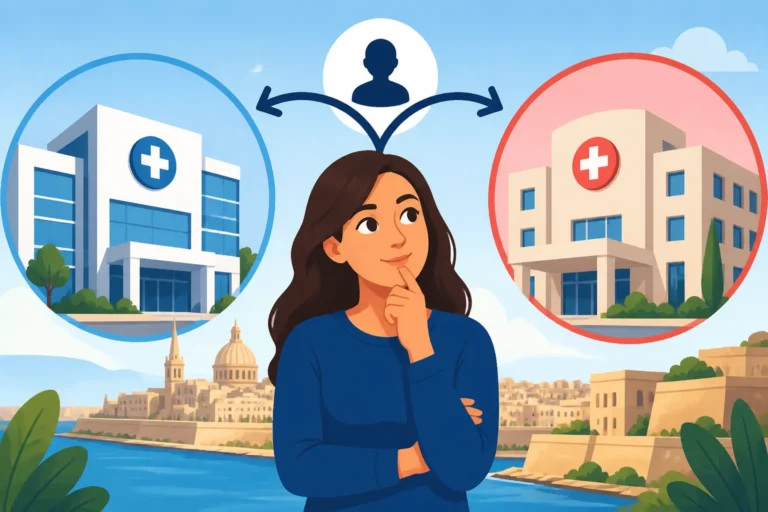
- Decide on Public vs. Private: If it’s an urgent but non-emergency issue, go private. If it’s a long-term issue and you want to save money, start the GP referral process at a health centre.
- Gather Your Records: If you have had recent surgeries or smear tests abroad, have those records ready to show the doctor.
- Register with a GP: Even if you plan to go private, Registering with a Health Centre and Choosing a GP in Malta is a crucial first step for your long-term health on the islands.
- Book Your Appointment: If going private, call a hospital like St. James or DaVinci today. They usually have receptionists available 24/7 or during long business hours.
Living in Malta offers a wonderful lifestyle, but the administrative side of health can be a hurdle. By understanding that you don't always have to wait for the public system and that private care is an affordable, high-quality alternative, you can take control of your reproductive health with confidence.
Disclaimer
The information provided in this article is for educational and informational purposes only and does not constitute medical or legal advice. Healthcare regulations and entitlement criteria in Malta are subject to change. Always consult with a qualified medical professional or the Maltese Health Authorities (Identità and the Entitlement Unit) regarding your specific health needs and legal status. Personal experiences shared are subjective and may not reflect the experience of every resident.