Finding a Doctor in Malta: GPs, Specialists, and the Referral System
The first time you feel a fever coming on or a sharp pain in your side in a foreign country, a wave of panic usually sets in that has nothing to do with the illness itself. I remember sitting in my first Maltese apartment, clutching my residency paperwork and wondering if I was allowed to just walk into a clinic or if I’d be turned away for not having the right stamp. This guide settles that anxiety by breaking down exactly how to find a doctor, navigate the referral maze, and secure the care you need in Malta.
Navigating the Maltese Healthcare Landscape: Public vs Private
When you first arrive, the dual-layered nature of Maltese healthcare can be confusing. It is not a system where you simply pick one and stick to it; most of us expats dance between the public and private sectors depending on the urgency of our problem and the depth of our pockets. The public system is the backbone of the country, funded by social security contributions, and it provides everything from routine check-ups to complex neurosurgery. However, because it is free at the point of use for those who qualify, the demand is incredibly high, leading to the legendary waiting times you will inevitably hear about at the local pastizzerija.
On the flip side, the private sector is vibrant, accessible, and surprisingly affordable compared to North America or Northern Europe. In Malta, private care isn't just for the wealthy; it’s a pragmatic choice for anyone who needs to see a doctor before their lunch break ends. You will find that many doctors actually work in both sectors—consulting at the state hospital in the morning and seeing private patients in a local pharmacy in the afternoon. This overlap is a quirk of the island that works in your favor once you understand how to leverage it.
Choosing between the two usually comes down to a trade-off between time and money. If you have a chronic condition that requires long-term management and expensive medication, the public system is your best friend. If you have a sudden ear infection or a weird rash and want it looked at within the hour, private is the way to go. For those who are still in the "limbo" phase of residency or digital nomads passing through, services like SafetyWing can provide a crucial safety net while you're still figuring out your long-term entitlement.
The Public System and Government Health Centres
The public primary care system revolves around regional Health Centres, often referred to locally as the "polyclinic." There are several main centres scattered across the islands—locations like Mosta, Floriana, Gzira, and Paola act as the first point of contact for anyone using state services. Unlike some countries where you are locked into a specific family doctor's list, in the public system, you generally go to the Health Centre that covers your "catchment area" based on your residential address.
When you walk into a public Health Centre, you don't usually have an appointment for a GP visit. It is a walk-in system. You take a number, sit in a plastic chair under the fluorescent lights, and wait your turn. I’ve had days where I was in and out in twenty minutes, and other days where I finished an entire novel before my name was called. The doctors here are efficient and highly trained, but they are also very busy. It’s important to have your thoughts organized and your questions ready.
To access these services for free, you need to prove your entitlement. This usually means showing your Maltese ID card or a certificate from the Entitlement Unit. If you haven't sorted this out yet, check out our guide on How to Register for Health Entitlement with the Entitlement Unit in Malta to avoid getting a bill at the end of your visit. Without entitlement, you can still be seen, but you will be charged as a non-resident, which can be a bit of a shock if you were expecting a free ride.
The Private System: Pharmacies and Clinics
The most "Maltese" way to see a doctor is to head to your local pharmacy. This was one of the biggest surprises for me when I moved here. Almost every pharmacy on the island has a small consultation room in the back where a GP (and often various specialists) holds clinic hours. You don't register with these doctors in a formal, bureaucratic sense; you simply call the pharmacy, ask what time the doctor is in, and show up. Some take bookings, while others operate on a first-come, first-served basis.
The beauty of the pharmacy clinic is the convenience. There is a pharmacy on nearly every street corner in high-density areas like Sliema and St. Julian's. You can see a doctor for a consultation fee that typically ranges from €15 to €25. Once the doctor gives you a prescription, you walk five feet to the counter and buy your medicine. It is a streamlined, efficient process that bypasses the crowds at the public Health Centres. For many expats, this is the default for minor illnesses, especially while waiting for their Healthcare in Malta for Foreign Residents: The Complete System Guide (2027) to become a lived reality.
Beyond pharmacies, there are dedicated private clinics and hospitals like St. James or DaVinci. These are more formal institutions where you can book specific appointment times with the same doctor every time, allowing for better continuity of care. These facilities are top-tier and offer a more "premium" experience, with shorter waits and more modern surroundings. If you are covered by a policy like SafetyWing, these private clinics are often the best places to go because they are accustomed to dealing with international patients and provide detailed receipts for insurance claims.
Deciding Which Path to Take
Deciding whether to go public or private often depends on your current administrative status in Malta. If you are a TCN (Third Country National) on a work permit, you are paying social security and are entitled to public care. However, the process of getting your ID card can take months. During that gap, you are essentially a private patient. It is wise for newcomers to keep a budget for private doctor visits in their first three months. It’s a small price to pay for the peace of mind of being seen quickly when you’re feeling miserable.
Another factor is the nature of the medical issue. For things like the flu, a quick prescription refill, or a sick note for work (which you need from day one in Malta), the private pharmacy doctor is unbeatable. For complex diagnostic tests, like MRIs or specialized blood work, the public system is incredible—if you can wait. If you can’t wait, you’ll be looking at the private hospitals. We go into more detail on this in our post about Private Healthcare and Insurance in Malta: When You Need Cover.
Lastly, consider the "continuity of care." In the public health centres, you rarely see the same doctor twice. If you have a condition that requires a doctor who knows your history, you are better off finding a private GP you like and sticking with them. You can still use the public system for your tests and specialists while keeping your private GP as your primary coordinator. This "hybrid" approach is how many long-term expats manage their health effectively without spending a fortune.
Registering with a GP: Your First Port of Call
One of the most common questions I get is, "How do I register with a doctor?" The answer depends entirely on which system you are using. In the Maltese public system, there isn't a "registration" in the way the UK's NHS or other European systems work. You don't have a single family doctor assigned to you at the Health Centre. Instead, you are "registered" with the system as a whole once you have your ID card and social security number. When you show up at the Health Centre, they pull up your digital file, and whichever doctor is on duty that day will treat you.
If you prefer the private route, registration is even simpler: there isn't any. You are a client. You provide your name, date of birth, and contact details at the pharmacy or clinic, and that’s it. You can see a doctor in Mosta on Monday and a different one in Valletta on Tuesday if you feel like it. However, I highly recommend finding one private GP you trust and making them your "primary" doctor. Having someone who has your full medical history on their computer can be a lifesaver when things get complicated.
For those who are just settling in, getting that first point of contact is vital. You don’t want to be searching for a clinic while you have a 39-degree fever. Take a walk around your neighborhood in your first week, find the nearest pharmacy, and look at the "Doctor in Attendance" sign usually posted on the door. It will list the times the GP is available. It’s a small bit of "life admin" that pays off enormously when you actually need it.
Finding Your Local Health Centre
Your local Health Centre is determined by your town of residence. This is a strict rule in the public sector. If you live in Gzira but try to go to the Mosta Health Centre because it’s newer, they might tell you to go back to your own catchment area unless it's a genuine emergency. This is part of the regionalized care model designed to manage the patient load across the island. You can find the full list of centres and their corresponding towns in our guide on Which Health Centre Do I Go to After Moving to Malta?.
Most of these centres are open 24/7 for emergency nursing and GP services, but for routine things like blood tests or specialized clinics (like diabetes or podiatry), you usually need to go during standard business hours. The larger centres, like the one in Floriana (often called the "Boffa" hospital area) or the Mater Dei outpatient departments, handle a huge volume of patients. Be prepared for a bit of a "government building" vibe—it’s functional, but it’s not a spa.
If you are living on the sister island, the situation is slightly different. There is one main hospital, the Gozo General Hospital, which serves as the primary health centre for the entire island, supported by smaller community clinics in various villages. Living in Gozo requires a slightly different approach to healthcare, often involving trips to the main island for very specialized appointments. It’s a beautiful place to live, but you should be aware of the logistics of Healthcare in Gozo: Gozo General Hospital and Inter-Island Transfers.
The Registration Process for New Residents
To be officially recognized by the public healthcare system, you need to have your residency status in order. The "key" to everything in Malta is your eResidence card. Once you have this, your ID number becomes your unique identifier in the national health database. This allows doctors at any public facility to see your past visits, prescriptions, and test results. If you are still waiting for your card, you can sometimes use your "Blue Paper" (the receipt of application), but this is hit-or-miss depending on the clerk at the desk.
The actual registration at a health centre happens the first time you go. You’ll present your ID card at the reception, and they will create your electronic record. It’s a good idea to bring any records of chronic conditions or current medications from your home country during this first visit. If you are an EU citizen, bringing your S1 form or a valid EHIC can also simplify things while you are waiting for your local social security to kick in. For a deep dive into the paperwork, read up on Registering with a Health Centre and Choosing a GP in Malta.
For non-EU residents, the process can be more stringent. You will often need to show proof that you are employed and paying NI (National Insurance) contributions. If you are on a Nomad Residence Permit, you aren't typically paying into the social security system, which means you aren't entitled to free public healthcare. This is why having comprehensive coverage like SafetyWing is not just a good idea—it’s often a legal requirement for your permit. It ensures you can access the private sector without worrying about the cost of every individual consultation.
Private GPs: The Pharmacy Clinic Model
If the public system sounds too bureaucratic, the pharmacy model is your sanctuary. To "find" a doctor here, you don't look at government lists; you look at the schedule taped to the pharmacy window. Most pharmacies have a "morning doctor" (usually 9:00 AM to 11:00 AM) and an "evening doctor" (usually 4:00 PM to 7:00 PM). These are almost always general practitioners. You don't need to be a regular customer of that pharmacy to see the doctor, though it helps if you live nearby.
When you see a private GP, you pay the consultation fee directly to the doctor or the pharmacist. Make sure to ask for a receipt! If you have private insurance, you’ll need this to get reimbursed. The care is very personal; because these doctors are building a private practice, they often take more time to listen and explain things than a doctor in a busy public health centre might. They can also issue private referrals to specialists, which can save you weeks of waiting.
One thing to note is that private doctors cannot usually issue "Yellow Cards" or "Pink Cards" (the schemes for free chronic medication). Only a consultant in the public system can authorize those. So, if you have a condition like asthma or diabetes, you might see a private doctor for your day-to-day needs but still maintain a relationship with the public system to get your free medicine. It's all about playing the system to your advantage.
The Referral System: Moving from Primary to Secondary Care
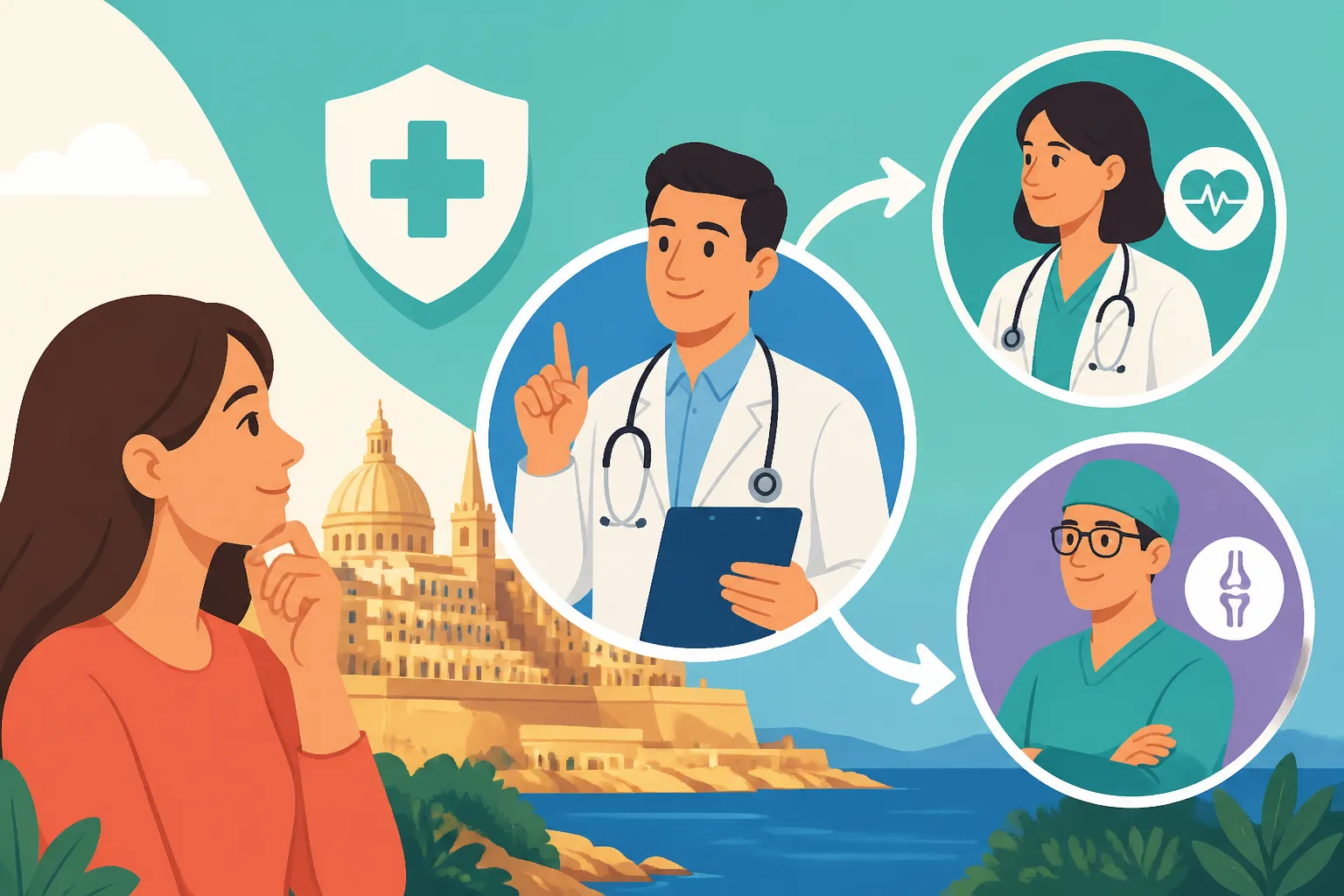
In Malta, you cannot simply call up a specialist at the state hospital and book an appointment because you have a stomach ache. The system is strictly "gatekept" by primary care doctors. This is the referral system, and understanding it is the key to getting specialized treatment. Whether you are in the public or private sector, your first stop is always a GP. They will assess your condition and, if they believe you need specialized care, they will write a referral.
This referral is a physical or electronic document that details your symptoms and why the GP thinks you need to see a consultant. In the public system, this referral is sent to the central booking office at Mater Dei Hospital. From there, you are "triaged"—meaning a specialist looks at your referral and decides how urgent you are. You will then receive a letter in the mail (the Maltese postal service is very important here!) with your appointment date and time. This can take anywhere from a few weeks to several months depending on the specialty.
If you are using the private sector, the referral system is much faster but follows a similar logic. A private GP will write a referral letter, and you can then take that letter to any private specialist of your choosing. You call the specialist’s clinic, tell them you have a referral, and you can often get an appointment within a few days. This speed is the primary reason people choose private care for non-emergency but bothersome issues, like a persistent knee injury or a dermatology concern.
How Referrals Work at Public Health Centres
When a doctor at a public Health Centre refers you, they usually fill out a form in the national electronic system. You should always ask for a printed copy or at least the "tracking number" of the referral. It is not uncommon for things to move slowly, and having that number allows you to call the Mater Dei outpatient department to check where you are in the queue. There is a specific art to following up on these appointments; a polite phone call can sometimes clarify a lost referral.
The triage system is quite fair but can be frustrating if you are deemed "non-urgent." Urgent cases, like suspected cancer or cardiac issues, are seen very quickly. Routine cases, like a standard ENT consultation or a non-essential surgery, will have a longer wait. If you find the wait is too long, you can take your public referral and use it to see a specialist privately. Many people do this: they get the initial diagnosis and referral for free, then pay for the first specialist visit privately to get the ball rolling.
Understanding this pathway is essential for anyone dealing with long-term health issues. You can read more about the specifics of the paperwork and tracking in our guide on How the Specialist Referral System Works in Malta's Public Hospitals. It covers everything from the "Ticket of Referral" to how to read the codes on your appointment letter.
Seeking Private Specialists Directly
One of the perks of the Maltese system is that if you are paying out of pocket or using insurance like SafetyWing, you have a lot more freedom. While many specialists still prefer to see a GP referral first to ensure they are the right person for the job, some will let you book directly. This is common in fields like gynecology, pediatrics, and dermatology. You can simply call a private hospital like St. James or a specialist clinic and ask for an appointment.
The cost of a private specialist consultation is higher than a GP, usually between €50 and €100. If they order tests, like blood work or an ultrasound, you will pay for those separately. However, the results are usually given to you immediately or emailed within 24 hours. For an expat who is working a full-time job and can’t afford to spend three separate mornings at a public clinic, this efficiency is worth every cent.
If you decide to go private, remember that you are in control. You can choose which consultant you see based on recommendations or reviews. Many Maltese specialists have studied in the UK, Italy, or the US, so the level of expertise is world-class. If you are looking for someone who speaks a specific language or has a particular sub-specialty, the private route gives you the flexibility to find them.
Managing Waiting Times and Priorities
Waiting times are the most significant "pain point" in Maltese healthcare. For elective surgeries, such as hip replacements or cataracts, the public waitlist can stretch into years. This is a hard reality that catches many foreigners off guard. If you have a condition that is likely to require surgery, you need to decide early on if you will rely on the public system or if you need to look into private options.
One strategy to manage this is the "cross-over." You can see a specialist privately to get your diagnosis and a "recommendation for surgery," and then take that recommendation to the public system to be placed on the state waitlist. This doesn't necessarily "skip" the queue, but it can sometimes speed up the initial diagnostic phase. However, the most reliable way to avoid long waits is to have a solid private insurance policy. For digital nomads, SafetyWing provides the kind of coverage that allows you to jump the queue by going private when the state system is backed up.
| Service Type | Public System Wait Time | Private System Wait Time | Estimated Private Cost |
|---|---|---|---|
| GP Consultation | Walk-in (1-4 hours) | Same day/Walk-in | €15 – €25 |
| Specialist Visit | 2 – 6 months | 1 – 7 days | €50 – €100 |
| Blood Tests | 1 – 4 weeks | Same day | €30 – €150 |
| MRI / CT Scan | 3 – 12 months | 1 – 5 days | €200 – €500 |
| Elective Surgery | 6 – 24 months | 2 – 4 weeks | €2,000+ |
Specialist Care and Hospitals in Malta
When your health needs go beyond a simple prescription, you’ll find yourself heading to one of the island's hospitals. For most of us, this means a trip to Mater Dei. It is a massive, state-of-the-art facility located in Msida, right next to the University. It handles everything from emergency trauma to maternity care. The quality of care at Mater Dei is generally excellent, but because it’s the only major acute hospital for the whole island, it is always busy.
Private hospitals offer a different experience. They feel more like hotels—quieter, with private rooms and a higher staff-to-patient ratio. St. James Hospital (with branches in Sliema and Zejtun) is the most well-known. These hospitals are excellent for diagnostic procedures, minor to mid-sized surgeries, and outpatient specialist clinics. If you are an expat used to a high level of personalized service, you will likely feel more "at home" in the private sector.
It is worth noting that for extremely serious, life-threatening emergencies—like a major car accident or a heart attack—you will almost always be taken to Mater Dei, even if you have the best private insurance in the world. Private hospitals in Malta aren't always equipped for major emergency trauma in the same way the state hospital is. This is a vital distinction to remember: private is for comfort and speed; public is for the heavy-duty life-saving stuff.
Mater Dei Hospital: The Hub of Specialized Care
Mater Dei is the pride of the Maltese public health system. It replaced the old St. Luke’s hospital years ago and brought the island’s medical infrastructure into the 21st century. As a patient, your experience here will usually start at the "Outpatients" department. This is a maze of corridors where hundreds of specialist clinics happen every day. Each clinic has its own reception desk, and the process is very similar to the health centres: show your ID, take a seat, and wait for your name to appear on the screen.
The hospital is divided into "blocks" and "wards." If you are admitted, you’ll find that the nursing care is top-notch. Maltese nurses are known for being incredibly hardworking and compassionate. However, the wards are often busy, and "overflow" is a common issue during the winter flu season. To understand what to expect if you are ever admitted, check out our guide on What to Expect as a Patient at Mater Dei Hospital.
One thing that surprises many expats is the "social" nature of the hospital. Family is everything in Malta, and you will see large groups of relatives visiting patients. It can be a bit noisy and chaotic compared to the hushed tones of Northern European hospitals, but it’s also very warm. If you don’t have family here, don’t worry—the staff are very good at looking after "solo" expats.
Private Hospitals and Specialized Clinics
The private hospital sector in Malta is small but highly efficient. St. James Hospital is the "big name," but there are others like DaVinci Health in Birkirkara. These facilities specialize in things like orthopedics, ophthalmology, and cosmetic surgery. They are also the go-to for rapid diagnostic imaging. If you need an ultrasound or a scan and don't want to wait six months, you can usually book one privately and have it done within 48 hours.
The relationship between private hospitals and insurance companies is very well-established. Most private hospitals will deal directly with major insurers, but for smaller ones or international plans like SafetyWing, you might need to pay upfront and claim it back. Always make sure to get a detailed medical report from the specialist; your insurance will need this to prove the visit was "medically necessary."
Another growing trend in Malta is specialized clinics that focus on just one thing—like the many dental clinics, eye clinics, or fertility centres. These offer a very high level of expertise in their specific field. We have a dedicated post on Private Hospitals and Clinics in Malta: Faster Specialist Access that breaks down which facility is best for which type of treatment.
Accessing Care on Gozo
Gozo is a different world, and that includes its healthcare. The Gozo General Hospital is a unique hybrid: it handles both public and private patients (through a partnership with Steward Health Care, though this has seen recent administrative changes). For most routine issues, Gozo residents don't need to leave the island. There are specialists who travel from Malta to Gozo once or twice a week to hold clinics.
However, for major surgeries or very specific specialized care (like certain types of cancer treatment), you will be referred to Mater Dei. This involves a trip on the ferry, which the health department often coordinates via a specialized ambulance or transport service. If it’s an absolute emergency, there is a helicopter link between Gozo and Mater Dei. It’s an efficient system, but it adds a layer of stress to being ill.
Expats living in Gozo often find that they rely more on their local GP for everything. The community is tighter, and the doctors often know their patients by name. If you are considering a move to the sister island, make sure to read Healthcare in Gozo: Gozo General Hospital and Inter-Island Transfers to understand the logistics of "island life" medical care.
Language, Culture, and Communication with Maltese Doctors
One of the greatest reliefs for expats moving to Malta is the language. English is an official language, and it is the primary language of medical instruction. Almost every doctor, nurse, and pharmacist on the island speaks fluent English. You will never have to worry about a "lost in translation" moment regarding your symptoms or your dosage. This makes navigating the system significantly easier than in, say, Spain or France.
However, while the words are the same, the medical culture can be different. Maltese doctors are often very direct. They don't always do the "small talk" that you might be used to in the US or UK. This isn't rudeness; it’s just a cultural preference for efficiency, especially in the busy public sector. They will tell you what’s wrong, give you a plan, and move on to the next patient. As a veteran expat, my advice is to be equally direct. Don't "suggest" what you think is wrong; just state your symptoms clearly.
Culturally, there is also a great deal of respect for doctors in Malta. It is a traditionally hierarchical society, and while things are changing, the doctor’s word is often seen as final. Don't be afraid to ask for a second opinion if you feel something is wrong, but do so politely. "Could we explore other options?" usually goes down better than "I think you're wrong." For more on the cultural side of things, check out Can I See a Doctor in English in Malta?.
English as a Medical Language
Because all medical training at the University of Malta is conducted in English, the terminology used is exactly what you would hear in London or New York. This is a massive advantage when it comes to prescriptions. You don't need to learn the local name for "paracetamol" or "antibiotics." Even the leaflets inside the medicine boxes are almost always bilingual (Maltese and English).
If you are coming from a non-English speaking country, you’ll find that many doctors also speak Italian, and some speak French or German, thanks to their international rotations. However, English remains the lingua franca. If you find yourself in a situation where you are struggling to communicate—perhaps with an older receptionist who prefers Maltese—simply ask, "Can we speak in English, please?" It is rarely an issue.
It’s worth noting that while the doctors speak English, the system’s "slang" can be Maltese. You might hear people talking about a "tal-linja" (the bus card) for transport to the hospital or the "POYC" for their free medicines. Don't be afraid to ask for clarification on these acronyms. Our guide on Finding a Doctor in Malta: GPs, Specialists, and the Referral System is designed to help you decode this "expat-Maltese" hybrid language.
Cultural Nuances in Patient-Doctor Interactions
One thing I noticed early on is that Maltese patients often bring a family member into the consultation room. It’s very common for a spouse, daughter, or even a close friend to sit in on the appointment. If you are an expat who prefers total privacy, you might find it strange that the doctor asks, "Is your partner coming in?" You are, of course, perfectly entitled to go in alone.
Another nuance is the "pharmacy first" culture. In many countries, the pharmacist is just someone who fills a prescription. In Malta, the pharmacist is a highly respected frontline medical professional. Many Maltese will go to the pharmacist for advice on minor ailments before even thinking about a doctor. If you have a cough or a localized pain, ask the pharmacist first. They might save you a €20 doctor’s fee by recommending an over-the-counter fix.
Finally, be aware of the "afternoon break." Many private clinics and pharmacies close for a few hours in the afternoon (usually between 1:00 PM and 4:00 PM) before reopening for the evening session. This can be frustrating if you’re used to all-day service, but it’s a standard part of the Mediterranean rhythm. Plan your medical errands for the morning or the early evening.
What to Bring to Your Appointment
Whether you’re going to a public health centre or a private clinic, there are a few things you should always have with you to make the process smoother. First and foremost: your Maltese ID card. This is your "passport" to the medical system. If you don’t have it yet, bring your passport and a copy of your work contract or residency application.
Second, bring a list of your current medications, including the dosages. If you have brought medicine from home, bring the original boxes. This helps the doctor ensure they are prescribing the Maltese equivalent correctly. If you have a complex medical history, a one-page summary from your previous doctor is worth its weight in gold. It saves you from having to explain a decade of health issues in five minutes.
Lastly, if you have private insurance like SafetyWing, bring a digital or printed copy of your policy summary and a "claim form" if your insurer requires the doctor to sign one. It’s much easier to get a signature while you’re in the room than to have to go back a week later. I always keep a folder on my phone with all these PDFs so I’m never caught off guard.
Costs and Entitlement for Foreigners
Money is always the elephant in the room when it comes to healthcare. In Malta, the cost of health is directly tied to your "entitlement." If you are an employee paying social security (NI), you and your dependent family members are generally entitled to free public healthcare. This is a fantastic benefit, but it only kicks in once your contributions are being processed. For many new arrivals, there is a "gap" of a few months where they are paying in but aren't yet fully "in the system."
During this gap, or if you are a non-working resident (like a self-sufficient retiree or a nomad), you will be charged for public services. These charges are standardized but can be expensive. A visit to the A&E at Mater Dei without entitlement can cost several hundred euros, and a hospital stay can run into the thousands. This is why having insurance is non-negotiable for anyone who isn't a 100% confirmed beneficiary of the state system.
Private costs, however, are very predictable. A private GP is around €20, a specialist is €70, and a standard blood test is €40. For many expats, these out-of-pocket costs are so low compared to their home countries that they don't even bother with insurance for the small stuff. But for the big stuff—surgeries, cancer treatment, or long-term hospitalization—you need a solid plan. Whether that's the public system or a policy like SafetyWing, you need to know where you stand before the bill arrives.
Understanding Social Security and Free Care
Your social security contributions (NI) are deducted directly from your payslip if you are employed. This money goes into a central fund that pays for pensions, unemployment benefits, and, of course, the health system. To unlock your right to use Mater Dei for free, you usually need to visit the Entitlement Unit in G'Mangia. They will check your records and issue a document (sometimes called a Certificate of Entitlement) that you take to the health centre.
If you are self-employed, you pay your NI in three installments throughout the year. You have the same rights as an employee, but the paperwork can be a bit more tedious to prove you are up to date with your payments. For a step-by-step guide on this bureaucracy, read Health Entitlement in Malta: How Social Security Contributions Unlock Free Care. It's the most important administrative task you'll do after getting your ID card.
For EU citizens, the EHIC (European Health Insurance Card) is a great safety net for the first few weeks. It entitles you to "necessary care" under the same conditions as a local. However, it is not a long-term solution for residents. Once you are living and working here, the EHIC from your home country is technically no longer valid for your daily care; you are expected to transition into the Maltese system.
Out-of-Pocket Costs for Private Visits
If you choose to bypass the state system, you are entering the world of "fee-for-service." The good news is that Malta has some of the lowest private medical costs in the EU. You don't need to be a millionaire to see a private consultant. Many locals use private care for "diagnostics" (getting the answer quickly) and then switch to the public system for "treatment" (getting the expensive surgery for free).
When you pay out of pocket, always ask for an official VAT receipt. In Malta, medical services are often VAT-exempt, but you still need a formal "fiscal receipt" for your tax records or insurance claims. If you are self-employed, some medical expenses might be deductible, but you should check with an accountant on that. Most pharmacy clinics only accept cash or local cards (like BOV or HSBC), so it’s a good idea to have some euros on you.
One "hidden" cost of private care is the price of medication. In the public system, if you have a chronic illness, your medicine is often free through the "Pink" or "Yellow" card schemes. In the private system, you pay the full market price at the pharmacy. Over a year, this can add up. This is another reason why even those who love private care still make an effort to get registered with the state system.
The Role of Private Health Insurance
Private health insurance in Malta serves two main purposes: speed and comfort. It allows you to skip the public waitlists and get treated in a private hospital. Most local insurance plans (like Atlas or GasanMamo) are designed for residents who already have public entitlement and just want "extra" coverage. They often have "moratoriums" on pre-existing conditions, meaning they won't cover things you already had when you signed up.
For nomads and newcomers, international plans like SafetyWing are often more flexible. They provide the "base" coverage you need to satisfy visa requirements and give you access to private clinics while you are still navigating the Maltese bureaucracy. They are particularly useful if you travel frequently between Malta and other countries, as they aren't tied to a single national system.
When choosing a plan, look at the "in-patient" vs "out-patient" coverage. Some plans only cover you if you are admitted to a hospital. For daily life in Malta, you want something that at least contributes to the cost of specialist visits and diagnostic tests. We have a full breakdown of the options in Choosing a Private Health Insurer in Malta: Cover, Costs, and Claims.
Tech and Online Tools for Managing Health
Malta has made huge strides in digitizing its healthcare system over the last decade. Gone are the days when every record was a dusty paper file (though you will still see a few of those!). Today, the system is linked by a central database that allows for a much more modern experience. As an expat, the most important tool you can use is the myHealth portal.
This is a government website where you can log in using your e-ID (which you get alongside your residence card). Once inside, you can see your medical history, your upcoming appointments at Mater Dei, and even your blood test results. This is a game-changer. Instead of waiting for a letter or a phone call, you can often see your results online the moment the lab uploads them. It also allows you to link your file to a specific private GP, so they can see your public records too.
There are also several private apps and booking platforms that are becoming popular. Some large clinics have their own booking systems, allowing you to choose your doctor and time slot from your phone. While Malta still loves a phone call, the "digital-first" approach is slowly taking over, making it much easier for those of us who prefer to manage our lives online.
Using the myHealth Portal
To use myHealth, you first need to activate your e-ID. This is done at the Identità office (usually the same place you get your residence card). Once activated, you log in with your ID number and a password. The dashboard is fairly intuitive. The most useful section for most of us is the "Laboratory Results" tab. Being able to see your cholesterol levels or iron counts from your laptop is incredibly convenient.
You can also use myHealth to choose a "Principal General Practitioner." This is a private GP you’ve seen and liked. By selecting them in the portal, you give them permission to access your state records. This creates a "bridge" between your public and private care, ensuring that your private doctor knows what the state specialists are doing. For more on this, read Booking Appointments and Using myHealth Online in Malta.
One thing to be aware of: not all historical data is in the system. If you had surgery ten years ago, it might not be there. But for anything current—prescriptions, recent scans, and clinic visits—it is an invaluable resource. It also helps you keep track of your "Schedule V" status (for free medicines), showing you when your entitlement is due for renewal.
Online Booking Systems and Apps
While the public system is still mostly "call or walk-in," the private sector is embracing apps. Some local pharmacies use booking platforms like Pharmacy.com.mt where you can see which doctors are in attendance across different locations. This is perfect if your usual doctor is away and you need to find an alternative nearby.
Some private hospitals also have dedicated portals for their patients. These allow you to manage your billing, download your X-rays or MRI images, and book follow-up appointments. If you are someone who likes to keep their own medical records organized, these digital tools are a dream. I always download my scan reports and save them to a cloud drive; you never know when you might need to show them to a doctor in another country.
For the digital nomad community, having everything in your pocket is essential. This is where services like SafetyWing shine—they are designed for a paperless lifestyle. Their portals are mobile-friendly, making it easy to upload a photo of a receipt from a Maltese pharmacy and get your claim processed without ever visiting a post office.
Emergency Situations and Urgent Care
No one wants to think about emergencies, but knowing what to do in a crisis is part of being a responsible resident. In Malta, the emergency number is 112. This will connect you to the police, fire, or ambulance services. If you need an ambulance, it will almost certainly take you to the Accident & Emergency (A&E) department at Mater Dei.
A&E is for life-threatening or very serious issues. If you show up with a minor cough or a broken finger that happened three days ago, you will be given a very low priority and might wait for 12 hours. For "urgent but not life-threatening" issues, the regional Health Centres are a better choice. Centres like Mosta, Paola, and Floriana have "Treatment Rooms" that can handle stitches, minor burns, and acute pain 24/7.
One unique Maltese service is the "urgent house call." Many private GPs offer home visits for a higher fee (usually €35-€50). If you are too sick to leave bed or have a small child with a high fever in the middle of the night, this is an incredible service. You can find "doctor on call" numbers in the local directory or by calling a 24-hour pharmacy.
When to Use A&E vs a Health Centre
The golden rule in Malta is: if you can walk and breathe normally, go to the Health Centre first. They act as a filter for the main hospital. If the GP at the Health Centre decides your issue is serious, they will arrange for an ambulance or give you a "priority note" to take to Mater Dei. This often gets you seen faster than if you just walked into A&E off the street.
The Health Centre treatment rooms are staffed by very experienced nurses and doctors. They can do ECGs, basic blood work, and administer IV fluids. It’s a much calmer environment than the chaos of A&E. To know which one is closest to you at 2 AM, keep a bookmark of Emergency Medical Care in Malta: 112, A&E, and Urgent Help.
If you do end up at Mater Dei A&E, be prepared for a long wait if your case isn't critical. Bring a charger for your phone, a bottle of water, and some snacks. The triage system is very effective—those with chest pains or major trauma go in immediately—but everyone else has to wait. It’s a busy, high-pressure environment, so patience is key.
112 and Urgent House Calls
Calling 112 is free from any phone. The operators speak English and will ask for your location and the nature of the emergency. If you are in a remote area or a narrow village street, try to have someone stand outside to flag down the ambulance. Maltese streets can be a maze, and every second counts.
For house calls, there are services like DoctorOnline or individual private doctors who advertise "24/7 house visits." This is a private service, so you will pay cash or card on the spot. It is a fantastic option if you don't have a car or if the thought of sitting in a waiting room is unbearable. Many expats use these services for peace of mind, and the cost is often reimbursable if you have a good insurance policy.
| Situation | Recommended Action | Estimated Cost |
|---|---|---|
| Life-threatening (Heart attack, trauma) | Call 112 / Go to A&E | Free (if entitled) |
| Urgent but stable (Stitches, high fever) | Regional Health Centre | Free (if entitled) |
| Non-urgent / After hours | Private House Call | €35 – €60 |
| Minor illness / Prescription | Pharmacy GP | €15 – €25 |
Disclaimer
The information provided in this guide is for educational and informational purposes only. While I have made every effort to ensure the accuracy of the details regarding the Maltese healthcare system as of 2026, medical regulations, entitlement rules, and costs can change. This guide does not constitute professional medical or legal advice. Always consult with a qualified healthcare professional or the relevant Maltese authorities (such as Identità or the Health Entitlement Unit) regarding your specific health needs and legal residency status. I am a veteran expat sharing my personal experience and research; I am not a doctor or a government official.