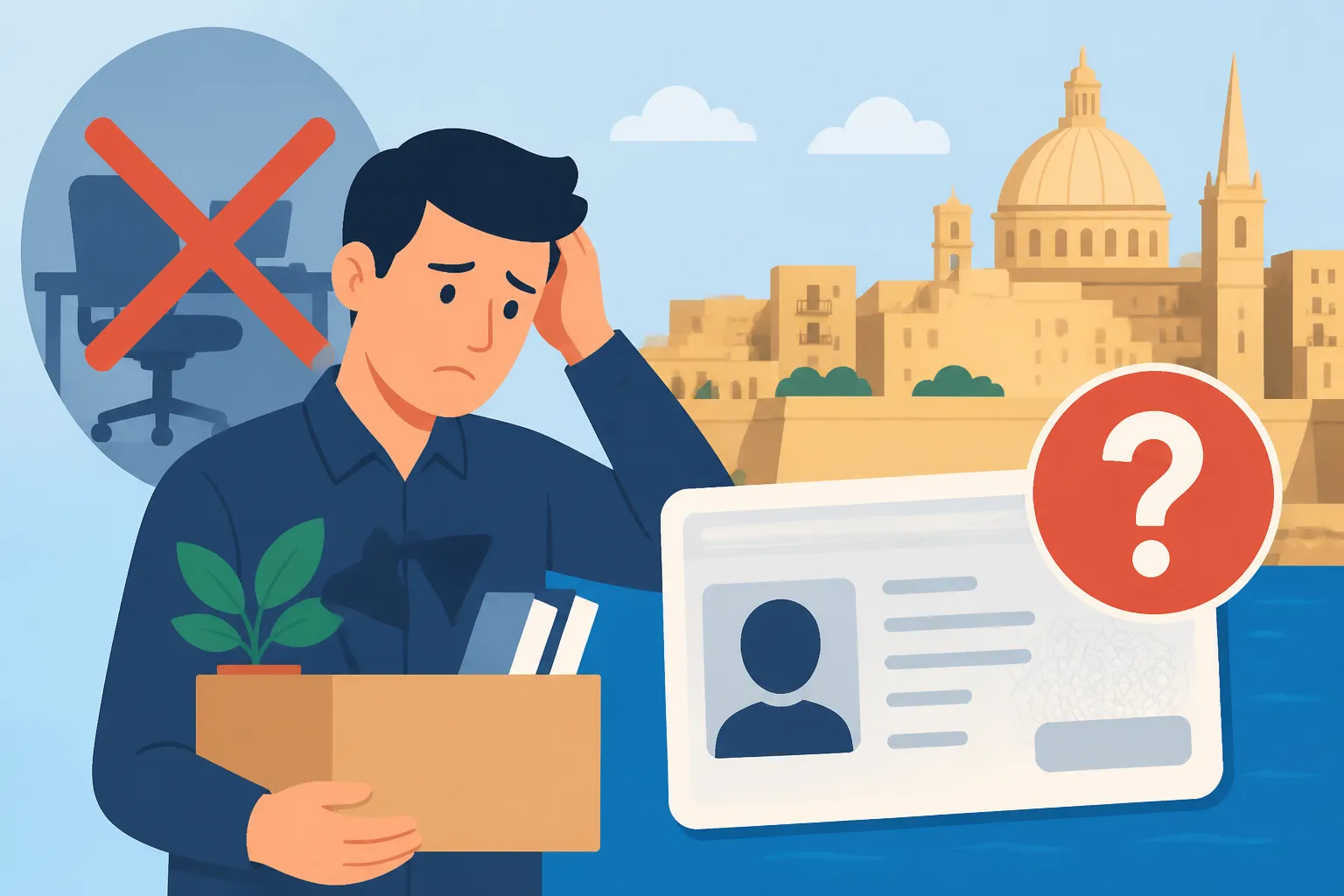
What Happens to Your Permit If You Lose Your Job in Malta
It's a gut-wrenching feeling, isn't it? One minute you're living your expat dream in Malta, basking in the sun and enjoying the unique island life, and the next, you're hit with the news: you've lost your job. Beyond the immediate shock and financial worry, a profound panic can set in for foreigners – "What about my permit? Do I have to leave? What happens now?" This guide is here to walk you through the often confusing and highly stressful process of navigating your Maltese residence permit status after losing your employment, offering practical advice and empathetic insights.
Understanding Your Permit's Foundation: Employment and Residence
For many expats, especially those from outside the EU/EEA, your right to reside in Malta is inextricably linked to your employment. When that link is severed, it naturally throws your entire status into question. It’s crucial to understand this fundamental connection to properly assess your situation.
The Single Permit: A Combined Status
If you arrived in Malta to work, chances are you hold what's known as a "Single Permit." This isn't just a work permit; it's a combined work and residence permit, meaning that your authorization to live on the island is directly contingent on your employment with a specific Maltese employer. The clue is in the name, really – it’s a single document that covers both aspects.
When you applied for your Single Permit, your employer was a key part of that process. They submitted documentation, confirmed your employment, and often acted as a sponsor, in a sense. This creates a clear legal link. Therefore, if that employment ends, the grounds upon which your residence permit was issued also change fundamentally. It's not just a matter of finding another job; it's about re-establishing the legal basis for your stay. You can learn more about this by reading our comprehensive guide on The Single Permit in Malta: Combined Work and Residence, Step by Step.
Other Permit Types: Students, Nomads, and the Self-Employed
While the Single Permit holder often faces the most immediate and direct impact from job loss, it's worth briefly noting how other permit types are affected. If you are here on a student permit, your residence is tied to your enrollment in an educational institution, not your part-time job. Losing that job, while financially challenging, doesn't immediately invalidate your right to stay, though you might need to prove you can still support yourself. Similarly, those on a Nomad Residence Permit are typically tied to remote work for a non-Maltese employer, so a job loss there would depend on the specific terms of their permit and their ability to secure new remote employment that meets the income criteria. Self-employed individuals hold permits based on their business activity and income generated from it. Losing a major client or project might impact their ability to renew, but it's not the same as being fired from an employer-sponsored role. The focus of this guide, however, is primarily on the more common scenario of an employed person on a Single Permit.
Immediate Aftermath: When the Worst Happens
The moment you receive notice that your employment is ending, a flurry of questions will hit you. Beyond contacting your employer for clarity on your last day and any final payments, your priority needs to shift quickly to your immigration status. The Maltese authorities expect to be informed of changes to your employment that affect your permit.
Notification Requirements: Telling Identità and Jobsplus
This is probably the most critical step you need to understand: the authorities need to know. Both your employer and you have obligations. Your employer is legally bound to inform Jobsplus (Malta's public employment service) that your employment has ceased. This notification is crucial because Jobsplus is the entity that typically issues the Employment Licence component of your Single Permit. Once Jobsplus is informed, this information is usually shared with Identità (the national agency responsible for identity management, including residence permits).
As the permit holder, you also have a responsibility to notify Identità directly. While the exact timeframe can sometimes feel vague in Maltese bureaucracy, it's always safest to do this as soon as possible after your last day of employment. You'll usually need to submit a form, often along with a letter from your employer confirming the termination of employment. Failure to notify Identità yourself could complicate future applications or renewals. This is not a situation where "out of sight, out of mind" applies; proactive communication is key.
Grace Periods and Short-Term Stays
Here's where things can get a bit anxiety-inducing. Unlike some countries that offer a clear, stipulated grace period (e.g., 60 or 90 days) for permit holders to find new employment, Malta's approach can feel less defined. Historically, there hasn't been an explicit, automatic "grace period" written into the immigration laws specifically for Single Permit holders who lose their jobs. Your permit is tied to your employment, so when that employment ends, your entitlement to reside under that permit could theoretically end on your last day of work.
However, in practice, Identità typically allows a reasonable period for individuals to seek new employment and apply for a new Single Permit with a new employer. This informal grace period can range from a few weeks to a couple of months, but it's not guaranteed, and it's certainly not something you should rely on without proactive engagement. The crucial point is that you must be actively seeking new employment and ideally have a new job offer in hand before your current permit is revoked or expires. If you manage to secure new employment quickly, you'll apply for a change of employer on your Single Permit, which is a process outlined in our guide on Changing Employers on a Single Permit in Malta: The Rules.
If you find yourself without new employment and your previous permit is nearing expiry or has been officially revoked, you might be asked to leave the country. In some cases, a short-stay Schengen visa might be an option for a temporary stay if you meet the criteria and need a few extra weeks, but this is usually for specific circumstances like closing affairs and preparing to depart, not for extended job hunting. Always consult directly with Identità if you're unclear about your specific timeline.
Exploring Your Options: Navigating the Crossroads
Losing your job in Malta doesn't automatically mean packing your bags the next day, but it does mean you need to seriously explore your options and act swiftly. There are several paths you can consider, each with its own set of requirements and timelines.
Finding New Employment: The Race Against Time
For many, the most obvious path is to find another job. This becomes a race against time, as the longer you are unemployed, the more precarious your residence status becomes. The Maltese job market can be competitive, especially in certain sectors. Your first steps should involve updating your CV, leveraging your professional network, and hitting online job portals.
Where to Look:
- Online Job Boards: Major local platforms like Jobsplus, KeepMePosted, and Times of Malta Careers are essential. Don't forget international platforms like LinkedIn, which are also very active in Malta.
- Recruitment Agencies: Many expats find success through recruitment agencies specializing in sectors like iGaming, Fintech, and IT, which are prominent in Malta. These agencies often have direct relationships with companies actively seeking foreign talent.
- Networking: Malta is a small island. Attending industry events, joining expat groups on social media, and simply spreading the word among your acquaintances can yield unexpected opportunities.
Your new prospective employer will need to be willing to apply for a new Single Permit (or a change of employment for your existing one) on your behalf. This process is very similar to your initial application and means demonstrating that no suitable Maltese or EU/EEA candidates could be found for the role. Our guide on Finding a Job in Malta: Where to Look and How to Apply offers more in-depth strategies for your job search.
Switching to Other Permit Categories: Self-Employment, Study, or Nomad
If finding another employed role isn't immediately feasible or if you're looking for a change, Malta offers a few other avenues for residence that you might consider.
- Self-Employment Permit: If you have a solid business idea, sufficient capital, and a clear plan to generate income, you might explore applying for a self-employment permit. This requires a detailed business plan, proof of financial sustainability, and often a minimum investment or commitment to hire Maltese residents. It's a significant undertaking and not a quick fix. You can find more details in Registering as Self-Employed with Jobsplus and the CFR in Malta.
- Student Permit: Perhaps this is a chance to upskill or change career paths. Enrolling in a recognised educational institution in Malta can qualify you for a student residence permit. This would mean demonstrating acceptance to a course, sufficient funds for tuition and living expenses, and health insurance. Remember, working hours are usually limited on a student permit. You can find more information in Student Residence Permits for Malta: Requirements and Renewal.
- Nomad Residence Permit: If your skills allow you to work remotely for companies outside Malta, the Nomad Residence Permit could be an option. This permit is specifically designed for digital nomads and remote workers, requiring a minimum gross monthly income of €2,700 and proof of a foreign employer or self-employment for non-Maltese clients. This is a popular option, but the income threshold is strictly applied. Get full details in The Nomad Residence Permit: Income Threshold and Conditions.
Each of these options has distinct requirements, and switching categories usually means a new application process with Identità, which can take time. It's vital to research thoroughly and prepare all necessary documentation.
Voluntary Departure and Re-entry
Sometimes, despite your best efforts, finding new employment or a suitable alternative permit isn't possible within the permitted timeframe. In such cases, a voluntary departure from Malta might be the most pragmatic (and legally compliant) option.
If you choose to leave, ensure all your affairs are in order. This includes closing bank accounts, cancelling contracts, informing utility providers like ARMS, and arranging for the shipment of your belongings. It's also wise to get confirmation from Identità that your departure is officially noted to avoid any complications should you wish to return to the Schengen area in the future.
Leaving doesn't necessarily mean "game over" for Malta. Many individuals find new opportunities and re-apply for a Single Permit or another type of residence from their home country once they secure new employment. The key is to manage your departure legally and avoid overstaying your permit, which could lead to re-entry bans for the entire Schengen area.
Financial and Practical Considerations During the Transition
Losing your job isn't just an immigration issue; it's a significant financial and practical challenge. During this uncertain period, you'll need to manage your money, understand your entitlements (or lack thereof), and ensure your basic needs, like healthcare, are covered.
Accessing Social Security Benefits: Sickness and Unemployment
This is often a point of confusion and frustration for non-EU expats. While Malta has a robust social security system, access to certain benefits, like unemployment benefits, for non-EU Single Permit holders can be limited. Generally, unemployment benefits are primarily for Maltese citizens and EU/EEA citizens who have worked and contributed to the social security system in Malta or another EU member state.
For non-EU workers on a Single Permit, your right to reside and work is tied to a specific employer. If that employment ceases, your permit's validity is compromised, and thus, your access to benefits designed for long-term residents might be restricted. However, if you've paid social security contributions, you might be entitled to other benefits, such as sickness benefit, if you fall ill during your permitted stay. It's crucial to contact the Department of Social Security directly to clarify your specific entitlements based on your contributions and permit status. Our article on Sickness Benefit in Malta: Your Rights When You Can't Work provides more context.
Healthcare Entitlement After Job Loss
Your access to public healthcare in Malta is generally linked to your social security contributions. As long as you were legally employed and contributing, you were likely entitled to public healthcare services. When your employment ends, this entitlement might also change.
If you are a non-EU citizen, and your residence permit becomes invalid, your right to public healthcare may cease. This is a serious concern, as medical costs can be substantial. It's essential to understand that if you lose your job and your permit is revoked, you might also lose your access to free public healthcare. During any grace period, you might still be covered, but this is a grey area and not something to gamble with. Many non-EU permit holders are required to maintain private health insurance, and this becomes absolutely critical if your public entitlement lapses. Even if you're an EU citizen, your EHIC might not cover long-term residence if you're no longer considered ordinarily resident or employed in Malta. For a complete understanding, review our guide on Healthcare in Malta for Foreign Residents: The Complete System Guide (2027).
Managing Your Finances: Tax Implications and Budgeting
Job loss means a sudden halt or reduction in income, making careful financial management paramount. You'll need to create a stringent budget, prioritizing essentials like rent, utilities (which you can learn about in Setting Up Electricity and Water with ARMS and Enemalta in Malta), and food.
Regarding taxes, if your employment ends mid-year, your employer will provide you with an FS3 form, which details your earnings and tax deducted up to your last day. You might need to file a tax return if you have other income or if your tax deducted at source needs adjustment. Consulting with a tax specialist or using services like Taxes for Expats can be incredibly helpful during this period. They can advise on how your change in employment and potential change in residency status impacts your tax obligations in Malta and potentially back in your home country. Understanding the nuances of Maltese tax residency and your obligations is vital. Our detailed guide, Money and Finance in Malta: A Complete Guide for Foreigners (2027), also covers these aspects.
The Emotional Toll: Coping with Uncertainty
Beyond the bureaucratic and financial hurdles, losing your job as an expat can take a massive emotional toll. You're not just losing income; you might feel a loss of identity, stability, and your place in a foreign country. It’s crucial to acknowledge these feelings and proactively seek support.
Maintaining Well-being: Support Networks and Mental Health
The stress of potential unemployment and the threat of having to leave Malta can lead to significant anxiety and feelings of isolation. Don't go through this alone. Reach out to friends, family (even if they're abroad), or fellow expats. Malta has numerous expat communities online and in person where you can find others who have faced similar challenges. Sharing your experiences can be incredibly validating and lead to practical advice or simply a sympathetic ear.
If feelings of stress, anxiety, or depression become overwhelming, consider seeking professional mental health support. There are English-speaking therapists and counsellors available in Malta, and taking care of your mental well-being is just as important as sorting out your paperwork.
Language and Cultural Hurdles: Bridging the Gap
While English is widely spoken in Malta, especially in business, embracing the local language, Maltese, can significantly enhance your job prospects and overall integration. When competing for roles, especially outside the core expat-heavy industries, even a basic grasp of Maltese can set you apart and demonstrate your commitment to living on the island.
This period of uncertainty, while stressful, could also present an opportunity to invest in yourself. Consider taking Maltese language classes. Platforms like iTalki offer online tutors, allowing you to learn at your own pace and connect with native speakers. This not only builds a valuable skill but can also serve as a positive distraction and a way to feel more in control of your situation. You might be surprised how much easier everyday life becomes, and how many more job opportunities open up, once you make an effort to learn the local tongue, as discussed in Learning Maltese: Why and How Newcomers Pick It Up. It's a way to feel more connected and less isolated, which can be a huge boost to your morale during a tough time.
Disclaimer
The information provided in this guide is for general informational purposes only and does not constitute legal or immigration advice. Maltese immigration laws and procedures can be complex and subject to change. It is strongly recommended to consult directly with Identità, Jobsplus, or a qualified immigration lawyer in Malta for advice tailored to your specific situation.