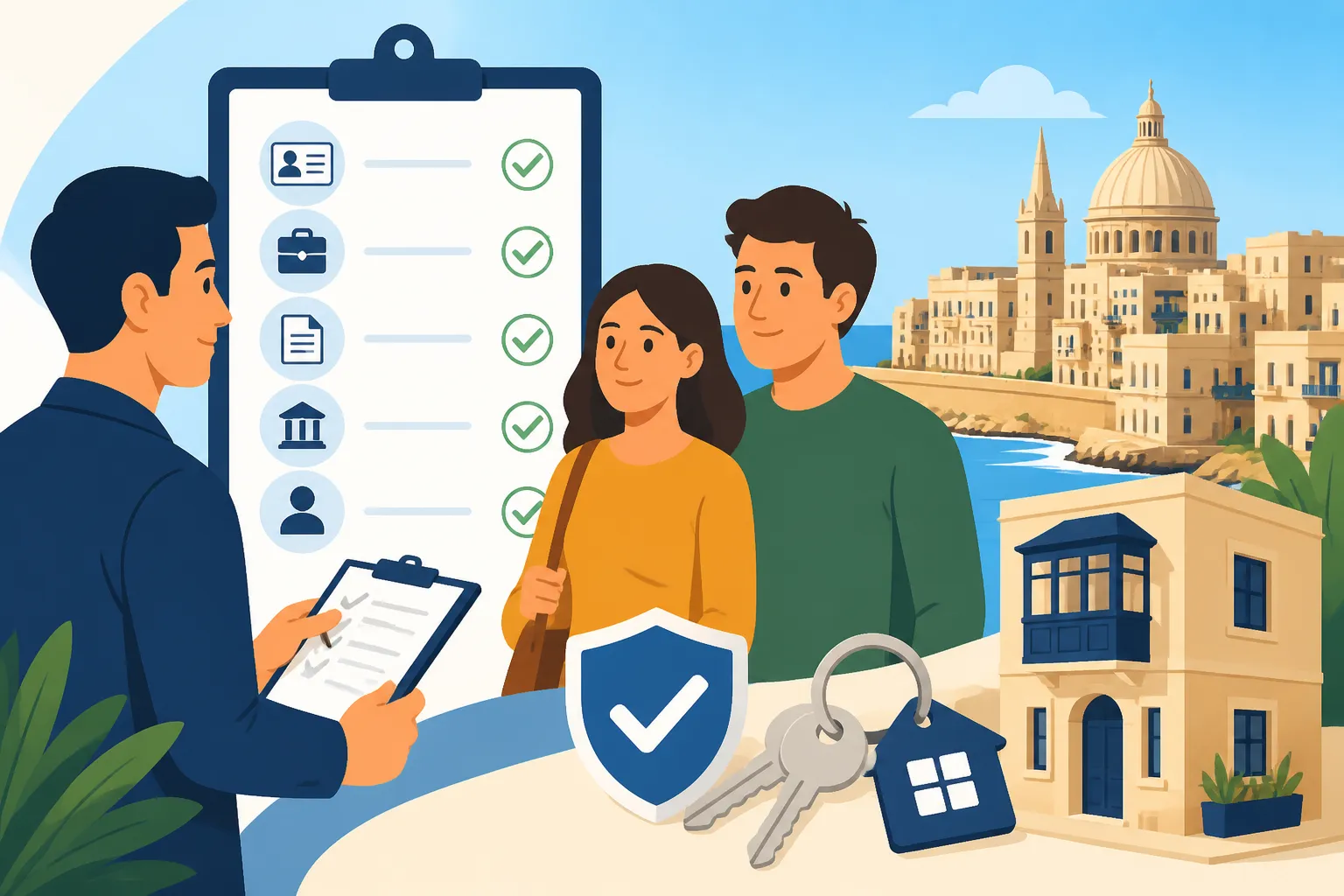
What Landlords in Malta Require Before They Rent to You
Moving to a new country like Malta often feels like navigating a maze, and finding a place to call home is one of the trickiest parts. Many expats arrive, eager to secure a beautiful apartment, only to be met with a barrage of requests for documents they never anticipated. It's frustrating, overwhelming, and can make you feel like you're jumping through hoops just to get a roof over your head. This guide is here to demystify what landlords in Malta really want to see before they'll hand over the keys, helping you prepare thoroughly and confidently.
The Initial Shock: Why Maltese Landlords Seem So Demanding
When you first start looking for a rental in Malta, it can feel like landlords are asking for your entire life story, and then some. You might come from a country where a simple background check and a deposit are enough, only to find yourself scrambling for payslips, bank statements, and even character references here. It's easy to feel personally scrutinized, but trust me, it's not usually personal. There are underlying reasons for this perceived "demanding" nature, rooted in both market dynamics and legal frameworks.
Decoding the Landlord's Mindset: Risk Aversion in a Dynamic Market
Imagine you own a property here in Malta, a significant investment. You've likely heard stories – or perhaps even experienced – tenants who leave without notice, damage the property, or struggle to pay rent on time. The Maltese rental market, especially in popular expat areas like Sliema, St Julian's, or Swieqi, can be incredibly dynamic, with high turnover and a mix of long-term residents and short-term visitors. This creates a certain level of risk for landlords. They want to ensure their property is in safe hands and that their income stream is reliable.
Their requests for extensive documentation are primarily a form of due diligence. They’re trying to assess your reliability, your financial stability, and whether you’ll be a responsible tenant. They're looking for signs that you'll pay rent consistently, maintain the property, and abide by the terms of the lease. For instance, if you're fresh off the boat with no local job history, they might be more hesitant or ask for more upfront security. It's not a judgment on you, but a reflection of their need to mitigate potential problems. Think of it from their perspective: they have a valuable asset, and they need to protect it.
Navigating the Legal Landscape: Obligations and Protections
Beyond risk aversion, the legal framework governing rentals in Malta also plays a significant role in what landlords ask for. The Private Residential Leases Act (PRLA), which came into full effect in 2020, introduced stricter regulations designed to protect both tenants and landlords. While it primarily focuses on lease registration and tenant rights, it indirectly encourages landlords to be more thorough in their vetting process. They know that once a lease is signed and registered, they have specific obligations, and removing a problematic tenant can be a lengthy and costly process.
This means that while the PRLA offers fantastic protection once you're in, it can make getting in a bit more challenging, especially if your documentation isn't impeccable. Landlords want to avoid any future legal headaches, so they'll often insist on a comprehensive set of documents from the outset. They’re not just being nosy; they're trying to ensure compliance and peace of mind for themselves, adhering to regulations that require clear tenant identification and financial standing. You'll find more details on your rights and obligations in our guide on Your Rights Under Malta's Private Residential Leases Act.
Your Foundational Documents: Proof of Who You Are and Your Right to Be Here
These are the absolute essentials, the non-negotiables that every landlord or letting agent in Malta will ask for. Having these ready, ideally scanned and organised into a digital folder, will significantly speed up your rental search.
Identity and Immigration Status: The Absolute Non-Negotiables
First and foremost, landlords need to verify who you are. This isn't just a formality; it's a legal requirement, especially when it comes to registering your lease with the Housing Authority, which is mandatory for most long-term residential leases.
You will need:
- Passport/National ID Card: A clear, current copy of your passport (photo page) or EU/EEA national ID card. This serves as your primary proof of identity.
- Maltese eResidence Card (or application proof): If you’re an EU citizen, your Maltese eResidence card confirms your legal right to reside here. For non-EU citizens, this is even more critical, as it proves you have a valid residence permit. If you've just arrived and are still waiting for your card, having proof of your application (e.g., Identità appointment letter, application submission receipt) is vital. Many landlords are wary of renting to individuals who don't have a clear path to legal residency, as it can complicate the lease registration process. If you’re still navigating the permit process, our guide on Getting Your Maltese eResidence Card and ID Number offers helpful steps.
Let's be clear: a landlord cannot legally deny you accommodation solely because you are non-Maltese or non-EU. However, they can absolutely decline if you cannot provide valid proof of identity and a legal right to reside in Malta, or demonstrable progress towards it. This protects them from potential legal issues down the line.
Establishing Residency: The eResidence Card and Its Significance
While your passport proves your nationality, your Maltese eResidence Card proves your status in Malta. For many landlords, especially those renting to non-EU citizens, seeing a valid eResidence card, or at least substantial proof of its processing, is a deal-breaker. Why? Because without it, you can't officially register your lease, which is a key requirement of the Private Residential Leases Act.
The eResidence card contains your unique Maltese ID number, which is necessary for various administrative tasks, including utilities setup and tax registration. Landlords know this and want to ensure you're a fully legitimate resident. If you’re an EU citizen, registering your residence and obtaining your eResidence card is a relatively straightforward process, but for non-EU citizens on a single permit, nomad visa, or other long-stay visas, the card is proof of your right to remain in the country. Some landlords might even ask for the attestation form that non-EU tenants require for their residence permit, linking your rental address directly to your immigration status. This also underlines the importance of having your residence permit sorted out as early as possible.
Proving Your Financial Prowess: Can You Afford This Place?
After confirming your identity, your financial stability is the next big piece of the puzzle. Landlords want assurance that you can consistently pay the rent, not just for the first month but throughout the entire lease term.
Employment and Income Verification: Your Bank Account as Your Storyteller
This is where you show the money, or at least prove you have access to it! Landlords will almost always ask for proof of employment and income. This usually includes:
- Employment Contract: A copy of your current employment contract, stating your position, salary, and employment start date. This gives the landlord confidence that you have a stable job.
- Recent Payslips: Typically, the last three to six months of payslips. These show your consistent income and verify the salary stated in your contract.
- Bank Statements: The last three to six months of bank statements are often requested to show regular income deposits, a healthy balance, and responsible financial behaviour. They might want to see statements from a Maltese bank account, but if you've just arrived, recent statements from your foreign bank account (translated into English if necessary) are usually acceptable. Many newcomers opt for digital banks like Revolut in the interim, but a local Maltese bank account is generally preferred for long-term stability. For insights into this, check out our piece on Why Maltese Banks Ask for So Much Documentation.
Hypothetical scenario: You've just landed a fantastic job in iGaming and are relocating from abroad. You might not have Maltese payslips or a local bank account yet. In this case, present your signed employment contract, offer letter, and recent bank statements from your home country. Be prepared to explain your situation clearly. Landlords appreciate transparency. If you're a freelancer or self-employed, providing invoices, client contracts, and tax returns from the previous year might be necessary to prove your income. It's a bit more effort, but it shows you're serious.
Security Deposits and Advance Rent: More Than Just a Precaution
The financial commitment upfront for a rental in Malta can be substantial. Landlords almost universally require a security deposit, and sometimes, several months of rent in advance. This isn't unique to Malta, but the amounts can sometimes feel higher, especially in sought-after areas.
- Security Deposit: Typically, this is one month's rent, but in competitive areas or for higher-end properties, it can be up to two months' rent. This deposit is held by the landlord (or agent) to cover any damages beyond normal wear and tear, or unpaid rent at the end of the tenancy. It’s crucial to understand that your deposit should be protected and returned at the end of your lease, provided you've met your obligations. You can learn more about this in our guide on How Much Deposit Do Landlords Require in Malta?.
- Rent in Advance: It's quite common for landlords to ask for one month's rent in advance, in addition to the security deposit. In some instances, particularly if you have less stable employment or a shorter lease period, they might request two or even three months' rent upfront. This acts as an additional layer of security for them, especially if they perceive a higher risk.
When considering a property, always factor these upfront costs into your budget. It’s not just the monthly rent; it’s usually at least two or three times that amount to get through the door. This table summarises the common financial documents and requirements:
| Requirement | Description | Typical Request |
|---|---|---|
| Proof of Income | Demonstrates your ability to pay rent consistently. | Latest 3-6 payslips, employment contract/offer letter, bank statements showing salary deposits. |
| Bank Statements | Provides an overview of your financial health, showing income flow and responsible money management. | Latest 3-6 months, often from a local Maltese bank, but foreign statements accepted initially. |
| Security Deposit | Held by the landlord against damages or unpaid rent. | 1 month's rent (common), up to 2 months' rent (for higher-value properties or perceived higher risk). |
| Rent in Advance | The first month's rent, paid upfront. Sometimes more is requested as additional security. | 1 month's rent (standard), sometimes 2-3 months if new to Malta or income source is less stable. |
| Funds for Utilities | While not always directly requested by landlords, they often expect you to have funds available for utility connection or top-ups. | Not a direct landlord request, but budget for initial utility setup fees or top-ups (electricity, water, internet). |
| Proof of Solvency (Self-Employed) | For freelancers or business owners, showing consistent income without a standard payslip. | Tax returns, company registration documents, recent invoices, accountant's letter, business bank statements. |
Beyond the Basics: Supplementary Requirements and Market Realities
Once you have your core documents sorted, some landlords and agents might ask for additional information or you might want to proactively provide them to strengthen your application in a competitive market.
The Value of References and a Strong Rental History
While not always a strict requirement, a good reference can significantly bolster your application, especially if you're new to Malta and lack a local employment or rental history.
- Previous Landlord References: If you've rented before, a positive reference from a past landlord can be gold. It reassures your potential new landlord that you're a responsible tenant, you pay on time, and you take care of the property. Make sure the reference includes contact details so it can be verified.
- Employer References: An employer reference, even if just a brief letter confirming your employment and good standing, can be helpful. It adds another layer of credibility to your application.
- Character References: Less common, but sometimes requested, particularly if you're very young or have no prior rental history. This could be from a university professor, a long-term colleague, or someone who can vouch for your responsible nature.
In a market where many tenants vie for the same desirable properties, a glowing reference can sometimes tip the scales in your favour, showing you as a reliable and trustworthy individual.
Understanding the Competitive Edge: What Can Set You Apart?
Malta's rental market, particularly in urban areas and tourist hotspots, can be fiercely competitive. Good properties at reasonable prices get snapped up quickly. Understanding what gives you an edge can be key.
- Being Prepared: Having all your documents ready, neatly organised, and immediately available shows you're serious and efficient. This includes your passport, eResidence card, employment contract, payslips, and bank statements.
- Prompt Communication: Responding quickly to messages and being flexible for viewings demonstrates your enthusiasm and reliability.
- Offering a Longer Lease Term: While the Private Residential Leases Act mandates a minimum one-year term (with specific conditions for shorter periods), offering a two-year lease, for example, might be attractive to a landlord looking for stability.
- Being Flexible with Move-in Dates: If a property is vacant, being able to move in quickly can make your application more appealing.
- Proactive Offer of Additional Security: If you have concerns about your financial stability proof (e.g., you're self-employed with variable income, or just starting a new business), you could proactively offer an extra month's deposit or more rent in advance. This isn't always necessary, but it can make a difference if you feel your application is weaker in other areas.
- A Personal Introduction: Sometimes, a polite, brief email or cover letter introducing yourself, explaining your situation (e.g., relocating for work), and expressing your interest in the property can add a human touch that agents and landlords appreciate.
Remember, agents often work on commission and want to close deals efficiently. Making their job easier by being a well-prepared, polite, and communicative potential tenant puts you at the top of their list. When looking for a place, having an active local phone number is crucial; consider using an eSIM from a provider like Airalo upon arrival so you can immediately contact agents and landlords without fuss. You can find more comprehensive advice on finding a rental in our guide on How to Find a Rental Property in Malta: Agents, Portals, and Groups.
Sealing the Deal: Lease Agreements, Registration, and Your Rights
So, you've found the perfect place, the landlord is happy with your documents, and you're ready to sign. This is a critical stage where understanding the legalities is paramount.
The Private Residential Leases Act PRLA: Your Shield and Your Sword
The Private Residential Leases Act (Cap. 604 of the Laws of Malta) is the legal framework that governs most private residential leases in Malta. It was implemented to provide greater clarity and protection for both landlords and tenants, addressing many of the issues that plagued the rental market for years.
Key takeaways from the PRLA:
- Mandatory Written Contract: All private residential leases must be in writing. No verbal agreements!
- Minimum Lease Term: The law specifies minimum durations for leases, generally one year for long-term leases, with specific rules for shorter leases (e.g., 6 months for non-residents for specific purposes).
- Automatic Renewal: Unless explicitly agreed otherwise, long-term leases automatically renew for the same period.
- Notice Periods: Strict notice periods apply for termination by either party, preventing sudden evictions.
- Deposit Protection: While not a dedicated deposit protection scheme, the PRLA outlines conditions for deposit return.
- Lease Registration: This is perhaps the most significant change introduced by the PRLA. Every private residential lease must be registered with the Housing Authority. Failure to register renders the contract null and void (though tenants can still enforce their rights).
Understanding these points is crucial before you sign anything. Don't be afraid to ask questions, and if something in the contract feels off, seek advice. Our detailed article, What to Check Before Signing a Rental Contract in Malta, can help you navigate this step.
The Mandatory Registration and Attestation Process
This is where the rubber meets the road. Once you and the landlord have signed the lease agreement, it’s not truly legal until it’s registered with the Housing Authority.
- Who Registers It? It is the landlord's legal responsibility to register the lease within ten days of the commencement of the lease. They typically do this online via the Housing Authority's portal.
- Proof of Registration: Once registered, the landlord should provide you with a copy of the registered lease, which includes the registration number. This is your official proof that your tenancy is legally recognised.
- Why is it Important? An unregistered lease means you lack the full protections offered by the PRLA. If a dispute arises, it will be much harder to enforce your rights. This is why when landlords ask for your ID and permit details, they're often doing so with the registration process in mind.
- Lease Attestation (for non-EU Tenants): For non-EU citizens applying for or renewing their residence permit, the lease agreement often needs to be "attested" by the Housing Authority. This means the Authority verifies that your rental contract is legitimate and that the property meets certain standards. This is a crucial step for your permit application, and your landlord will need to cooperate with this. You can read more about this in What Is the Lease Agreement Attestation Form in Malta?. This attestation proves that you have legitimate accommodation in Malta, which is a requirement for many permit types.
Always insist on a copy of the registered lease. If your landlord is reluctant or tells you it's not necessary, that's a huge red flag. Protecting yourself means ensuring all legal formalities are completed correctly.
Preparing for Your Rental Search: Practical Tips
Looking for a place in Malta can be a sprint, not a marathon. Being organised and prepared will make the process much less stressful and more efficient. For instance, before you even begin your property search, having a plan for your move can save you headaches. Companies like Sirelo can help you compare international moving quotes, ensuring your belongings arrive smoothly, so you can focus on the rental hunt.
Organising Your Documents for a Smooth Process
The golden rule for renting in Malta is: be prepared. Create a dedicated digital folder with clear scans of all the documents mentioned in this guide. This includes:
- Passport photo page
- Maltese eResidence Card (front and back) or proof of application
- Employment Contract/Offer Letter
- Latest 3-6 Payslips
- Latest 3-6 Bank Statements (local and/or foreign)
- Previous Landlord Reference (if available)
- Any other relevant financial proofs (e.g., tax returns for self-employed)
Rename your files clearly (e.g., "John_Doe_Passport.pdf," "Jane_Smith_EmploymentContract.pdf"). When an agent or landlord asks for documents, you can send them immediately. This quick response time can be the difference between securing a viewing or even the property itself, especially in a fast-moving market.
What to Do If You're New to Malta and Lack Local History
It’s a chicken-and-egg situation many expats face: you need a rental for your permit, but landlords want local history. Don't despair, it's a common challenge, and there are ways to navigate it:
- Be Proactive and Transparent: Explain your situation clearly to agents and landlords. Let them know you're new to the island, but highlight your stable employment, good financial standing (show those foreign bank statements!), and why you're a reliable tenant.
- Offer More Upfront: If you can afford it, offering an extra month's deposit or a few months' rent in advance can sometimes reassure a cautious landlord who is worried about your lack of local history. This shows commitment.
- Seek Employer Support: Sometimes, if you're relocating for a specific company, your employer might be willing to provide a letter of guarantee or even act as a reference, which can be very helpful.
- Consider Temporary Accommodation First: If the pressure is too high, consider booking a short-term rental (e.g., Airbnb, serviced apartment) for your first few weeks or month. This gives you a physical address, allows you to settle in, open a local bank account, start working (and get payslips!), and apply for your eResidence card before diving into the long-term rental market. This also gives you time to explore different areas and ensure you choose the right location, rather than rushing into a decision.
- Utilise Agents: While there are fees involved, reputable letting agents in Malta often have established relationships with landlords and can sometimes help bridge the gap, vouching for a new arrival if they're confident in your profile.
Remember, finding a home in a new country is a journey, not a sprint. With patience, preparation, and an understanding of what's expected, you'll soon find your perfect place in Malta.
Disclaimer
Please note that while this guide provides comprehensive information, rental laws and requirements in Malta can change. It is always advisable to verify the latest regulations with official sources like the Housing Authority and to seek independent legal advice if you have specific concerns or complex situations. This content is for informational purposes only and does not constitute legal advice.