How Maltese Health Entitlement Fits with Social Security Contributions
You arrive in Malta, see the National Insurance deduction on your first payslip, and assume you’re fully covered for any medical mishap. I made that exact same mistake years ago, only to realize that paying into the system and being entitled to use it are two very different administrative hurdles. This guide clears up the confusion between contributions and care.
The Philosophical and Practical Link Between NI and Care
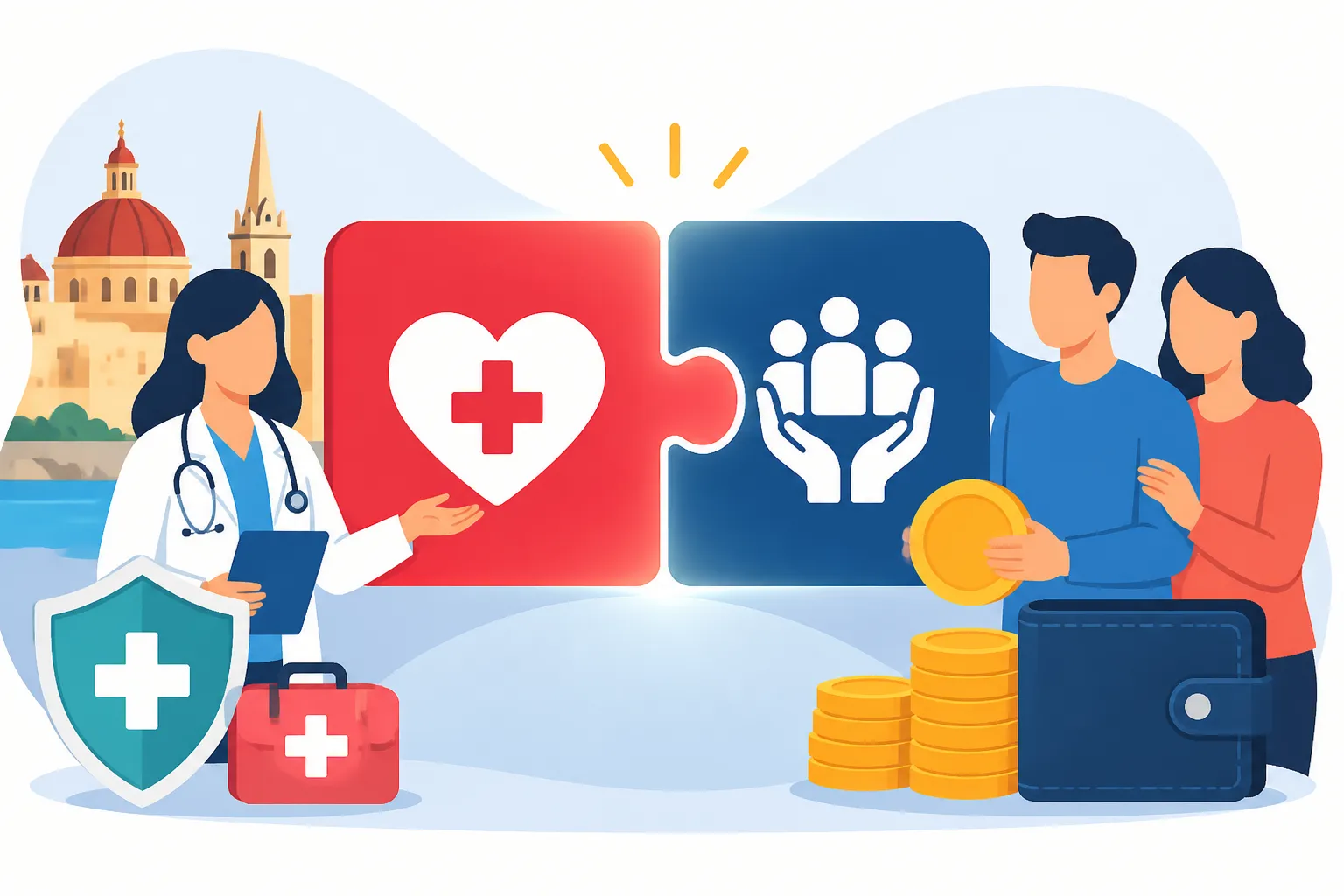
In Malta, the healthcare system is built on a principle of solidarity. This means that those who are working and contributing to the economy fund the high-quality care provided at Mater Dei and local health centres. However, simply having money taken out of your paycheck doesn't automatically "ping" a server at the hospital to let them know you’re eligible for free treatment. There is a manual bridge you have to cross.
Understanding Social Security Contributions and What They Fund in Malta is the first step. These payments, often referred to as NI (National Insurance), cover more than just healthcare; they feed into your future pension, sickness benefits, and unemployment support. In the context of medical care, your contributions act as your "membership fee" to the public health system. Without them, you are essentially a private patient, liable for the full cost of every bandage, blood test, and consultation.
The link is practical because the amount you pay is tiered based on your income. Whether you are a high-flying iGaming executive or working in a local cafe, as long as you meet the minimum contribution threshold, you are entitled to the same standard of public care. This is a far cry from systems where your level of "insurance" dictates which ward you stay in. In Malta, the "Insurance" is the social security system itself, but the bureaucracy requires you to prove your status before the system recognizes you.
Solidarity and the Pay to Play Model
The "pay to play" nature of the Maltese system can be a shock if you come from a country with a purely tax-funded system like the UK or a purely private one like the USA. In Malta, healthcare is technically free at the point of use, but only for those who are "entitled." This entitlement is almost always tethered to your social security record. I remember being baffled that my tax ID wasn't enough; the hospital specifically wanted to see my social security status.
This model ensures that the system remains sustainable. By linking care to contributions, the government ensures that residents are actively participating in the social fabric of the islands. For expats, this means that your right to healthcare begins the moment your first contribution is recorded, but it also means that if you stop paying (for example, by leaving your job and not registering as a jobseeker), your entitlement can evaporate quite quickly.
The Critical Difference Between NI and Income Tax
It is a common pitfall to conflate income tax with social security. You might see a large chunk of your salary disappearing and assume it’s all "the same thing." It isn't. Income tax goes into the general government coffer for infrastructure, education, and debt. Social security is a ring-fenced fund. When you go to the Entitlement Unit, they don't care how much income tax you paid; they only care about your NI contributions.
If you are an employee, your payslip will clearly show "NI" as a separate line item. If you are self-employed, you pay this yourself three times a year. Understanding How Malta's Public Healthcare Works: Entitlement, Contributions, and Costs is vital because if you have a gap in your NI history, you might find yourself facing a bill from the hospital even if you've lived here for years. Some people get hit with four-figure bills for a short hospital stay simply because they forgot to transition their social security status between jobs.
Class 1 Contributions The Employee Path
If you are working for a Maltese company, you are likely paying Class 1 contributions. This is the most straightforward path to healthcare entitlement, but it still requires some legwork. Your employer is legally obligated to deduct a percentage of your basic salary (usually 10%) and match it with their own 10% contribution. This dual payment is what builds your "credit" in the system.
However, the administrative lag is real. It can take weeks or even months for the Social Security Department to process these payments and for that information to be available to the health authorities. This is why Getting Your Maltese ID Card Number: The Key to Accessing Healthcare is so urgent. Your ID card number is the unique identifier that links your employment record to your medical record. Without that number, you are essentially invisible to the public health database.
How Your Employer Handles the Admin
In theory, your employer handles everything. They register you with Jobsplus and start the FSS (Final Settlement System) deductions. In practice, things can go wrong. Small companies might be late with filings, or there might be a typo in your ID number. It is advisable for newcomers to to keep every single payslip for at least the first year. These are your only proof that you are paying your way while the government’s computers catch up.
Your first payslip is a golden document. Even if you haven't received your official entitlement letter yet, a recent payslip showing NI deductions can sometimes be used as "soft proof" at a health centre if you have an urgent (but non-emergency) need. However, do not rely on this. The goal is to move from "paying" to "registered" as fast as possible. You should proactively check that your Health Entitlement in Malta: How Social Security Contributions Unlock Free Care is being processed by following up with your HR department after your first month of work.
Why Your First Payslip Is Not a Medical Card
A major point of frustration for expats is the "Limbo Period." You start work on the 1st of the month, your first payslip arrives on the 30th, but you get a toothache on the 15th. At that moment, you have technically started contributing, but the system doesn't know it yet. This is a gap where many foreigners find themselves out of pocket.
During this initial phase, the hospital will likely classify you as a "non-entitled" patient. You will be asked to pay for your visit, and while you can theoretically claim this back later once your entitlement is confirmed, the process for doing so is a bureaucratic nightmare that I wouldn't wish on anyone. It involves multiple trips to different offices and a mountain of receipts. To avoid this, many expats use a flexible plan like SafetyWing during their first three months to ensure they have coverage while the NI wheels turn slowly in the background.
Class 2 Contributions The Self-Employed Struggle
For the freelancers, digital nomads who have transitioned to local self-employment, and small business owners, healthcare entitlement is a different beast entirely. You are responsible for your own Class 2 contributions. These are not deducted monthly; they are paid in three installments: April, August, and December. Because you are paying in arrears, the system often views you with suspicion until you have a proven track record of payments.
The question of Do I Get Free Healthcare in Malta If I Pay Social Security? is particularly sensitive for the self-employed. Unlike an employee who is "covered" from day one of their contract, a self-employed person often has to show that they have made at least one full contribution or have a valid Social Security certificate before the Entitlement Unit will issue a certificate of care.
The Quarterly Payment Rhythm and Health Access
The rhythm of Class 2 payments can create "blind spots" in your healthcare coverage. If you register as self-employed in January, your first payment isn't due until April. During those three months, you haven't technically paid any social security yet. This can lead to a rejection at the Entitlement Unit because there is no record of payment on your file.
Some freelancers have been told they weren't entitled to care because they were "in between" payment cycles. The trick is to ensure you have your Jobsplus registration letter and your tax registration (TIN) ready to show that you are an active contributor. However, even with these, some health centres will still insist on seeing a "paid" receipt. This is why staying on top of your How to Register for Health Entitlement with the Entitlement Unit in Malta is a full-time job in itself during your first year.
The Six-Month Rule for New Freelancers
There is often an unwritten "six-month rule" that administrative staff might apply. They want to see that you are a stable resident who is actually contributing to the Maltese economy, rather than someone who registered as self-employed just to get a free surgery. While the law says you are entitled if you are a resident and paying NI, the reality involves a lot of scrutiny.
If you are a high-earner, your Class 2 contributions will be higher, but this doesn't get you "better" care; it just fulfills your legal obligation. If you are struggling to get your public entitlement sorted as a freelancer, don't let your health suffer. Many of us in the freelance community keep a basic SafetyWing policy active even after getting our ID cards, simply because the public system’s administrative hurdles can be so unpredictable for the self-employed.
Navigating the Entitlement Unit
If there is one place that defines the expat experience in Malta, it is the Entitlement Unit. Currently located within the grounds of St. Luke’s Hospital in G'Mangia, this is where your social security contributions are officially "converted" into a right to healthcare. You cannot simply walk into Mater Dei with a payslip; you need the official letter of entitlement issued by this unit.
I remember my first trip there—hot, crowded, and full of people clutching folders of documents. You need to be prepared. They will check your ID card, your employment contract, and your social security history. This is the bottleneck of the Maltese medical system. Once you pass through here, you are "in." Until you do, you are an outsider. Ensuring you have everything ready for The Entitlement Unit: Sorting Out Your Right to Treatment in Malta will save you from making three return trips.
The Essential Documents for NI-Based Entitlement
The Entitlement Unit staff are thorough. If you are missing one photocopy, they will send you away. To prove your entitlement based on your social security contributions, you generally need:
- A valid Maltese eResidence card.
- Your official Jobsplus engagement form (which proves your employer registered you).
- Your last three months of payslips (if you’ve been here that long).
- A copy of your rental agreement (to prove you are a resident).
- Your social security number (which is usually your ID number followed by a letter).
If you are an EU citizen, you might also need an S1 form or a record of your previous contributions in your home country to bridge the gap. For non-EU citizens, the requirements are even stricter, as your entitlement is often tied directly to the specific duration of your work permit.
What Happens Once You Are Registered
Once the Entitlement Unit approves your application, they will either issue a physical "Certificate of Entitlement" or update your record in the national database. This is the moment you can breathe a sigh of relief. This registration allows you to start Registering with a Health Centre and Choosing a GP in Malta without the fear of being handed a bill.
Your entitlement is usually valid for the duration of your residence permit. This means every time you renew your permit with Identità, you potentially have to re-verify your entitlement. It’s an annoying cycle, but once you’ve done it once, you know the drill. Just remember that if you change from an employee to a self-employed person, you must notify the Entitlement Unit, as your category of contribution has changed, and this can trigger a review of your status.
Comparison of Healthcare Access Routes in Malta
| Feature | Public System (NI-Based) | Private Healthcare | SafetyWing (Expat Insurance) |
|---|---|---|---|
| Funding Source | Social Security (NI) | Out-of-pocket / Private Insurance | Monthly Subscription |
| Eligibility | Working Residents / Entitled EU | Anyone who pays | Global travelers & nomads |
| Primary Hospital | Mater Dei | St. James / DaVinci | Any (based on policy) |
| Waiting Times | Can be long for specialists | Usually very short | N/A (Direct to Private) |
| Cost of Surgery | Free (if entitled) | Very high | Covered (as per policy) |
| Medicine | Free for certain chronic conditions | Full market price | Covered (as per policy) |
Gaps in the System and Private Alternatives
Even with perfect social security contributions, there are gaps. The public system in Malta is excellent for emergencies and chronic care, but it can be slow for elective procedures or specialist consultations. Many expats find that relying solely on their NI contributions leaves them frustrated with long waiting lists. This is where Private Health Insurance Requirements for Non-EU Permit Holders in Malta becomes a relevant topic even for those who think they are covered.
Furthermore, some groups are excluded from the NI-based system entirely. Digital Nomads on the Nomad Residence Permit do not pay local social security. Therefore, they have zero entitlement to the public system (except in life-threatening emergencies where they will still be billed later). For these residents, a solution like SafetyWing isn't just a "nice to have"—it's a legal and practical requirement to live on the island.
The Limbo Period for New Arrivals
The most dangerous time for an expat's wallet is the first 90 days. You are paying into the system, but your "status" is often still pending. If you have an accident during this window, you might find yourself in a tug-of-war between the hospital billing department and the social security office. This often happens to people who thought their work contract was enough.
During this transition, having a private backup is common sense. SafetyWing is particularly popular among the Malta expat community because it can be started and stopped monthly. It fills that gap perfectly. Once your NI contributions are officially recognized and your Entitlement Unit letter is in hand, you can decide whether to keep the private cover for faster access to specialists or rely purely on the public route.
Why Many Expats Keep a Private Safety Net
Even after my entitlement was fully sorted, I kept my private insurance. Why? Because sometimes you just don't want to wait six months for an MRI or three months to see a dermatologist. Public healthcare in Malta is a wonderful safety net, and your contributions entitle you to some of the best surgeons in Europe. However, the "daily" stuff—the minor concerns, the specialist second opinions—is often handled more smoothly through the private sector.
Your Sickness Benefit in Malta: Your Rights When You Can't Work is also tied to your NI contributions, but it only pays a basic rate. If you are used to a certain lifestyle, the public sickness benefit might not cover your rent in Sliema. Private insurers often offer "top-up" benefits that work alongside the state system, providing a more comprehensive shield for your life in Malta.
Permanent Residence and the Future of Your Care
As you stay in Malta longer, your relationship with social security changes. If you eventually apply for Long-Term Residence (usually after five years), your entitlement becomes more stable. You are no longer tied to a specific work permit, and your history of contributions acts as a powerful testament to your right to remain in the system.
However, the "contributory" nature never truly goes away. If you stop working and stop paying NI, you must ensure you are registered as "Seeking Work" to maintain your credits, or you must be able to prove you are self-sufficient and paying for private coverage. Malta is very generous to those who contribute, but it is strictly "contributory." Always keep an eye on your social security record through the myHealth portal to ensure there are no missing weeks that could come back to haunt you during a medical crisis.
Disclaimer
The information provided in this guide is for educational and informational purposes only and does not constitute legal or professional medical advice. While every effort has been made to ensure the accuracy of the details regarding Maltese social security and health entitlement as of 2026, regulations and administrative procedures at Identità and the Entitlement Unit are subject to change. Always verify your specific situation with the relevant Maltese authorities or a qualified legal professional before making decisions regarding your residency or healthcare coverage.