How Malta’s Public Healthcare Works: Entitlement, Contributions, and Costs
Moving to a new country often involves a whirlwind of paperwork, but nothing feels more daunting than realizing you have no idea where to go if you wake up with a fever or a twisted ankle. I vividly remember standing outside a closed pharmacy in Msida during my first week, clutching a foreign prescription and feeling completely lost about how the local system actually worked. This guide is designed to strip away that confusion and give you a clear, boots-on-the-ground roadmap to navigating Malta's public healthcare, from your first social security contribution to walking through the doors of Mater Dei.
Understanding the Maltese Healthcare Landscape
The first thing you need to grasp about life on the islands is that the healthcare system is a dual-layered beast. On one hand, you have a robust, high-quality public system that is technically free at the point of use for those who qualify. On the other, there is a thriving private sector that many expats use to bypass the inevitable queues. When you look at Healthcare in Malta for Foreign Residents: The Complete System Guide (2027), you see a system that consistently ranks high in global health indices, yet the day-to-day reality involves a lot of patience and specific administrative knowledge.
Public healthcare is funded through a "pay-as-you-go" social insurance model. It isn't just about having a residence card; it’s about your status as a taxpayer or a protected person under EU regulations. This can be a shock for those coming from countries with purely tax-funded systems or entirely private ones. You will quickly learn that while the medical care itself is excellent, the administrative hurdles required to access it can feel like a part-time job in your first few months.
The Mediterranean Model: High Standard, High Bureaucracy
In Malta, the public healthcare system is centralized, primarily revolving around Mater Dei Hospital in Msida. This is a state-of-the-art facility where almost all major surgeries, specialized treatments, and emergency care happen. Because the island is small, having one massive "super-hospital" makes sense logistically, but it also means that the pressure on this single point of contact is immense. You’ll find that the doctors are incredibly well-trained—often having studied or worked in the UK—but they are working within a system that is stretched to its limits.
The bureaucracy is the "hidden" part of the Mediterranean model. To get anything done in the public system, you usually need a trail of paperwork that starts with your local health centre. There is no such thing as "just showing up" at the main hospital for a non-emergency. I learned the hard way that trying to skip the primary care level only results in being redirected back to your local clinic after a four-hour wait. Understanding this hierarchy is the secret to keeping your sanity.
The Hub-and-Spoke System: Health Centres and Mater Dei
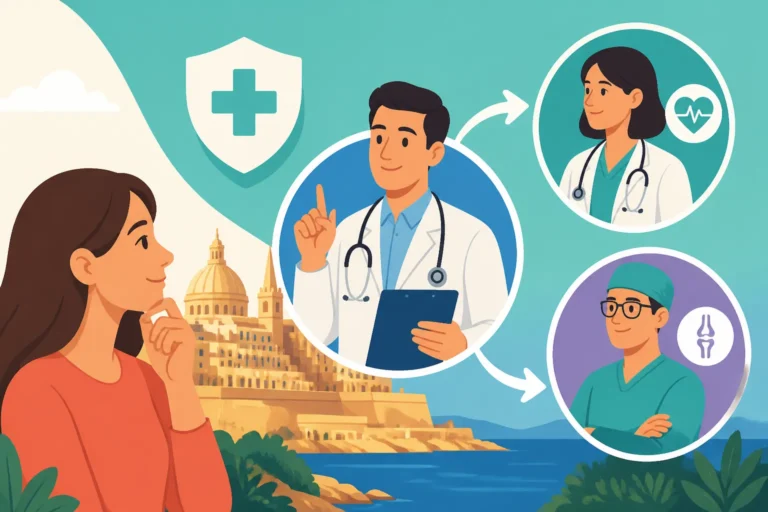
The system operates on a hub-and-spoke model. The "hubs" are the regional Health Centres scattered across Malta and Gozo, located in towns like Floriana, Mosta, Paola, and Rabat. These centres are your first port of call for everything from a flu jab to a blood test. They are open 24/7 for emergencies, but for routine visits, they function much like a GP surgery in other countries. If you are living in a busy area like Sliema or St. Julian's, your designated centre might be Gżira, and knowing exactly which one you belong to is vital for Registering with a Health Centre and Choosing a GP in Malta.
Mater Dei acts as the "spoke" for everything specialized. If your Health Centre doctor decides you need an X-ray, a specialist consultation, or surgery, they will issue a referral. This referral enters the Mater Dei system, and you then wait for an appointment letter to arrive at your home address. This letter-based system is charmingly old-school but can be frustrating if you’re used to instant digital booking. You have to trust that the postman will deliver that brown envelope with your appointment date, which might be three months away.
Deciphering the Entitlement Puzzle
One of the most frequent questions I get from new arrivals is, "Am I actually covered?" The answer isn't always a simple yes. Entitlement in Malta is tied directly to your National Insurance (NI) contributions. If you are working for a Maltese company, your employer deducts NI from your salary every month. This is your golden ticket. However, if you are a freelancer, a digital nomad, or a retiree, the rules shift significantly. You need to look into Health Entitlement in Malta: How Social Security Contributions Unlock Free Care to see where you stand.
It is also important to note that "residency" and "entitlement" are two different things. You can have a valid eResidence card but still not be entitled to free public healthcare if you aren't paying into the system or covered by a reciprocal agreement. This gap is where many foreigners get caught out, often facing a hefty bill after an emergency visit to Mater Dei because they assumed their residency status was enough.
The Role of Social Security Contributions
Your social security contributions are essentially your premium for the public health insurance. For employees, this is Class 1 social security. For the self-employed, it is Class 2. As long as these payments are being made, you and your dependent family members are generally covered for all essential medical services. This includes hospital stays, operations, and consultations. When I first started working here, I was obsessed with checking my payslip to ensure the 'NI' column was filled, knowing that those few euros were my safety net.
For those who are in Malta but not yet paying social security—perhaps you’re still job hunting or waiting for your permit—you are in a bit of a limbo. This is why many expats choose a flexible insurance like SafetyWing during their transition period. It provides that essential bridge of coverage so you aren't left paying out of pocket if you get sick before your first Maltese payslip is issued. Having a SafetyWing policy can take the edge off the "what if" anxiety that follows you around during your first month in a new country.
Residency vs. Entitlement: The Crucial Distinction
Let’s be very clear: having an ID card does not automatically mean free healthcare. To be fully registered in the public health database, your details from Identità must sync with the Entitlement Unit. The Entitlement Unit is the gatekeeper. They verify that your social security contributions are up to date or that you are covered by an EU S1 form. Some people try to use the public system for months using just their ID card, only to eventually receive a bill in the mail because the system flagged them as "non-entitled."
If you are a non-EU citizen on a work permit, your entitlement is generally tied to your employment contract. If you lose your job, your entitlement usually ends shortly after. This is a stressful reality for many TCNs (Third Country Nationals). On the other hand, EU citizens have it slightly easier thanks to reciprocal agreements, but even then, you must often prove you are no longer covered by your home country to fully integrate into the Maltese system.
The Entitlement Unit and the Yellow/Pink Cards
If you have a chronic condition, you will become very familiar with the "Yellow Card" (Schedule V). This card is a lifesaver. It entitles you to free medication for specific chronic illnesses like asthma, diabetes, or hypertension, regardless of your income. To get one, a consultant at Mater Dei must sign off on your condition. It’s a bit of a process, involving The Entitlement Unit: Sorting Out Your Right to Treatment in Malta, but once you have it, you can collect your regular meds for free from your local pharmacy.
Then there is the "Pink Card." This is means-tested and usually reserved for those on very low incomes or social benefits. It covers a wider range of medications and even some dental work that the standard public system doesn't. For most working expats, the Yellow Card is the one that matters. It’s worth the effort of the paperwork; I have a friend who saves nearly €150 a month on insulin thanks to her Schedule V card.
Navigating the Registration Process
You cannot wait until you are sick to start the registration process. If you show up at a Health Centre for the first time while you have a 39-degree fever, the last thing you want to do is argue about which documents you’ve brought. Registration is a multi-step process that requires patience and a fair bit of photocopying. You have to prove who you are, where you live, and that you have a right to be there.
The process has become more digital in recent years, but there is still a heavy reliance on physical documents. You will need your eResidence card, your employment contract (if applicable), and often a copy of your registered lease agreement. This is where Getting Your Maltese ID Card Number: The Key to Accessing Healthcare becomes the foundation of your medical life in Malta.
Step 1: Getting Your Maltese ID Card Number
Your ID card number (ending in 'A' for foreigners) is your unique identifier for everything. Without it, you effectively don't exist in the health system's eyes. You get this by applying for residence at Identità in Msida (or the Gozo office). Once you have that plastic card, you are halfway there. This number will be used for your blood test results, your pharmacy records, and your hospital files.
Pro tip: Memorize this number. You will be asked for it at every reception desk, every pharmacy, and every doctor's office. It becomes your second name. When I first moved, I kept a photo of my ID card on my phone's home screen because I was asked for it so frequently. It is the key that unlocks the door to the public system.
Step 2: Registering with Your Local Health Centre
Once you have your ID, you need to "connect" yourself to your local Health Centre. Each town in Malta is assigned to a specific regional centre. For example, if you live in Birkirkara, you go to the Mosta Health Centre. If you live in Valletta or Floriana, you go to the Floriana Health Centre. You should visit the reception desk with your ID card and a proof of address to ensure your record is active in their local database.
While you are there, ask about the "GP system." In the public sector, you don't really "choose" a specific doctor in the way you might in the US or UK. You see whoever is on duty when you walk in. However, for chronic care, they do try to keep some continuity. Registering early ensures that when you actually need a doctor, your file is already "live," and they can pull up your history instantly.
Step 3: Accessing the myHealth Portal
Malta has a fantastic digital tool called the myHealth portal. This is where the 21st century finally meets the Maltese medical system. Once you have your eID credentials (which you get alongside your ID card), you can log into myHealth. This portal allows you to see your lab results, look up your upcoming appointments at Mater Dei, and even see which medications have been prescribed to you.
Using the portal is a game-changer. Instead of waiting for a phone call about your blood results, you can often see them online within 48 hours. You can also link your record to a private GP, allowing them to see your public hospital records. This creates a bridge between the public and private sectors that is incredibly useful. I highly recommend Booking Appointments and Using myHealth Online in Malta as soon as you get your ID card sorted.
Public Healthcare Costs and Coverage
One of the most attractive things about the Maltese system is the low cost for entitled residents. If you are paying your NI, you won't see a bill for your GP visit at the Health Centre, your stay at Mater Dei, or your emergency surgery. It is truly "free at the point of use." However, "free" doesn't mean everything is included. There are specific gaps, particularly around dental care, optical care, and non-essential medications.
It is also important to understand What Public Healthcare Costs in Malta: Free Services and Paid Extras. If you are not entitled—for example, if you are a tourist from a non-EU country or a resident who hasn't paid their social security—the costs are significant. A single night in a Mater Dei ward can cost over €600, and a trip to A&E can easily run into the hundreds.
| Service Category | Public System (Entitled) | Public System (Non-Entitled) | Private Clinic (Typical) |
|---|---|---|---|
| GP Consultation | Free | €30 – €60 | €15 – €35 |
| Specialist Visit | Free (with referral) | €100+ | €60 – €120 |
| Emergency Room | Free | €150 – €500+ | N/A (Emergencies go to public) |
| Hospital Overnight | Free | €600 – €900 per night | €400 – €800 per night |
| Blood Tests | Free | Variable | €30 – €100 |
What is "Free" and What is Paid?
Generally, anything "medically necessary" is free. This includes oncology, maternity care, emergency trauma, and infectious diseases. If you are in a car accident or have a heart attack, the system kicks into high gear, and you will receive world-class care without ever seeing an invoice. Even the ambulance ride is free for entitled residents, which is something many expats from the US find hard to believe. You can find more detail on this in our guide to Emergency Medical Care in Malta: 112, A&E, and Urgent Help.
What you do pay for are things like "convenience" and "extras." If you want a private room at Mater Dei (which are very limited anyway), you won't find it in the public wing. You also pay for your own outpatient medications. If a doctor at the Health Centre gives you a prescription for antibiotics for a chest infection, you take that script to a local pharmacy and pay the retail price. The only exception is for chronic conditions covered under the schemes mentioned earlier.
Prescription Medicines and the POYC Scheme
The "Pharmacy of Your Choice" (POYC) scheme is a uniquely Maltese system. It allows patients entitled to free medicine (those with Yellow or Pink cards) to collect their medications from a private pharmacy near their home rather than trekking to the hospital basement. You choose one pharmacy, register with them, and they become your designated dispenser for your free state-funded meds.
This system is great because it supports local small businesses and makes life easier for patients. However, keep in mind that the state-funded medicine list is specific. If your consultant prescribes a brand-name drug but the state only funds the generic version, you’ll get the generic. If you insist on the brand name, you’ll have to pay for it yourself. Learning The POYC Pharmacy of Your Choice Scheme: How to Collect Free Medicines is essential for anyone managing a long-term illness here.
Specialist Referrals and the Waiting Game
This is where the "cost" of the public system is measured in time rather than money. Because it is free, the demand for specialists—dermatologists, cardiologists, orthopaedic surgeons—is massive. If your GP refers you to a specialist at Mater Dei for a non-urgent issue, the waiting list can be anywhere from three months to over a year.
If you have a nagging issue that isn't life-threatening but is affecting your quality of life, the "waiting game" can be unbearable. This is why many expats maintain a private insurance policy or simply pay out of pocket to see a specialist privately. A private specialist consultation usually costs between €60 and €100 and can often be booked within a week. For those who can't afford to wait, SafetyWing or a similar private cover is a vital supplement to the public system.
Healthcare for Specific Expat Groups
Your experience with Maltese healthcare will change based on the plastic card in your wallet and the passport you hold. Malta has different "tracks" for different groups. EU citizens, for example, have the benefit of the EHIC card for temporary stays and the S1 form for permanent moves. This allows for a relatively smooth transition of health rights from your home country to Malta.
Non-EU workers, particularly those on the Single Permit, have a more precarious situation. Their right to healthcare is usually "earned" through their employment. If you are a digital nomad or a retiree on a self-sufficiency permit, you are often required by law to have private health insurance because you aren't paying social security in Malta. This is a common point of confusion that leads to permit delays.
EU Citizens and the EHIC/S1 Transfer
If you are an EU citizen moving to Malta, your EHIC (European Health Insurance Card) is only for temporary stays—it’s not a substitute for local registration. Once you become a resident, you should look into Can EU Citizens Use Maltese Healthcare with an EHIC Card? to understand the limits. To get full "free" access, you usually need to be working here. If you are a pensioner, you can get an S1 form from your home country, which "exports" your healthcare rights to Malta, and the Maltese government then bills your home country for your care.
It’s a great system, but it requires a lot of stamps and signatures. You have to take your S1 to the Entitlement Unit in Gżira, wait for them to process it, and then receive a Certificate of Entitlement. This piece of paper is what you then take to the Health Centres. Don't assume that just because you have a French or German passport, the doctor will treat you for free—you need that Maltese certificate.
Non-EU Workers on a Single Permit
For Third Country Nationals (TCNs), healthcare is often the most stressful part of the "Single Permit" process. While you are waiting for your permit to be approved, you are often in a legal grey area regarding healthcare. Most employers will not start your social security contributions until the permit is in hand. During this 2-to-4-month waiting period, you are essentially uncovered unless you have private insurance.
This is why nearly all non-EU residents start their Maltese journey with a private policy. Whether it’s a requirement for your visa or just common sense, you need that protection. Once your permit is issued and you start working, you gain access to the public system. However, many TCNs choose to keep their private insurance as a backup, given the long waiting lists in the public sector.
Digital Nomads and the Private Insurance Gap
Malta has become a massive hub for digital nomads, but the Nomad Residence Permit comes with a specific requirement: you must have health insurance that covers you in Malta. Since nomads don't pay local social security, they don't get free access to Mater Dei. If a nomad walks into a Health Centre, they are billed as a non-resident.
For this group, a solution like SafetyWing is almost perfect. It meets the visa requirements, it’s flexible, and it covers you globally if you decide to hop over to Sicily or Greece for the weekend—something a local Maltese private policy might not do as easily. If you’re living the nomad life in Sliema, you want insurance that moves with you, not something that ties you to a single island's bureaucracy.
The Realities of Using the System
Living here for a few years teaches you the "unspoken" rules of the system. For instance, if you go to the Floriana Health Centre at 10:00 AM on a Monday, you’re going to be there for a long time. If you go at 8:00 PM on a Tuesday, you might be out in thirty minutes. The public system is excellent in a crisis, but for the "small stuff," it requires strategy.
You also have to be your own advocate. The doctors are great, but the system is busy. If you feel like you need a referral, you often have to ask for it clearly. Don't expect the system to follow up with you; you follow up with the system. This proactive attitude is the difference between getting treated in three months or falling through the cracks for six.
Mater Dei Hospital: The Good, The Bad, and The Emergency
Mater Dei is an impressive building, and the care inside is top-notch. However, the Emergency Department (A&E) is notoriously busy. Because Malta lacks many small urgent-care clinics, everyone with a minor injury or a major crisis ends up at A&E. This means wait times can exceed 8 or 10 hours for non-life-threatening issues. I’ve sat in that waiting room with a friend who had a deep cut, and we watched the sun go down and come back up again.
The "Good" is that if you are actually in danger, you are seen instantly. The triage system works. If you arrive by ambulance with chest pains, you are in a theatre in minutes. The "Bad" is the lack of comfort for those in the middle—the ones who aren't dying but are in pain. My advice? If it’s not a true emergency, go to a regional Health Centre first. They can do stitches, X-rays (at certain times), and basic diagnostics much faster than the main hospital.
Dental and Mental Health: The System's Blind Spots
If there is one thing you should budget for, it’s dental care. The public system’s dental offering is extremely limited, usually restricted to emergency extractions or very basic fillings for those on benefits. For the average expat, public dental care is effectively non-existent. You will almost certainly need to use a private dentist. Fortunately, private dental care in Malta is quite affordable compared to Northern Europe or the US. Check out Dental Care in Malta: Public Provision, Private Dentists, and Costs for a price comparison.
Mental health services are another area where the public system is struggling. While there is a dedicated psychiatric hospital (Mount Carmel) and outpatient clinics, the waiting lists for therapy are very long. Most expats seeking mental health support end up going private, paying between €40 and €70 per session. It is a significant out-of-pocket expense that the public system isn't yet equipped to handle for the general population.
When Public Fails: The Role of Private Cover
There will come a time when you just can't wait. Maybe you have a knee injury that makes it hard to work, and the public system says the MRI wait is six months. This is when Private Healthcare and Insurance in Malta: When You Need Cover becomes relevant. Private hospitals like St. James or DaVinci offer almost everything Mater Dei does, but with no waiting time.
Many residents use a "hybrid" approach. They use the public system for emergencies and expensive chronic care, but they use private insurance or pay-per-use for diagnostics and specialist consultations. Having a policy like SafetyWing can be a life-saver here, as it allows you to get that MRI or specialist opinion done privately and then take the results back into the public system for the long-term treatment. It gives you the power to skip the queue when it matters most.
Living Healthy in Malta
The best way to navigate any healthcare system is to avoid needing it. Malta offers a beautiful lifestyle, but it comes with specific health challenges. The humidity in winter can be brutal for those with respiratory issues, and the summer sun is no joke. I’ve seen more expats in the clinic for severe sunburn and dehydration in July than for actual illnesses.
You also need to adjust to the local "Pharmacy Culture." In Malta, pharmacists are highly respected and have a lot of autonomy. Before you run to a doctor for a minor ailment, talk to your local pharmacist. They can often suggest effective over-the-counter treatments and save you a trip to the Health Centre.
Dealing with Heat, Humidity, and Seasonal Allergies
Malta’s climate is lovely but can be a shock to the system. From June to September, the heat index often hits 40°C. Dehydration happens fast, especially if you’re out exploring Valletta or hiking in Gozo. Always carry water, and don't underestimate the "Siesta" culture—there is a reason locals stay indoors between 1:00 PM and 4:00 PM.
In the winter, the challenge is humidity. Maltese houses are built to stay cool in summer, which means they are damp and cold in winter. Mould is a common problem and can trigger asthma or allergies. If you are prone to these issues, investing in a high-quality dehumidifier is arguably more important than having a good GP. It will save your lungs and your walls.
The Pharmacy Culture: Your Local Advisor
The community pharmacy is the heart of the Maltese health system. Most pharmacies have a "clinic" in the back where a GP or specialist visits for a few hours a day. You can often book a 10-minute slot with a doctor right there in the shop for about €15-€20. It is the most convenient way to get a quick check-up or a prescription refill without dealing with the Health Centre crowds.
Get to know your local pharmacist. They know which medicines are in stock (shortages happen occasionally on the island) and can give advice on everything from jellyfish stings to the best vitamins for the summer heat. They are often your first and most reliable point of contact in the entire medical network.
Healthcare in Malta: A Quick Reference Disclaimer
This guide is intended for informational purposes and reflects the personal experiences and observations of a long-term resident in Malta. Healthcare laws, entitlement rules, and social security rates are subject to change by the Maltese government and health authorities. Always verify your specific situation with the Entitlement Unit, Identità, or your employer. This content does not constitute professional medical or legal advice. If you are experiencing a medical emergency in Malta, please dial 112 immediately.