Can I See a Doctor in English in Malta?
When you are sitting in a cold waiting room with a throbbing fever, the last thing you want to worry about is whether the person treating you will understand your description of the pain. I still remember my first week in Sliema, clutching a box of tablets and trying to remember the Maltese word for "stomach ache" before the doctor smiled and greeted me in perfect English. This guide solves every doubt you have about the language barrier in the Maltese medical system and explains exactly how to access care comfortably.
English as the Standard for Healthcare in Malta
One of the most significant reliefs for any expat moving to the Maltese islands is the discovery that English is not just a secondary language; it is a co-official language used in every layer of the administrative and medical infrastructure. You will find that from the moment you walk into a health center to the moment you are discharged from a specialist ward, English is the primary medium of communication for records, prescriptions, and consultations.
The Education and Training of Medical Professionals
Every doctor practicing in Malta, whether they are a General Practitioner (GP) or a high-level surgeon at Mater Dei, has undergone a rigorous medical education that is conducted entirely in English. The University of Malta’s Medical School, which has a history spanning centuries, uses English-language textbooks, lectures, and examinations. This ensures that medical terminology is standardized in English across the board.
Because of this academic foundation, you never have to worry about a "lost in translation" moment regarding complex diagnoses. If a doctor describes a cardiovascular condition or explains the side effects of a specific neurological medication, they are using the exact same English terminology you would find in London, New York, or Sydney. Many Maltese doctors also spend significant portions of their post-graduate training in the UK or other English-speaking countries, further cementing their fluency and familiarity with international medical standards.
Nursing and Support Staff Communication
While doctors are almost universally fluent, you might occasionally encounter support staff or older nursing assistants whose first language is Maltese. However, in any clinical setting, there is always someone nearby who speaks English fluently. In my experience, even when a staff member prefers Maltese for casual conversation with colleagues, they will switch to English the moment they address a foreign patient.
It is also worth noting that the healthcare workforce in Malta is becoming increasingly international. You will frequently meet nurses and specialists from across the EU, the Philippines, India, and Pakistan. In these multicultural environments, English serves as the "lingua franca" for the entire hospital. Whether you are consulting a specialist or just asking for directions to the X-ray department, you will find that your needs are understood without the need for a translator.
Public Healthcare and Language Accessibility
The public healthcare system in Malta is robust but can feel overwhelming if you are used to a more streamlined private system. Accessing services often begins at the local health center, and understanding the linguistic landscape here is key to a stress-free visit. For a broader look at how this all fits together, you might want to read through Healthcare in Malta for Foreign Residents: The Complete System Guide (2027).
Navigating the Health Centres
Health centers, known locally as "il-Berġa" in smaller villages or "Health Centres" in larger hubs like Mosta, Floriana, or Gżira, are the front line of the public system. When you walk into a health center, the reception staff will generally ask for your ID card. Even at this initial administrative stage, everything is handled in English. If you are a new arrival and haven't sorted your local documentation yet, you might find yourself asking, Can I See a Doctor in Malta Before My Health Entitlement Is Approved? The answer is yes, though you may be asked to pay a fee at the reception desk, which is clearly explained in English-language signage and forms.
The triage process, where a nurse determines the urgency of your case, is also conducted in English. They will ask you to describe your symptoms, and they will record these notes in the digital system in English. This is crucial because when you finally see the GP, they will read those notes on their screen before you even sit down. The continuity of the language across the digital and verbal stages of care is one of Malta's greatest strengths for expats.
Specialist Referrals and Mater Dei
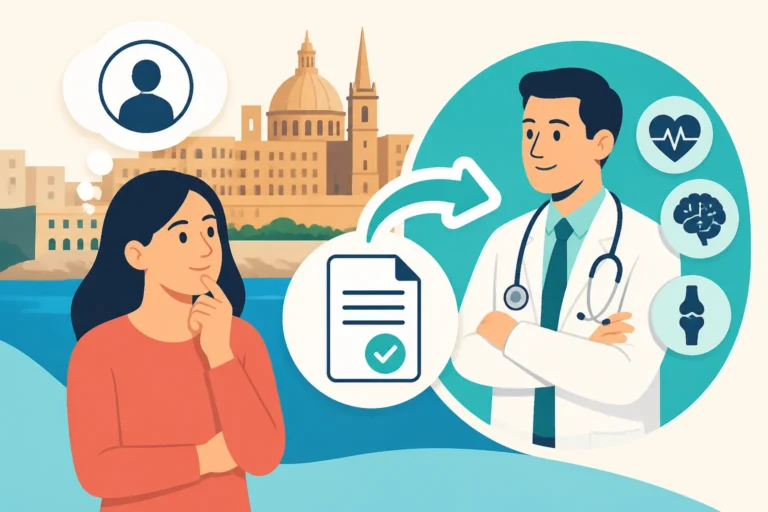
If your GP decides you need more specialized care, they will issue a referral. This is a printed or digital document, written in English, that you will take to the hospital or wait for an appointment letter to arrive at your home. For more details on this transition, see Mater Dei and Beyond: A Guide to Malta's Public Hospitals and Health Centres.
At Mater Dei, the primary state hospital, the scale of the operation is massive. Every sign in the building is bilingual, featuring both Maltese and English. The public address announcements, the patient information leaflets, and the consent forms for surgery are all available in English. This level of accessibility is vital during high-stress moments, such as a trip to the Emergency Department. If you ever find yourself in that situation, you can find specific protocols in Emergency Medical Care in Malta: 112, A&E, and Urgent Help.
Private Healthcare: The English-First Experience
While the public system is excellent, many expats choose private healthcare for the sake of speed and convenience. In the private sector, the "customer service" aspect of healthcare is heightened, and English communication is treated as the gold standard.
Pharmacy Clinics and Private GPs
One of the unique quirks of the Maltese system is that most local pharmacies have a private GP clinic attached to them. You don't usually need an appointment; you simply show up, ask the pharmacist when the doctor is "in," and wait your turn. This is often the fastest way to see an English-speaking doctor for minor ailments.
In these private settings, the doctor often has more time to chat. I’ve found that private GPs in Malta are particularly empathetic to the expat experience and are happy to explain the nuances of local prescriptions in great detail. If you are exploring this route, Finding a Doctor in Malta: GPs, Specialists, and the Referral System provides a deeper dive into how to choose the right professional for your needs.
Using Private Insurance and SafetyWing
For many newcomers, especially digital nomads or those on a Nomad Residence Permit, the public system isn't immediately accessible until social security contributions are sorted. This is where private cover becomes essential. Having a policy from a provider like SafetyWing can be a lifesaver during your first few months. SafetyWing is designed for people who are between "home" and "abroad," providing a safety net while you navigate the bureaucracy of Getting Your Maltese ID Card Number: The Key to Accessing Healthcare.
When you visit a private hospital like St. James or DaVinci with your SafetyWing cover, you are essentially entering a five-star environment where English is the primary language of every interaction. The administrative staff will assist you with the English-language claim forms, and the specialists will often provide you with detailed medical reports in English that you can easily send to insurance adjusters or your doctor back in your home country.
| Feature | Public Health Centres | Private Clinics/Hospitals |
|---|---|---|
| Primary Language | English & Maltese | English (Priority) |
| Medical Records | Digital, English | Digital/Paper, English |
| Wait Times | Walk-in (can be long) | Appointment-based (shorter) |
| Documentation | Required (ID/Social Security) | Passport/Insurance (e.g., SafetyWing) |
| Cost | Free (if entitled) | Paid (reimbursable by insurance) |
Communicating in Pharmacies and for Prescriptions
Even after you’ve seen the doctor, the "medical journey" continues at the pharmacy. This is another area where English-speakers have very few hurdles. Pharmacists in Malta are highly trained professionals—often holding doctoral degrees—and their level of English is exceptional.
Explaining Symptoms to Pharmacists
In Malta, pharmacists are often the first point of contact for minor health issues. If you have a cough or a skin rash, you can walk into any pharmacy and explain your symptoms in English. They will provide advice and can often recommend over-the-counter medications that would require a prescription in other countries.
If you are covered by the state system and have a chronic condition, the pharmacist will also help you navigate the "Pharmacy of Your Choice" (POYC) scheme. Everything from the registration forms to the labels on the medicine bottles will be in English, ensuring you never take the wrong dosage due to a linguistic misunderstanding.
Understanding Maltese Prescription Terms
While the language is English, you might occasionally see a few local abbreviations or terms on a prescription. For example, a doctor might write instructions for a "suspension" or use specific dosing intervals that feel slightly different from what you're used to. However, if you ask for clarification, they will explain it in plain English. For those worried about the costs associated with these medications, checking What Public Healthcare Costs in Malta: Free Services and Paid Extras can help you budget accordingly.
Overcoming the "Maltese-English" Accent and Nuances
While everyone speaks English, it is helpful to acknowledge that Maltese English has its own rhythm and local flavor. Some older doctors might use a "sing-song" intonation that reflects the Maltese language's Semitic roots.
Tips for Clear Medical Communication
- Be Direct: Maltese culture is generally quite direct. When describing symptoms, you don't need to wrap them in too much polite "fluff." Just state the facts.
- Ask for Written Instructions: If a doctor's accent is particularly thick, don't be afraid to ask, "Could you please write that dosage down for me?" They are used to this and won't be offended.
- Confirm the Next Steps: Always end the consultation by summarizing what you understood. "So, I take these twice a day for a week, and then I come back for a blood test?" This ensures no nuances were missed.
For those who are not yet fully integrated into the local system, having a plan for these consultations is vital. Using a service like SafetyWing during your transition period ensures that you can afford to see a private doctor who can spend that extra ten minutes making sure you understand every part of your treatment plan in English.
Handling Medical Emergencies in English
In an emergency, your brain often reverts to its most basic functions, and the fear of not being understood can skyrocket. In Malta, the emergency services are fully geared toward English speakers.
Calling 112
The emergency number in Malta is 112. The operators are trained to handle calls in both Maltese and English. When you call, stay calm and state your location and the nature of the emergency in English. They will dispatch an ambulance, and the paramedics who arrive will be fluent in English. They will ask for your medical history and any allergies—terms that are identical in English medical practice worldwide.
The A&E Experience
Upon arrival at the Accident and Emergency department at Mater Dei or Gozo General Hospital, the triage nurse will prioritize your case. For expats, the relief of being able to explain a complex medical history or a sudden trauma in your native or fluent tongue cannot be overstated. If you are a visitor or a nomad and find yourself in A&E, having your SafetyWing details ready is helpful, as the hospital will eventually need to coordinate with an insurer if you aren't covered by the Maltese social security system.
It is always a good idea to keep a digital copy of your insurance and a basic "medical cheat sheet" (allergies, current medications) in English on your phone. This speeds up the process significantly in the public system, where the volume of patients can be high. If you are looking for more information on the private alternative to the emergency room, Private Healthcare and Insurance in Malta: When You Need Cover provides excellent context.
Summary of the Linguistic Advantage in Malta
Malta is truly one of the easiest countries in Europe for an English speaker to navigate health-wise. The combination of an English-taught medical curriculum, a bilingual administrative system, and a multicultural workforce creates a safety net that is hard to find elsewhere.
Whether you are popping into a local pharmacy for some paracetamol or undergoing complex surgery at Mater Dei, the language of care is English. By understanding how the systems work—and perhaps keeping a backup plan like SafetyWing while you wait for your Private Healthcare and Insurance in Malta: When You Need Cover.
Medical Disclaimer
The information provided in this article is for general informational purposes only and does not constitute professional medical advice, diagnosis, or treatment. Always seek the advice of your physician or another qualified healthcare provider with any questions you may have regarding a medical condition. Never disregard professional medical advice or delay in seeking it because of something you have read in this guide. The healthcare system in Malta is subject to change, and you should always verify current procedures with the relevant authorities or your insurance provider.