Pharmacies and the POYC Scheme: Getting Medicines in Malta
Staring at a locked pharmacy door on a Tuesday afternoon because you didn't realize they close for a three-hour "siesta" is a classic newcomer rite of passage in Malta. I’ve personally spent hours pacing outside a closed chemist with a migraine, wondering why the system felt so opaque. This guide solves the mystery of getting your medications, navigating the Pharmacy of Your Choice (POYC) scheme, and understanding exactly how entitlement works for expats.
The Unique Landscape of Maltese Pharmacies
Pharmacies in Malta are much more than just places to pick up a box of paracetamol; they are the frontline of the local community. Unlike the massive corporate drugstores you might find in the US or the UK, most Maltese pharmacies are family-run or small-scale operations. They serve as the primary point of contact for minor health issues, often acting as a bridge before you ever see a GP.
The Community Hub Philosophy
When you walk into a local pharmacy in a village like Naxxar or Żebbuġ, you’ll notice the pharmacist often knows half the customers by their first names. This isn't just small-town charm; it’s a functional part of the healthcare system. Pharmacists here often provide basic medical advice, wound dressing, and even blood pressure checks. I remember being pleasantly surprised when a local pharmacist noticed my hay fever symptoms before I even asked for help and suggested a specific local brand of antihistamine that worked better for the island's unique pollen.
Because these pharmacies are so central to the community, they often host private GP clinics in their back rooms. This is a crucial detail for expats. If you need a prescription but can't get an appointment at a health centre, you can usually see a private doctor at the pharmacy for a small fee, often ranging from €15 to €30. This makes the pharmacy your one-stop-shop for both the consultation and the medication.
However, this community focus means operating hours can be erratic. While most are open from 8:30 AM to 12:30 PM and again from 4:00 PM to 7:00 PM, these times vary wildly by location. Understanding this rhythm is the first step to mastering Healthcare in Malta for Foreign Residents: The Complete System Guide (2027) and ensuring you are never caught without your essentials.
The Green Cross and Sunday Rosters
You will quickly learn to look for the neon green cross. If the cross is lit, the pharmacy is open; if it’s blinking, they might be getting ready to close. But what happens on Sundays and public holidays? Malta has a very specific "Sunday Roster" system. Only a select few pharmacies across the island are open on these days, usually from 9:00 AM to 12:00 PM (and sometimes a few hours in the afternoon in North/Central areas).
The roster is published in local newspapers and on various government websites. I highly recommend bookmarking the official roster on your phone. There is nothing more stressful than driving across the island to three different "closed" pharmacies when you have an urgent need. If you are still waiting for your local entitlement to kick in, having a flexible plan like SafetyWing can provide peace of mind for unexpected medical costs that arise during these off-hours.
In emergency situations outside of roster hours, your only option is the Mater Dei Emergency Department or a regional health centre. Therefore, it is always wise to keep a basic "home pharmacy" stocked with basics to avoid the Sunday scramble.
Identifying the Right Pharmacy for You
Not all pharmacies are part of the POYC scheme, though most are. When you first move to a new locality, look for the "POYC" sticker on the door. This indicates that the pharmacy is authorized to distribute free medications under the national health scheme. Even if you aren't using the POYC yet, choosing a "POYC-registered" pharmacy as your regular spot is smart, as it simplifies things later if you develop a chronic condition or become eligible for free care.
The relationship you build with your pharmacist is vital. They can often tell you which medicines are currently out of stock island-wide (a common frustration here) and can suggest equivalents. Since they deal with both the public and private sectors, they have a bird's-eye view of the How Malta's Public Healthcare Works: Entitlement, Contributions, and Costs framework that a newcomer might lack.
It is wise for newcomers introduce themselves to their local pharmacist early on. Explain your residency status and any long-term medications you take. They can often give you the "real talk" on whether your specific brand is available in Malta or if you’ll need a local doctor to switch you to a different brand.
Understanding the POYC Pharmacy of Your Choice Scheme
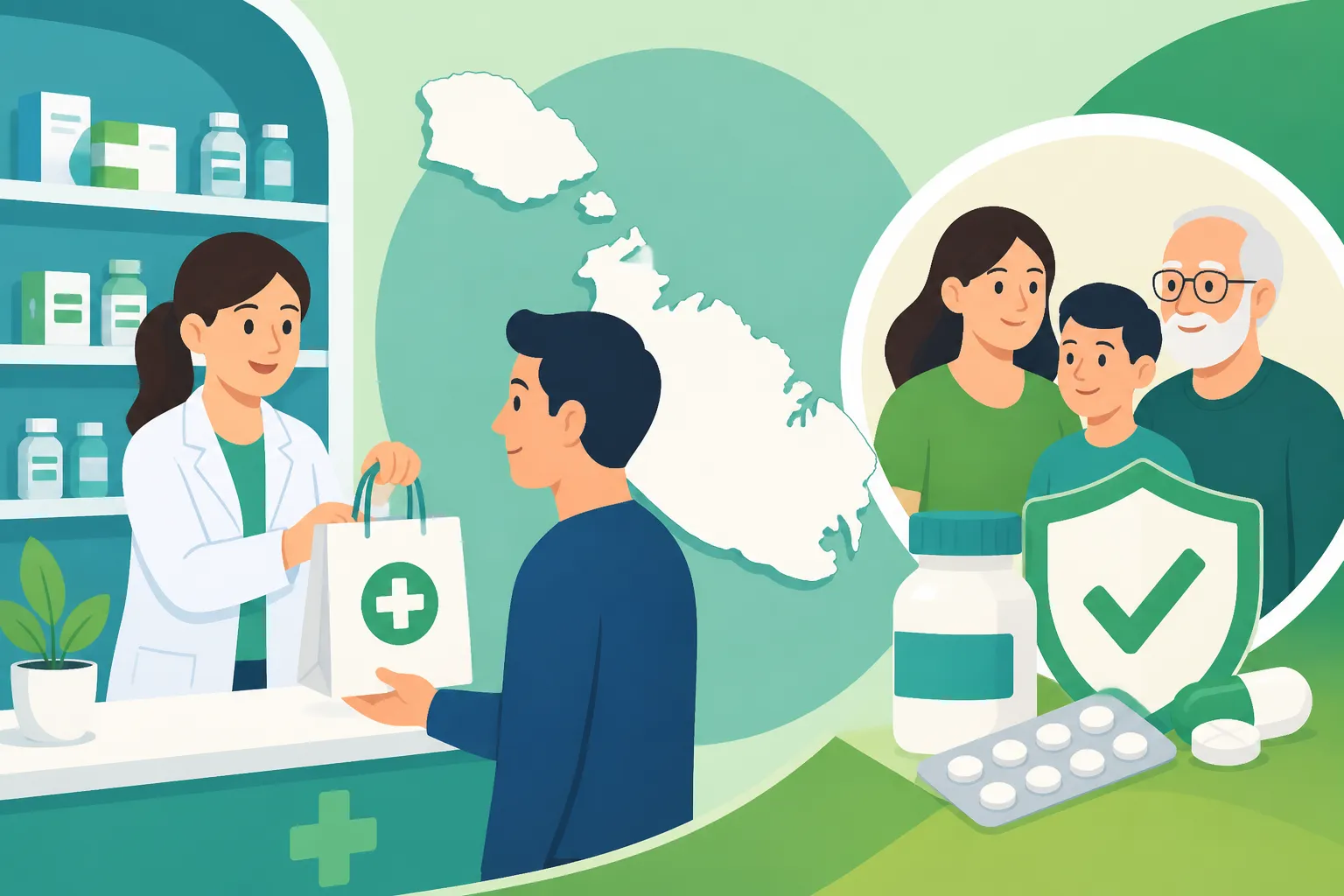
The POYC scheme is one of the most generous aspects of the Maltese healthcare system, but it is also one that causes the most confusion for expats. In short, it allows residents with certain chronic conditions or low income to collect their medications for free from a private pharmacy near their home, rather than trekking to a central government dispensary.
How the POYC Bridges the Public and Private Sectors
The genius of the POYC is convenience. Before its inception, everyone entitled to free medicine had to go to the government pharmacy at Mater Dei or regional health centres, leading to enormous queues. Now, the government "outsources" the distribution to your local chemist. The government pays for the medicine, and the pharmacy receives a small fee for managing the distribution.
For you, the expat, this means that once you are registered, you simply walk into your chosen pharmacy, present your entitlement card, and walk out with your medicine without opening your wallet. It sounds simple, but the registration process requires you to have your administrative house in order first. You will need to understand The POYC Pharmacy of Your Choice Scheme: How to Collect Free Medicines and how it integrates with your residency status.
Note that the POYC only covers medications listed on the "Government Formulary." This is a list of approved drugs that the state provides. If your doctor prescribes a "designer" or very new brand that isn't on the list, you will have to pay for it privately, even if you are fully entitled to free care. This is where having private coverage from a provider like SafetyWing can be useful, as it may help cover costs for medications or specialist consultations not fully catered for by the public formulary.
Registration Requirements and Eligibility
You cannot simply walk into a pharmacy and ask to be on the POYC. First, you must be entitled to public healthcare in Malta. This generally means you are either an EU citizen, a non-EU citizen paying Social Security contributions, or a resident under a specific scheme that grants health rights. You will need to have sorted your Health Entitlement in Malta: How Social Security Contributions Unlock Free Care before the POYC office will even look at your application.
The process usually starts at a Government Health Centre. A public sector consultant (not just a private GP) must confirm your condition and fill out the necessary "Schedule V" or "Schedule II" forms. These forms are then sent to the Entitlement Unit and the POYC office. Once approved, you receive a "White Card" or a specific permit which you take to your chosen local pharmacy to register.
Many expats get frustrated because they think their private doctor’s note is enough. It isn't. The public system requires its own validation. You will likely need to go through the process of Registering with a Health Centre and Choosing a GP in Malta to get the ball rolling on your POYC registration.
Collecting Your Medications
Once you are in the system, you don't just get medicines whenever you want. Usually, you are given a "voucher" or a prescription that is valid for a set period (often six months). You visit your pharmacy once a month or once every two months to collect your quota.
One thing I learned the hard way: don't wait until the very last pill to go to the pharmacy. Sometimes the POYC stock takes a day or two to arrive at the pharmacy after they request it from the central stores. If there is a national shortage of a specific drug, the pharmacist will be the first to know, and they can advise you on how to get a "one-off" replacement from the government dispensary if necessary.
It is also worth noting that if you move house, you have to formally "switch" your POYC pharmacy. You can't just go to a new one. This involves filling out a form at your current pharmacy to "release" you and then registering at the new one. It takes a few days to process, so plan your move around your medication schedule!
Entitlement Cards: Yellow, Pink, and White
To the uninitiated, the Maltese healthcare system looks like a rainbow of paperwork. There are several different "cards" that determine what you pay (or don't pay) at the pharmacy. Understanding which one applies to you is essential for Managing a Chronic Condition in Malta: Schedule V Medicines and Care.
The Schedule V Yellow Card
The "Yellow Card" is officially for people with chronic illnesses listed under "Schedule V" of the Social Security Act. This includes conditions like diabetes, hypertension, asthma, and many others. If you have a Yellow Card, you are entitled to free medications specifically related to that condition, regardless of your financial means.
Getting the Yellow Card as an expat involves getting a specialist at a public hospital (like Mater Dei) to sign off on your diagnosis. Even if you have been treated for 20 years in your home country, the Maltese system usually requires a local consultant’s confirmation. This can take time due to waiting lists, so many expats continue to buy their meds privately for the first few months while the paperwork moves through the system.
During this transition period, What Public Healthcare Costs in Malta: Free Services and Paid Extras becomes very relevant. You’ll be paying out of pocket, so keep all your receipts. Some private insurance policies, like those from SafetyWing, are designed for the "transitional" expat who is moving between systems and needs a safety net.
The Schedule II Pink Card
The "Pink Card" is means-tested. It is generally issued to people with very low income or those receiving certain social benefits. If you hold a Pink Card, you are entitled to a much broader range of free medications, including "acute" medicines like antibiotics, which Yellow Card holders usually have to pay for.
For most working expats, the Pink Card is rarely applicable. However, if you are a retiree or in a specific vulnerable category, it is worth checking your eligibility. It also grants access to free dental treatment and free spectacles, which are generally not covered for the average resident.
The Pink Card is issued by the Social Security department, not the Health department. This is a common point of confusion. You have to prove your global income to qualify, which can be a bureaucratic headache for newcomers. If you find yourself in this boat, ensure you have a solid grasp of How the Specialist Referral System Works in Malta's Public Hospitals to ensure your health needs are documented for the application.
Comparison Table of Health Entitlement Cards
| Card Type | Official Name | Primary Benefit | Eligibility Criteria |
|---|---|---|---|
| Yellow Card | Schedule V | Free meds for specific chronic illnesses | Diagnosis of a qualifying chronic condition by a public consultant |
| Pink Card | Schedule II | Wide range of free meds and dental/eye care | Means-tested (low income) or specific social benefits |
| White Card | POYC Permit | Privilege to collect free meds at a private pharmacy | Must already hold a Yellow or Pink card and be registered with POYC |
Prescriptions: The Private vs. Public Divide
In Malta, there is a distinct difference between a "private prescription" and a "public prescription." Knowing how to use both will save you time and money.
Using Private Prescriptions
A private prescription is issued by a GP or specialist you see privately—either in their own clinic or in the back room of a pharmacy. These are usually written on the doctor’s own letterhead or a standard blue form.
The beauty of a private prescription is speed. You can see a doctor today and get your medicine five minutes later. However, you will have to pay the full retail price for the medication at the pharmacy. For many common drugs, this is quite affordable. For example, a standard course of antibiotics might cost between €7 and €20.
If you are a frequent traveler or a digital nomad, you might prefer this route for its lack of bureaucracy. In fact, many nomads using SafetyWing find that the ease of private GP visits in Malta fits their lifestyle perfectly, as they can often claim back expenses for more significant medical events while paying for minor prescriptions out of pocket.
Navigating Public Prescriptions
Public prescriptions are issued by doctors at Government Health Centres or Mater Dei Hospital. These are required if you want to get the medicine for free (provided you have entitlement). If you are entitled to free care but see a private doctor, that private doctor cannot write a script for free medicine. You would have to take the private recommendation to a Health Centre GP, who will then transcribe it onto a government form.
This "transcription" process is a common source of frustration. The government GP has the right to refuse or change the medication if it doesn't align with the government's cost-saving protocols. To avoid this, many expats eventually transition to seeing public specialists for their chronic needs while using private GPs for quick, "one-off" issues.
To manage this, you’ll need to understand the Finding a Doctor in Malta: GPs, Specialists, and the Referral System process thoroughly. It’s about learning when to wait in line for the "free" route and when to pay the €20 for the "fast" route.
Validity and Refills
Maltese prescriptions are generally valid for a single dispensing unless they are specifically marked for "repeat." For chronic medications, the doctor might give you a script that lasts for six months, but the pharmacist can only give you one month's supply at a time. You leave the script with the pharmacist, and they log your collections.
I recommend always taking a photo of your prescription before handing it over. If you lose your "booklet" or the pharmacy misplaces your script, having that photo can be a lifesaver when trying to explain your needs to a new doctor or pharmacist.
Also, be aware that many medications that require a prescription in other countries—like certain high-strength painkillers or hormonal treatments—are strictly controlled in Malta. You cannot "talk your way" into getting these without the proper paperwork. Always bring your medical records from home to help local doctors understand your history when issuing these scripts.
Over-the-Counter (OTC) Realities
While many things in Malta require a prescription, the "Over-the-Counter" (OTC) culture is quite robust. Pharmacists have a fair amount of discretion for non-controlled substances.
What You Can Buy Without a Script
Common items like paracetamol, ibuprofen, cough syrups, and mild antihistamines are readily available. You’ll also find that many "pharmacy-only" items that aren't on the open shelves can be requested at the counter. This includes things like certain topical steroid creams or localized antibiotics for eye infections.
However, don't expect to find large "value packs" of painkillers like you do in the US. Most are sold in blister packs of 10 or 20. If you need a large supply for a chronic but non-prescription issue, you’ll end up paying significantly more than you might expect.
Maltese pharmacists are excellent at suggesting local equivalents. If you ask for "Tylenol," they will give you "Panadene" or "Paracetamol." If you ask for "Advil," they will give you "Nurofen." Being flexible with brand names will make your life much easier.
The Role of the Pharmacist in Triage
I have often gone to the pharmacist before the doctor for things like skin rashes, minor burns, or stomach upsets. They are trained to tell you if you can treat it with OTC products or if you absolutely must see a GP. This triage saves the public health system a lot of time.
Be prepared for the pharmacist to ask questions. "Who is this for?" "What other medications are you taking?" They take their role as gatekeepers seriously. This is part of the Private Healthcare and Insurance in Malta: When You Need Cover conversation—knowing how to utilize these free "mini-consultations" at the pharmacy counter.
Prices and VAT on Medicines
In Malta, VAT on medicines is generally 5%, which is lower than the standard 18% rate. This helps keep OTC prices relatively stable. However, because Malta is a small island, the cost of importing small batches of specific brands can make certain items more expensive than in mainland Europe.
If you are on a budget, ask for "generic" versions. The pharmacist is usually happy to provide the unbranded version of a drug, which can be 30-50% cheaper. I’ve saved a fortune over the years simply by asking, "Do you have a generic version of this?"
Dealing with Shortages and Out-of-Stock Issues
One of the less glamorous realities of living on a small island is the occasional medicine shortage. Because Malta has a small market, pharmaceutical companies don't always prioritize it when supplies are low globally.
Why Shortages Happen
Sometimes, the government's central procurement runs into a tender dispute, or a shipment is delayed due to weather in the Mediterranean. When this happens, a medicine might disappear from the "free" POYC shelves for weeks.
I’ve had moments where my usual asthma inhaler was unavailable island-wide. In these cases, you have two choices: wait for the government stock to return, or buy it privately if the private importers still have stock. Usually, private pharmacies keep a separate "private" stock that they sell even when the "public" stock is out.
This is another reason why it’s good to have a backup plan. If you are a resident who relies on a specific medication, always keep a one-month "emergency buffer" in your cupboard. Don't rely on the "just-in-time" delivery of the POYC system.
Finding Alternatives
If your specific drug is out of stock, your pharmacist can't just give you a different one without a new prescription. You will have to go back to your doctor to get a script for an alternative. This is where the system gets "sticky."
During these times, your relationship with your pharmacist is your best asset. They can tell you exactly which "alternative" is currently in stock, so you can tell your doctor precisely what to write on the new script. This saves you from getting a script for a second drug that is also out of stock!
For those who are just settling in, checking Can I Bring My Regular Medication into Malta from Abroad? is a must. It is wise to bring a three-month supply of your essential meds from home when you first move, giving you time to navigate these potential supply chain hiccups.
The Role of Private Insurance in Shortages
While private insurance doesn't magically make a drug appear, it can help if you are forced to go to a private specialist to get an emergency alternative prescription. If a shortage is severe, you might need to see a specialist to adjust your treatment plan.
Services like SafetyWing can be invaluable here, especially if the shortage requires more intensive medical oversight or if you decide to fly back to your home country briefly to secure a supply of a life-saving medication that is temporarily unavailable on the island.
Practical Tips for the Savvy Expat
Navigating the Maltese pharmacy system is a skill that takes a few months to master. Here are the "pro-tips" I wish someone had told me in my first week.
The "Same Doctor" Rule
If you are using a private GP at a pharmacy, try to see the same one every time. They usually have a "roster" (e.g., Dr. Borg is there on Monday evenings). Having a doctor who knows your history makes getting repeat prescriptions much faster. They will often write you a "repeat" script for three or six months if they know you, saving you the €20 consultation fee every month.
The myHealth Portal
Malta has a fantastic digital system called myHealth. Once you have your Maltese ID card (e-Residency), you can log in to see your records, including all the medicines dispensed to you under the POYC. You can also link your account to your private doctor, allowing them to see your public hospital results. This digital integration is a key part of Booking Appointments and Using myHealth Online in Malta.
Document Everything
In Malta, "the paper carries the person." Always keep your residency documents, your social security number, and your health entitlement letters in a dedicated folder. When you go to a new pharmacy or a new health centre, take the whole folder. It might seem overkill, but it prevents the "come back tomorrow with this form" dance that is so common in Maltese bureaucracy.
Knowing How to Register for Health Entitlement with the Entitlement Unit in Malta is the foundation of all your pharmacy rights. Do not wait until you are sick to start this process. The Entitlement Unit can take weeks to process a new application.
Understanding Local Naming
Some things are just called different things here. "Rubbing alcohol" is often called "Surgical Spirit." "Band-aids" are "Plasters." "Cotton swabs" are "Cotton wool." If the pharmacist looks confused, try describing the function of what you need rather than using the brand name or the term from your home country.
Summary of Key Points for Newcomers
- Find your local POYC pharmacy early and introduce yourself.
- Check the Sunday Roster before you leave the house on a weekend.
- Get your Health Entitlement sorted as soon as you have your residency card.
- Use Private GPs in pharmacies for fast, affordable prescriptions.
- Always keep a buffer supply of essential medications to guard against island-wide shortages.
- Register for myHealth to track your prescriptions digitally.
Getting medicines in Malta doesn't have to be a headache. Once you understand the rhythm of the village pharmacy and the specific rules of the POYC, you'll find the system is surprisingly supportive. It’s a blend of old-school community care and modern digital tracking that, while sometimes slow, ensures that no one is left without the care they need.
Disclaimer
This guide is for informational purposes only and does not constitute medical or legal advice. Healthcare regulations in Malta, including POYC eligibility and medication availability, can change. Always consult with a qualified medical professional or the Maltese Health Authorities (Identità and the Entitlement Unit) for the most current information regarding your specific situation. Private insurance such as SafetyWing is recommended as a supplement to, not a replacement for, understanding your local legal obligations and entitlements.